
Hello and welcome back.
In our last lesson, we explored a fundamental principle of Jain philosophy: it's not just our actions but our intentions that forge the chains of karma. We saw how the passions, or Kaṣāyas, act as the "glue" that determines the strength of our karmic bondage. This naturally leads to the question: if this bondage is the core problem, what is the ultimate solution? What is the final destination of the spiritual path?
Today, we will answer that question. This lesson focuses on the supreme goal of Jainism: Moksha (मोक्ष), the state of ultimate liberation. Understanding this goal is crucial, as it provides the context for every practice you'll learn, from meditation to conscious sleep. It is the "why" that powers the entire spiritual journey.
Our learning outcome for this lesson is to describe the goal of liberation (moksha) in Jain philosophy.
1. What is Moksha? The Ultimate Freedom from Samsāra
At its heart, Jainism is a mokṣamārga—a path to liberation. The ultimate aim is not a heavenly paradise granted by a deity, but the soul's final release from saṃsāra, the endless and often painful cycle of birth, death, and rebirth.
To begin, let's establish a clear definition of Moksha.
The Wikipedia article 'Moksha (Jainism)' provides a concise and accurate introduction to this core concept.
Please read the introductory section of the article. It defines Moksha, describes the nature of a liberated soul, and establishes Moksha as the highest objective in Jainism.
As the reading clarifies, Moksha is not an external reward. It is the attainment of the soul's own true and pristine nature. This is a state of:
- Ananta Jñāna: Unlimited, perfect knowledge.
- Ananta Darśana: Unlimited, perfect perception.
- Ananta Sukha: Unlimited, unending bliss.
- Ananta Vīrya: Unlimited, infinite energy.
This "unlimited bliss" is fundamentally different from the happiness we experience in our daily lives. Worldly happiness is temporary and dependent on external objects, people, or circumstances. The bliss of Moksha is inherent to the soul itself, uncovered once the veils of karma are removed.
Let's explore this distinction further.
The article 'The Liberation' from Jainworld offers a thoughtful explanation of why true happiness cannot be found in material situations and how it is an intrinsic property of the soul.
Read the first three sections of this article. It contrasts the Jain concept of liberation with other religious ideas, rejects the notion of a Creator God, and explains that true happiness manifests only when the soul's karmic limitations are fully eradicated.
This reading reinforces a core Jain principle: the soul (jīva) is an independent, eternal, and conscious substance. It doesn't need anything from the outside to be complete. Liberation is a process of subtraction, not addition—removing the karmic dirt to let the soul's inherent luminosity shine through.
2. The Liberated Soul: The State of a Siddha
A soul that has achieved Moksha is called a Siddha (सिद्ध), which means "one who is accomplished." A Siddha is a pure, disembodied consciousness, forever free from the cycle of birth and death.
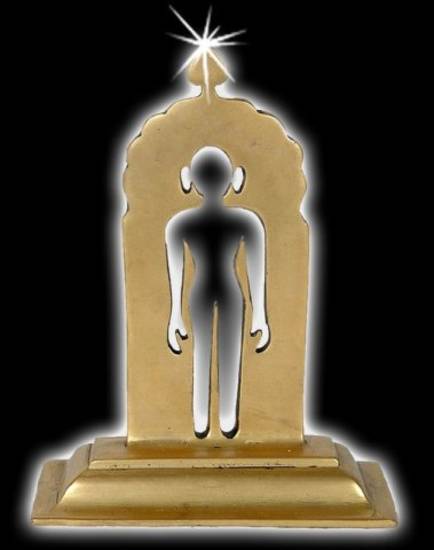
What happens to a soul upon liberation? Where does it go?
Having shed all karmic weight, the soul, by its nature, travels upwards to the very apex of the universe, known as the Siddhashila (सिद्धशिला)—the realm of the liberated ones. It comes to rest there because the medium of motion (Dharmāstikāya) does not exist beyond that point.
In this state, the Siddha exists eternally, formless and bodiless, completely absorbed in its own nature of infinite knowledge and bliss. It does not interfere with the world, nor can the world affect it. It is a state of perfect stillness, awareness, and freedom.
3. The Path to Liberation (Mokṣamārga)
Moksha is not achieved by accident or by grace from an external power. It is the result of dedicated, personal effort along a clearly defined path, the Mokṣamārga. This path is famously summarized as the Ratnatraya (रत्नत्रय), or the Three Jewels of Jainism:
- Samyag Darśana (सम्यग् दर्शन): Right Faith or Right Perception. This is the conviction in the true nature of reality as taught by the Jinas (the omniscient teachers).
- Samyag Jñāna (सम्यग् ज्ञान): Right Knowledge. This is the correct and doubt-free understanding of the Jain principles, especially the nature of the soul and karma.
- Samyag Cāritra (सम्यक् चारित्र): Right Conduct. This involves living one's life according to ethical principles, including the great vows (mahāvratas), to stop the influx of new karma and shed the old.
These three must be cultivated together. Right knowledge without right conduct is useless, and right conduct without right faith is blind.
The journey of the soul towards liberation is a gradual ascent through 14 spiritual stages, known as the Gunasthānas (गुणस्थान). These stages map the progressive purification of the soul as it sheds karma and overcomes the passions (Kaṣāyas).
The table below, from the Wikipedia article you read earlier, outlines this path from gross ignorance to final liberation. You don't need to memorize these stages now, but it's helpful to see the structured, step-by-step nature of the path.
| Gunasthāna (Stage) | Meaning |
|---|---|
| 1. Mithyātva | Gross ignorance / Wrong belief |
| 2. Sasādana | Downfall from right faith |
| 3. Misradrsti | Mixed right and wrong belief |
| 4. Avirata samyagdrsti | Vowless right belief |
| 5. Deśavirata | Partial self-control |
| 6. Pramattasamyata | Slightly imperfect vows |
| 7. Apramatta samyata | Perfect vows |
| 8. Apūrvakaraņa | New thought-activity for purification |
| 9. Anivāttibādara | Advanced thought-activity |
| 10. Sukshma samparaya | Slightest delusion remaining |
| 11. Upaśānta-kasāya | Subsided delusion |
| 12. Ksīna kasāya | Destroyed delusion |
| 13. Sayoga kevali | Omniscience with a body |
| 14. Ayoga kevali | Omniscience without activity (just before death) |
When a soul passes the 14th stage, it becomes a Siddha.
4. Arihant vs. Siddha: A Crucial Distinction
You may have noticed stage 13, "Omniscience with a body." This introduces an important distinction between two types of enlightened beings: Arihants and Siddhas.
-
An Arihant (अरिहंत) is a human being who has conquered their inner enemies (the Kaṣāyas) and attained omniscience (Kevala Jñāna). They have destroyed the four soul-defiling (Ghātiyā) karmas but still retain the four non-defiling (Aghātiyā) karmas that govern their body, lifespan, etc. Arihants, like Lord Mahavira, are the great teachers who preach the path to liberation to the world. They are living, embodied Jinas.
-
Nirvāṇa (निर्वाण) is the final event when an Arihant's remaining lifespan is over. At this moment, they shed their last four Aghātiyā karmas and leave their physical body forever.
-
Moksha is the state that immediately follows Nirvāṇa. The soul of the Arihant, now free of all 8 types of karma, becomes a Siddha and ascends to the Siddhashila.
So, all Siddhas were once Arihants, but not all Arihants are yet Siddhas (as they are still alive). Arihants are the role models who show the way; Siddhas are the ideal state that is the ultimate goal.
Test your understanding!
A spiritual being has attained perfect, complete knowledge of the entire universe. They travel from place to place, teaching others how to achieve the same state. Are they an Arihant or a Siddha? Why?
Show answer
This being is an Arihant.
The key clues are that they have a body (they "travel from place to place") and they are actively teaching others. A Siddha is a formless, bodiless, pure consciousness that resides in the Siddhashila and does not interact with the world. Only an Arihant, an omniscient being who still possesses a physical body, can perform these actions.
Conclusion
Today, we have defined the ultimate destination of the Jain spiritual path. Moksha is not an otherworldly paradise but the profound and final liberation of the soul from the clutches of karma, allowing it to realize its innate, perfect, and blissful nature.
Key Takeaways:
- Moksha is the complete liberation from the cycle of birth and death (saṃsāra).
- It is the state where the soul regains its true nature of infinite knowledge, perception, and bliss.
- A liberated soul is a Siddha, a pure consciousness dwelling eternally in the Siddhashila.
- The path to Moksha involves cultivating the Three Jewels (Right Faith, Knowledge, and Conduct) and progressing through 14 spiritual stages (Gunasthānas).
- An Arihant is a living, omniscient being who teaches the path. They become a Siddha upon attaining Nirvāṇa (the final release from the body).
Preview of the Next Lesson:
Having established the goal of Moksha, we must now look more closely at the obstacles within our own consciousness that prevent us from reaching it. Our previous lesson noted that our inner state (Bhāva) and intentions are critical for karmic bondage. In our next lesson, we will dive into a concept central to Acharya Mahapragya's teachings: Adhyavasāya (अध्यवसाय). This refers to the deep-seated mental dispositions and psychic colorations that shape our thoughts and intentions, often from a subconscious level. Understanding adhyavasāya is the next crucial step in connecting Jain psychology to the modern science of the mind.