
Good to see you again. In the previous lesson, you drew Lewis structures for polyatomic ions by adjusting the valence-electron total for charge, completing outer atoms, and forming multiple bonds when the central atom needed an octet.
Now the focus shifts from drawing to checking. This is an essential exam habit: a Lewis structure is not complete just because it looks familiar. You need to verify, atom by atom, that bonding pairs and non-bonding pairs give each atom the correct number of outer-shell electrons. This check will also catch missing lone pairs, incorrect multiple bonds, and errors in an ion’s electron total.
What exactly are you counting?
A Lewis structure shows valence electrons in two forms:
- Bonding pairs: electron pairs shared between two atoms. A single line represents one bonding pair.
- Non-bonding pairs, usually called lone pairs: electron pairs located on just one atom.
A line is not merely a connection: it represents two electrons.
| Bond shown | Bonding pairs | Electrons in the bond |
|---|---|---|
| 1 | 2 | |
| 2 | 4 | |
| 3 | 6 |
The key idea is that a bonding pair is counted for both atoms in that bond. In , each bond contributes two electrons to hydrogen’s outer shell and two electrons to oxygen’s outer shell.
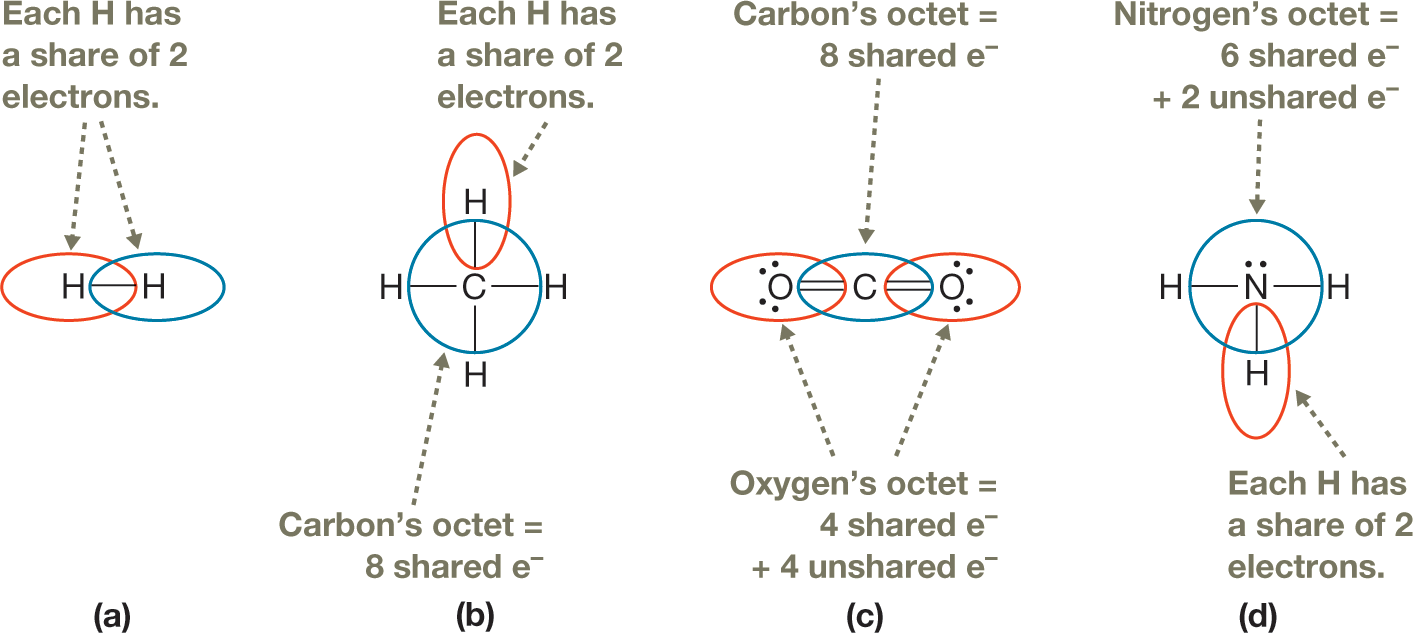
For the common atoms in this course, use these stability targets:
- Hydrogen needs a duet, meaning 2 electrons.
- Carbon, nitrogen, oxygen, and halogens usually need an octet, meaning 8 electrons.
Since one electron pair contains two electrons:
- hydrogen should have one electron pair around it;
- most other common non-metal atoms should have four electron pairs around them.
That does not mean four bonds. The four pairs can be a mixture of bonding pairs and lone pairs.
The local check: inspect one atom at a time
For every atom, use this three-part routine:
-
Count bonding pairs touching the atom.
A single bond counts as 1 pair, a double bond as 2, and a triple bond as 3. -
Count lone pairs on that atom.
-
Add the pairs, then convert to electrons.
Multiply the number of pairs by 2.
For a common non-hydrogen atom:
means:
For hydrogen:
It is useful to keep these common patterns in mind:
| Atom in a typical neutral molecule | Bonding pairs | Lone pairs | Total electrons around atom |
|---|---|---|---|
| H | 1 | 0 | 2 |
| C | 4 | 0 | 8 |
| N | 3 | 1 | 8 |
| O | 2 | 2 | 8 |
| F, Cl, Br, I | 1 | 3 | 8 |
These are patterns, not a substitute for checking. For instance, nitrogen in has four bonding pairs and no lone pairs, but it still has an octet.
A short visual check
The following short segment from Khan Academy’s Drawing Lewis diagrams shows the exact reasoning to use: count the non-bonding electrons and the shared bonding electrons around each atom.
Drawing Lewis diagrams | AP Chemistry | Khan Academy
Watch this brief Khan Academy segment to see an octet check carried out explicitly for fluorine and silicon. Notice that the shared electrons in each bond count around both bonded atoms.
Watch the octet check. Focus on the distinction between six non-bonding electrons on fluorine and the two electrons it shares in a bond.
The wording may differ from an NCEA question, but the process is identical: account for every pair around the particular atom you are checking.
Worked check 1: water,
A complete Lewis structure of water has two single bonds and two lone pairs on oxygen.
  ..
H-O-H
  ..
Check oxygen first:
- two single bonds bonding pairs;
- two lone pairs non-bonding pairs;
- total pairs electrons.
Now check either hydrogen:
- one single bond bonding pair;
- no lone pairs;
- total pair electrons.
So oxygen has an octet and each hydrogen has a duet.
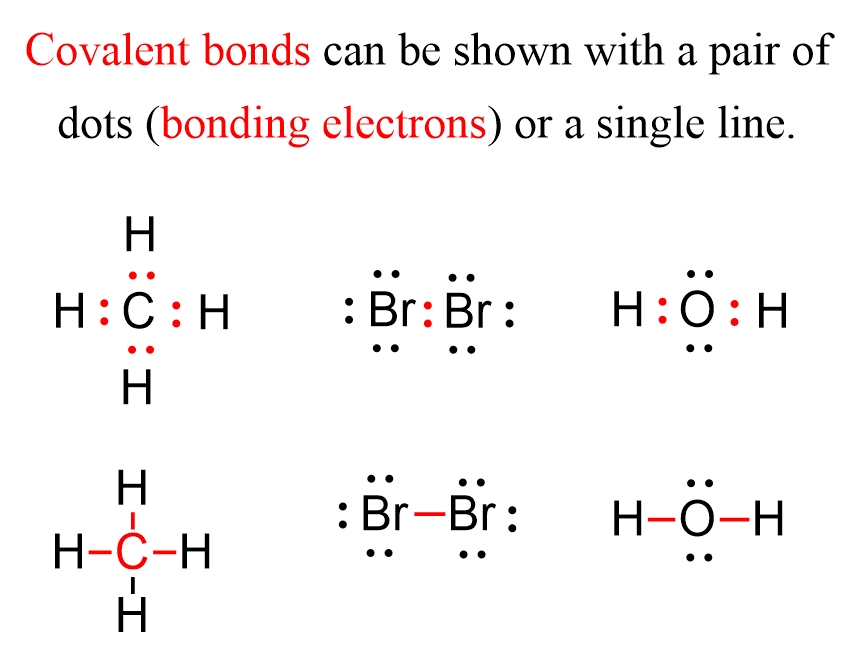
When you draw with lines, be careful not to let the line notation hide lone pairs. The lower water structure in the image is only complete because the two lone pairs on O are also shown.
Worked check 2: ammonia,
Ammonia has three single bonds and one lone pair on nitrogen.
    ..
H - N - H
    |
    H
Check nitrogen:
- three single bonds bonding pairs;
- one lone pair non-bonding pair;
- total pairs electrons.
Each hydrogen has one bond:
- one bonding pair;
- total electrons.
The nitrogen octet comes from six shared electrons plus two non-bonding electrons. This is why leaving out nitrogen’s lone pair makes the Lewis structure incorrect.
Multiple bonds: count each line separately
A double or triple bond contains more than one bonding pair. This matters particularly when checking carbon, which often reaches its octet through multiple bonds.
Carbon dioxide,
The correct Lewis structure is:
..     ..
O = C = O
..     ..
Each oxygen has two lone pairs.
Check the central carbon:
- left double bond bonding pairs;
- right double bond bonding pairs;
- no lone pairs;
- total pairs electrons.
Check either oxygen:
- one double bond bonding pairs;
- two lone pairs pairs;
- total pairs electrons.
A helpful shortcut is to see that carbon has four bond lines in total: two in the left double bond and two in the right double bond.
Nitrogen,
:N≡N:
Each nitrogen has:
- one triple bond bonding pairs;
- one lone pair non-bonding pair;
- total pairs electrons.
Do not make the mistake of treating a triple bond as only one pair because it joins the same two atoms. It contains three shared electron pairs.
The global check: does the entire diagram use the correct number of electrons?
The atom-by-atom check is the local check. It answers: “Does this atom have a duet or octet?”
You should also perform a global electron-total check. It answers: “Did the whole Lewis structure use exactly the number of valence electrons available?”
For the global check:
- Count all electrons in bonds once only.
- Add all electrons in lone pairs.
- Compare that total with the valence-electron budget from the formula and any ion charge.
This is different from the local check. Locally, a shared bond pair is counted around each atom. Globally, the same two electrons must be counted only once because they are one physical pair.
Why both checks matter
Consider this incomplete diagram for carbon dioxide:
..     ..
O = C = O
Here, each oxygen has only one lone pair rather than two.
The global total appears correct:
- two double bonds: electrons;
- two lone pairs total: electrons;
- total: electrons.
Carbon dioxide really does have 12 valence electrons, so the global check alone would not expose the problem.
But the local oxygen check shows the error:
- double bond: 2 bonding pairs;
- one lone pair: 1 non-bonding pair;
- total: 3 pairs electrons.
Each oxygen lacks two electrons. The diagram must have a second lone pair on each oxygen.
Conclusion: a correct total electron count does not guarantee that every atom has a full shell. Use both checks.
Checking ions: octets, total electrons, and charge notation
For an ion, the checking logic is unchanged, but the global electron budget must include the charge.
Consider one valid resonance form of carbonate, :
       O
       ||
[ O - C - O ]2-
The lone pairs are not shown above, so they must be included mentally or added before checking:
- double-bonded O: two lone pairs;
- each single-bonded O: three lone pairs.
Local checks
| Atom | Bonding pairs | Lone pairs | Electrons around atom |
|---|---|---|---|
| C | 4 | 0 | 8 |
| Double-bonded O | 2 | 2 | 8 |
| Each single-bonded O | 1 | 3 | 8 |
Every atom satisfies the usual octet rule.
Global check
Carbonate has:
valence electrons: four from C, eighteen from the oxygens, and two more due to the charge.
Now count electrons in the Lewis structure:
- one double bond: 4 electrons;
- two single bonds: 4 electrons;
- double-bonded oxygen’s two lone pairs: 4 electrons;
- two single-bonded oxygens’ six lone pairs: 12 electrons.
The structure therefore passes both the local octet check and the global electron-total check. The brackets and charge complete the representation.
An exam-ready audit routine
Before moving on from any Lewis structure, run this compact audit.
1. Check every atom locally
For each atom, ask:
- How many bonding pairs touch it?
- How many lone pairs sit on it?
- Does it have 2 electrons if it is H, or usually 8 if it is C, N, O, or a halogen?
2. Check the whole structure globally
Ask:
- Do electrons in all bonds and lone pairs add to the correct valence-electron total?
- For an ion, did I add electrons for negative charge or subtract for positive charge?
3. Check what is actually drawn
Ask:
- Have all lone pairs been shown?
- Are multiple bonds represented by the correct number of lines?
- If it is an ion, are brackets and overall charge present?
A concise Excellence-style statement could look like this:
In , nitrogen has three bonding pairs and one lone pair, giving four electron pairs or eight electrons around nitrogen. Each hydrogen has one bonding pair and therefore two electrons. The Lewis structure satisfies the octet rule for nitrogen and the duet rule for hydrogen.
Notice that this does more than state “the structure is correct”: it gives the pair count and links it explicitly to electron count.
Key takeaways
A Lewis-structure check has two layers:
- Local check: Count bonding and non-bonding pairs around each atom. Hydrogen needs one pair, while C, N, O, and halogens usually need four pairs.
- Global check: Count all drawn electrons once and compare with the total valence-electron budget, adjusted for ion charge.
Remember:
- single, double, and triple bonds contain 1, 2, and 3 bonding pairs respectively;
- a bonding pair counts around both atoms it joins;
- lone pairs are essential parts of a complete Lewis structure, not optional decoration;
- a correct total number of electrons can still be arranged incorrectly, so always inspect each atom as well.
Next, you will begin using Lewis structures to count regions of electron density around a central atom. That count is the starting point for predicting molecular shape and bond angles.
Can't find a good explanation? Sign up and we'll make it for you
Sign up