
Good to see you again. In the previous lesson, you checked Lewis structures by counting bonding pairs and lone pairs around each atom. Those bond lines represent real attractions holding atoms together—but an important new distinction is that a substance can also have attractions between separate molecules.
This difference is central to AS91164 explanations. It lets you explain why a substance melts, boils, or changes state without incorrectly claiming that its covalent bonds have broken. By the end of this lesson, you should be able to identify whether a labelled force is inside a particle or between particles, and explain the consequence clearly.
The key distinction: where is the attraction?
The prefixes give a reliable starting point:
- Intra means within.
- Inter means between.
An intramolecular bond is a chemical bond that holds atoms together within one particle. In the molecular substances you will most often work with, these are covalent bonds: the attraction between the positively charged nuclei and the shared bonding electrons.
An intermolecular attraction is an attraction between separate molecules. It does not create a new molecule; it simply pulls neighbouring molecules toward one another.
The boundary test is the quickest way to classify a force:
Draw an imaginary boundary around one molecule. If the attraction stays inside that boundary, it is intramolecular. If it crosses from one molecule to another, it is intermolecular.
| Feature | Intramolecular bond | Intermolecular attraction |
|---|---|---|
| Location | Within one molecule | Between separate molecules |
| What it connects | Atoms | Molecules |
| Example in water | An covalent bond | Attraction between the H of one water molecule and the O of another |
| Relative strength | Usually strong | Usually much weaker |
| Main effect | Determines the molecule’s chemical identity and structure | Strongly affects physical properties such as melting point and boiling point |
A useful terminology warning: hydrogen bonding is an intermolecular attraction, despite the word “bonding” in its name. It is not the same as the covalent bond within a water molecule.
A short visual introduction
Watch this short explanation from Intermolecular vs Intramolecular forces Grade 11 Chemistry by Miss Martins Maths and Science. It establishes the vocabulary and shows how diagrams distinguish the two kinds of attraction.
Intermolecular vs Intramolecular forces Grade 11 Chemistry
Watch this brief video to secure the meaning of the prefixes and connect the definitions to diagram conventions and physical properties.
Begin with the prefixes to fix the meanings of intra and inter. Continue through the force boundary, where the speaker contrasts a bond within \mathrm{HCl} with an attraction between two \mathrm{HCl} molecules. Finish with the property link, focusing on why attractions between molecules affect melting and boiling points.
When interpreting a chemistry diagram, solid lines within a structural formula normally show covalent bonds. Dotted or dashed lines drawn between separate molecules normally show intermolecular attractions.
Water contains both kinds of attraction
Water is the most important example because it contains strong covalent bonds within each molecule and hydrogen bonds between molecules.
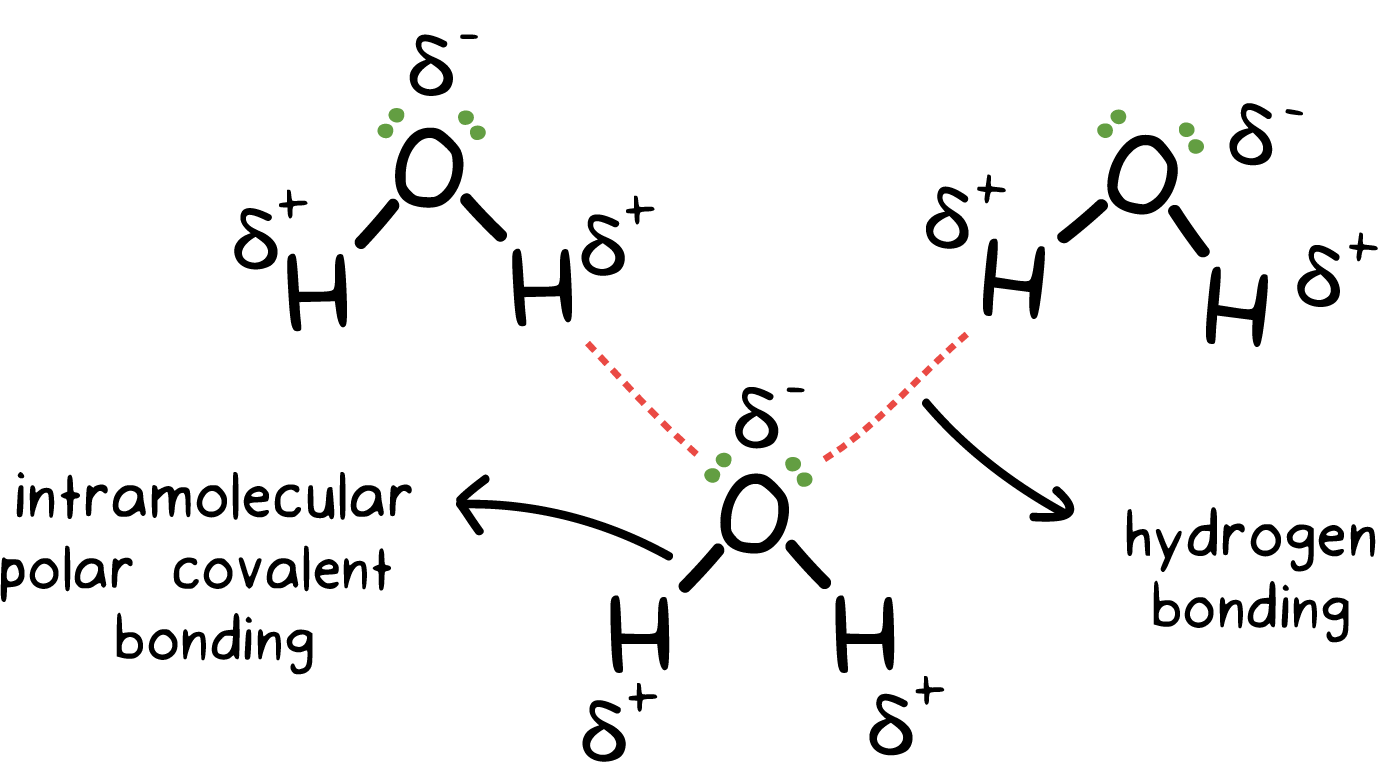
Look carefully at the central molecule in the diagram.
Inside one water molecule
Each black line is a polar covalent bond. Oxygen and hydrogen share a pair of electrons, but oxygen attracts the shared electrons more strongly. This gives:
- oxygen a partial negative charge, written ;
- each hydrogen a partial positive charge, written .
These bonds are intramolecular because they are inside one molecule. Breaking one would change the water molecule chemically.
Between two water molecules
The positive hydrogen end of one water molecule is attracted to a negative oxygen end, including a lone-pair region, of a neighbouring water molecule. This is a hydrogen bond.
It is intermolecular because it crosses from one water molecule to another. The molecules remain separate: they are not joined into one larger covalent molecule.
A precise statement is:
In water, the bonds are polar covalent intramolecular bonds within each molecule. Hydrogen bonds are intermolecular attractions between the hydrogen of one water molecule and the oxygen of another water molecule.
This is a strong model for an exam explanation because it identifies:
- the force;
- its location;
- the particles involved; and
- the charge-based reason for the attraction.
Heating water: what is actually being overcome?
The intramolecular–intermolecular distinction becomes especially important when a question describes melting or boiling.
When liquid water boils:
- water molecules gain enough kinetic energy to separate much more widely;
- intermolecular hydrogen bonds are overcome;
- the covalent bonds within individual molecules remain intact.
Steam is still made of molecules. If boiling broke the bonds, water would no longer be water; that would be a chemical change rather than a change of state.
Compare these two situations:
| Process | What happens to the particles? | What happens to attractions? | Type of change |
|---|---|---|---|
| Water boils | molecules move apart | Intermolecular attractions are overcome | Physical change |
| Water reacts chemically to form different substances | Atoms are rearranged into new particles | Intramolecular bonds are broken and new bonds form | Chemical change |
Use careful vocabulary:
- We normally say an intramolecular bond is broken.
- We normally say an intermolecular attraction is overcome.
Both processes require energy, but breaking covalent bonds within molecules generally requires much more energy than separating molecules from one another.
Why this matters for melting and boiling points
Intermolecular attractions help determine how much energy is needed to separate molecules. Therefore, they are closely connected to observable physical properties:
- melting point;
- boiling point;
- whether a substance is likely to be a gas, liquid, or solid at room temperature;
- solubility, later in the course.
Stronger attractions between molecules mean more energy is needed to separate those molecules. This generally gives higher melting and boiling points.
For example:
- Methane, , has covalent bonds inside each molecule, but only weak intermolecular attractions between its molecules. It is a gas at room temperature.
- Water, , also has covalent bonds inside each molecule, but its molecules can form relatively strong hydrogen bonds with one another. Water is a liquid at room temperature.
Do not conclude that water has strong covalent bonds while methane does not. Both have covalent bonds within their molecules. The major difference for these physical properties is the attraction between their molecules.
Read the distinction in context
Chemguide’s Intermolecular forces gives a compact explanation using water changing into steam and solid iodine changing into iodine vapour.
Read the opening of Chemguide’s “Intermolecular forces” page to reinforce the difference between forces inside molecules and forces between neighbouring molecules.
In the opening section, “What is an intermolecular force?”, read the water and iodine examples. Begin at the sentence defining intermolecular attractions and stop after the statement that covalent bonds within a molecule are separate. Focus on the fact that both steam and iodine vapour still contain intact molecules.
Iodine is a particularly useful second example. Solid iodine consists of molecules held close together by weak attractions. When it becomes iodine vapour, those attractions are overcome, but each gaseous particle is still an molecule. The covalent bond has not been broken.
Common diagram and wording traps
Trap 1: Calling every line in a diagram an intermolecular force
A line connecting atoms inside one displayed molecule is usually a covalent, intramolecular bond.
For example, in:
the bond is intramolecular because H and Cl are part of the same molecule.
If two molecules are drawn near each other, the attraction between the H end of one molecule and the Cl end of the other is intermolecular.
Trap 2: Saying that boiling breaks covalent bonds
A boiling point refers to separating molecules from one another. For a molecular substance, the relevant attractions are intermolecular.
Better wording:
On boiling, energy is used to overcome the attractions between molecules. The covalent bonds within each molecule remain intact.
Trap 3: Treating partial charges as full ionic charges
In polar covalent molecules, symbols such as and mean partial charges caused by unequal sharing of electrons. They are not full ionic charges such as and .
The partial positive and partial negative regions are enough to create attractions between polar molecules.
Trap 4: Using “intermolecular” for ionic lattices
The term intermolecular literally means “between molecules.” Ionic compounds such as sodium chloride are not made of separate molecules; they form giant lattices of positive and negative ions. Their strong ion–ion electrostatic attractions are part of the ionic lattice structure, not ordinary intermolecular forces.
For now, use intermolecular attractions when the particles being attracted are separate covalent molecules, such as , , , or .
An Excellence-ready explanation pattern
When a question asks you to distinguish the two, avoid giving only definitions. Identify the specific particles and attraction in the substance.
Use this structure:
- State the intramolecular bond and where it occurs.
- State the intermolecular attraction and where it occurs.
- Link the distinction to a physical change or property if the question provides one.
For water, an extended response could be:
The bonds within each water molecule are polar covalent intramolecular bonds. They involve shared electron pairs between oxygen and hydrogen atoms. Because oxygen is more electronegative, each water molecule has a oxygen region and hydrogen regions. The hydrogen of one water molecule is attracted to the oxygen of a neighbouring water molecule, forming an intermolecular hydrogen bond. During boiling, these intermolecular attractions are overcome so the water molecules separate, while the covalent bonds remain intact.
Notice that this explanation does not merely say “intra means inside and inter means between.” It applies those definitions to actual particles and explains what changes during boiling.
Key takeaways
- Intramolecular bonds hold atoms together within a molecule. In molecular substances, these are usually covalent bonds.
- Intermolecular attractions act between separate molecules.
- In water, covalent bonds are intramolecular, while hydrogen bonds between neighbouring water molecules are intermolecular.
- Intermolecular attractions are usually weaker than intramolecular bonds and strongly influence physical properties such as melting point and boiling point.
- During a change of state, intermolecular attractions are overcome; the covalent bonds within each molecule remain intact.
- In written explanations, name the particles, identify the attraction, and state whether it occurs within one molecule or between separate molecules.
This completes the bonding foundation for the module. Next, you will use Lewis structures in a new way: counting regions of electron density around a central atom, which leads directly to predicting molecular shape.
Can't find a good explanation? Sign up and we'll make it for you
Sign up