
Welcome back. Last lesson extended your Lewis-structure method to double and triple bonds: count the valence-electron budget, draw a single-bond skeleton, complete outer shells, and convert lone pairs into multiple bonds when a central atom lacks an octet.
A polyatomic ion follows the same method, with two additions:
- Its overall charge changes the total number of electrons available.
- The completed structure must be enclosed in square brackets, with the overall charge written at the upper right.
By the end of this lesson, you should be able to draw ions such as , , , and , including bonds, lone pairs, brackets, and charge.
The charge changes the electron budget
An ion has gained or lost electrons.
- A negative charge means the particle has gained electrons. Add electrons to the total.
- A positive charge means the particle has lost electrons. Subtract electrons from the total.
For an ion with charge magnitude :
for a negative ion, and
for a positive ion.
The charge is not an extra atom and does not make a bond. It only changes your electron count.
| Ion | Neutral-atom valence electrons | Charge adjustment | Total electrons |
|---|---|---|---|
| add 1 | 8 | ||
| subtract 1 | 8 | ||
| add 1 | 10 | ||
| add 2 | 24 |
The final format matters in assessment questions:
The brackets surround the entire ion. The charge sits outside the top-right corner of the brackets.
A reliable method for every simple polyatomic ion
Use this sequence every time, including when an ion has a multiple bond.
- Count valence electrons from all atoms.
- Adjust for the charge. Add for negative; subtract for positive.
- Choose a skeleton. Hydrogen is always outside. Usually, the single atom or least electronegative non-hydrogen atom is central.
- Draw single bonds between the central atom and the surrounding atoms.
- Complete the outer atoms first with lone pairs. Hydrogen only needs two electrons.
- Put any remaining electrons on the central atom.
- Check octets. If the central atom lacks an octet, convert a lone pair on a neighbouring atom into a double or triple bond, as in the previous lesson.
- Audit the electron total.
- Add brackets and the overall charge.
The first six steps are almost identical to drawing neutral molecules. The charge adjustment is made at the beginning, while brackets and the charge are added at the end.
Lewis Diagrams of Ions Made Easy
Watch “Lewis Diagrams of Ions Made Easy” from ketzbook for a compact demonstration of the electron-count adjustment, followed by ammonium and carbonate examples.
Begin with the charge rule, focusing on why gaining electrons makes an ion negative and losing them makes it positive. Then watch ammonium for the full cation method, including brackets. Finish with carbonate, pausing when the presenter turns a lone pair into a double bond; compare that move with the method used for carbon dioxide in the previous lesson.
Worked example 1: hydroxide,
Hydroxide is a useful first example because it has only two atoms but still requires both the charge adjustment and brackets.
1. Count electrons
Oxygen contributes six valence electrons and hydrogen contributes one:
The negative charge means one additional electron:
So hydroxide has 8 valence electrons.
2. Draw a single bond
Place a single bond between hydrogen and oxygen. This uses two electrons.
Hydrogen is now complete because it has two electrons in its one bond.
3. Place the remaining electrons
There are six electrons left. Put these as three lone pairs on oxygen.
Oxygen now has:
- one bonding pair;
- three lone pairs;
- eight electrons around it.
A complete Lewis structure is:
  ..
[H-O..]-
  ..
The dot placement can vary, but the important features are:
- one single bond;
- three lone pairs on O;
- square brackets;
- a outside the brackets.
The bond uses two electrons and oxygen’s three lone pairs use six:
That matches the electron budget.
Worked example 2: ammonium,
Ammonium is the common example of a positive polyatomic ion.
1. Count electrons
Nitrogen provides five electrons. Four hydrogens provide four more:
The positive charge means one electron has been lost:
So has 8 valence electrons.
2. Draw the skeleton
Nitrogen is central and each hydrogen makes one single bond to nitrogen. Four single bonds require:
electrons.
    H
    |
H - N - H
    |
    H
All eight electrons have now been used. There are no lone pairs on nitrogen.
3. Check each atom
- Each H has one bond, giving it two electrons.
- N has four single bonds, giving it eight electrons.
- Total electrons in four bonds: .
Now add brackets and the charge:
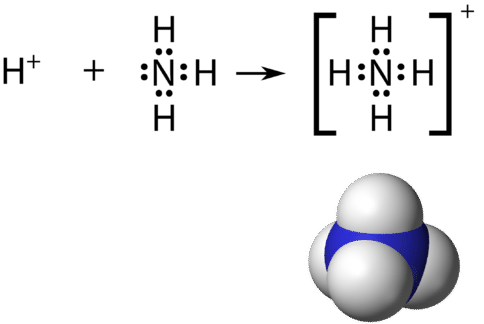
The image shows ammonium forming from ammonia and . Before bonding, ammonia has a lone pair on nitrogen. Once ammonium has formed, draw all four bonds identically in the final Lewis structure. You do not need to label one bond differently.
Worked example 3: cyanide,
Cyanide brings together both new ideas: the extra electron from the negative charge and the triple-bond process from the previous lesson.
1. Count electrons
Carbon contributes four, nitrogen contributes five, and the negative charge adds one. There are 10 valence electrons.
2. Start with a single bond
C-N
The bond uses two electrons, leaving eight.
If you place three lone pairs on nitrogen, all 10 electrons have been used, but carbon has only two electrons around it. Carbon needs an octet.
3. Form multiple bonds
Convert two of nitrogen’s lone pairs into bonding pairs between C and N. The single bond becomes a triple bond.
[:C:::N:]-
In line notation, the same structure is:
There is one lone pair on carbon and one lone pair on nitrogen.
4. Check
- Triple bond: 6 electrons
- Carbon lone pair: 2 electrons
- Nitrogen lone pair: 2 electrons
Both carbon and nitrogen have eight electrons around them. The brackets and negative charge identify the structure as the cyanide ion, not neutral .
Worked example 4: carbonate,
Carbonate is a common example where a central atom requires a double bond after outer atoms have been completed.
1. Count electrons
Carbon supplies four electrons. Three oxygens supply eighteen:
The charge contributes two more:
The carbonate ion has 24 valence electrons.
2. Draw the single-bond skeleton
Carbon is central:
    O
    |
O - C - O
Three bonds use six electrons, leaving eighteen.
3. Complete outer oxygens
Give each oxygen three lone pairs. This uses all eighteen remaining electrons. Each oxygen has an octet, but carbon has only six electrons because it has three single bonds.
4. Give carbon an octet
Move one lone pair from one oxygen into the bond between that oxygen and carbon. This produces one double bond.
A valid Lewis structure has:
- one oxygen double-bonded to carbon, with two lone pairs;
- two oxygens single-bonded to carbon, each with three lone pairs;
- brackets with a charge outside.
A simplified layout is:
       O
       ||
[ O - C - O ]2-
Remember that this line-only sketch is incomplete unless you add the lone pairs:
- double-bonded O: 2 lone pairs;
- each single-bonded O: 3 lone pairs.
You may place the double bond to any one of the three oxygens. These alternative valid drawings are called resonance structures. For this lesson, the key skill is recognising why one double bond is needed: carbon must reach an octet without adding any extra electrons.
Fast checks before you move on
Before treating a Lewis structure as finished, check all four points.
| Check | What to ask |
|---|---|
| Electron count | Did I add electrons for a negative charge or subtract for a positive charge? |
| Outer shells | Does each H have two electrons, and do C, N, and O usually have eight? |
| Lone pairs | Have I shown every unused electron pair? |
| Ion notation | Is the entire structure in brackets, with the correct charge outside? |
Three errors are especially common:
- Using the neutral-molecule electron count. For example, using 22 electrons instead of 24 for .
- Writing the charge inside the brackets or on one atom without showing the ion’s overall charge. The expected format is .
- Adding a multiple bond but forgetting to reduce the lone pairs on that atom. When an oxygen changes from a single bond to a double bond, it changes from three lone pairs to two.
Key takeaways
Lewis structures for polyatomic ions use the same electron-budget method as neutral molecules, but the ion charge changes the budget:
- add one electron for every charge;
- subtract one electron for every charge;
- complete octets and create multiple bonds only when needed;
- enclose the final ion in brackets and write its overall charge outside.
For example, has 8 electrons, has 8 electrons, has 10 electrons, and has 24 electrons.
Next, you will practise checking Lewis structures systematically by counting both bonding and non-bonding electron pairs around every atom.
Can't find a good explanation? Sign up and we'll make it for you
Sign up