Hello! Welcome to the fourth lesson in our module on the functions and benefits of sleep.
In our last lesson, we discovered the brain's private cleaning service, the glymphatic system. We learned that deep sleep is essential for this system to flush out metabolic waste, including proteins linked to Alzheimer's disease. This highlighted how specific physiological states, unique to sleep, are non-negotiable for maintaining brain health.
Today, we shift our focus from the brain's internal environment to the body's defense forces. The learning outcome for this lesson is to describe sleep's role in immune system function. We will explore how sleep acts as a critical force multiplier for our ability to fight off everything from the common cold to more serious diseases. This will add another crucial piece to our puzzle as we catalog the essential biological processes that any alternative state of "conscious rest" would need to replicate.
The Immune System: Your Body's Military
Before we dive into sleep's role, let's establish a basic understanding of the immune system. You can think of it as a sophisticated, multi-layered military operation designed to protect your body from invaders (pathogens like bacteria, viruses, and fungi) and internal threats (like cancerous cells).
It has two main branches:
- Innate Immunity: This is your first line of defense. It's fast, general-purpose, and non-specific. It includes physical barriers like your skin and mucous membranes, as well as specialized cells that attack any foreign invader they encounter.
- Adaptive (or Acquired) Immunity: This is your special forces unit. It is slower to respond initially, but it is highly specific and builds a "memory" of past invaders. When it encounters a pathogen it has seen before, it mounts a rapid and powerful targeted response. This is the principle behind vaccines.
A healthy body relies on the seamless cooperation of both branches.
Sleep & Immunity: Can a Lack of Sleep Make You Sick?
To get a clear understanding of these two branches and how sleep supports them, let's start with a foundational article from the Sleep Foundation.
Please read the first part of the article, from the heading 'How Does Sleep Affect the Immune System?' down to (but not including) the section 'Can Sleep Deprivation Make You Sick?'. Focus on how sleep supports both innate and adaptive immunity, and the concept of strengthening 'immune memory'.
As the article explains, sleep is a period where the immune system isn't just resting; it's actively training, re-arming, and consolidating its intelligence. During sleep, there is an increased production of key signaling proteins called cytokines, some of which promote inflammation to help fight infection and reinforce the adaptive immune system's memory.
Sleep: A Superpower for Your Immune Soldiers
To understand the dramatic impact of sleep on your immune defenses, let's look at one of the most important soldiers in your innate immune army: the Natural Killer (NK) cell.
NK cells are like the secret service agents of your immune system. They patrol your body, identifying and destroying dangerous threats, including virally infected cells and cancerous cells, on sight. You want a robust and active force of these cells at all times.
So, what does even a small amount of sleep loss do to these elite agents? The results are striking.
Sleep Is Your Superpower | Matt Walker | TED
In this segment from his popular TED talk, sleep scientist Matt Walker vividly explains the impact of a single night of sleep restriction on your Natural Killer cells.
Please watch from 09:26 to 11:00. Pay close attention to the specific percentage drop in NK cell activity after just one night of partial sleep deprivation.
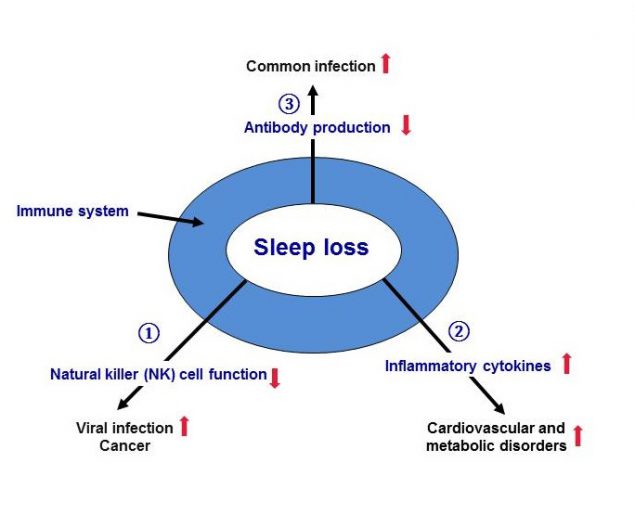
A 70% drop in Natural Killer cell activity from just one night of four hours of sleep is a staggering state of immune compromise. This isn't a minor dip; it's a profound weakening of one of your body's key anti-cancer defenses.
This leads to a direct and concerning link between insufficient sleep and long-term health risks.
The Consequences of an Underslept Immune System
The impact of a weakened immune system plays out in both the short and long term.
Short-Term: Susceptibility to Illness
The link between poor sleep and catching a cold is not just an old wives' tale. Studies have shown that individuals who regularly get less than six or seven hours of sleep are significantly more likely to get sick after being exposed to a virus, like the common cold.
Sleep is also crucial for the effectiveness of vaccines. As we learned, vaccines work by "teaching" your adaptive immune system to recognize a threat. This learning process is consolidated during sleep.
The Sleep Foundation article you read earlier (LINK) highlights studies on hepatitis and H1N1 vaccines, which found that people who didn't sleep the night after vaccination produced a much weaker antibody response, sometimes rendering the vaccine less effective.
Long-Term: Chronic Disease and Cancer
The chronic consequences of an under-slept immune system are even more serious. The World Health Organization has classified any form of nighttime shift work as a "probable carcinogen" precisely because of the disruption it causes to sleep-wake rhythms and, by extension, immune function.
To see just how profound this effect can be, let's look at some experimental evidence in more detail.
Fighting cancer and improving immune function with sleep | Peter Attia, M.D. & Matt Walker, Ph.D.
In this discussion, Matt Walker elaborates on the link between sleep loss and cancer, describing a powerful study conducted on mice.
Please watch two segments. First, from 01:40 to 02:54, which recaps the 70% drop in NK cell activity. Then, watch from 09:12 to 10:54, where a study on mice demonstrates how sleep restriction affects tumor growth and metastasis.
The findings from the mouse study are sobering: sleep-restricted mice not only had tumors that grew 200% larger, but the cancer was also more aggressive and had begun to metastasize (spread to other parts of the body). While this is an animal study, it provides a causal mechanism explaining the epidemiological links observed in humans.
This is driven by two factors:
- A weakened defense: Fewer active NK cells to fight the cancerous cells.
- A pro-tumor environment: Lack of sleep can alter other immune cells, creating conditions that are more favorable for tumor growth.
Test your understanding!
A friend who works frequent night shifts tells you they seem to catch every cold that goes around. Another friend, preparing for an overseas trip, plans to get a vaccination the day before their long-haul flight, assuming they won't sleep well on the plane.
Based on what you've learned, explain the distinct immunological reasons for the problems each friend is facing or might face.
Show answer
-
The night shift worker: Their chronic sleep disruption and circadian misalignment are likely causing a significant, persistent reduction in their innate immune defense, particularly the activity of their Natural Killer (NK) cells. This makes their body less effective at fighting off viruses on first contact, leading to a higher susceptibility to common illnesses like colds.
-
The traveler: The problem here relates to adaptive immunity. Getting a vaccine and then immediately depriving the body of sleep will compromise the immune system's ability to create a robust "memory" of the pathogen. The production of antibodies and the consolidation of immunological memory are sleep-dependent processes. As a result, the vaccine may be significantly less effective, leaving them with weaker protection than they assume.
A Bidirectional Relationship
Finally, it's important to recognize that the relationship between sleep and immunity is a two-way street. Not only does sleep affect your immune system, but your immune system also affects your sleep.
When you're sick, your immune system releases cytokines that act as powerful sleep-inducing agents, making you feel tired and compelling you to rest. This isn't a sign of weakness; it's a strategic move. This response changes your sleep architecture, typically by:
- Increasing deep NREM sleep: This is the most restorative stage of sleep and helps conserve energy that the body can then redirect toward fighting the infection.
- Suppressing REM sleep: Your body can't shiver during REM sleep (due to muscle atonia). By reducing REM, the body is better able to mount a fever, which helps fight many pathogens.
This shows just how deeply intertwined these two systems are. Sleep is an intelligently regulated process that the body uses as a tool to heal itself.
The Challenge of Conscious Rest
This lesson has established another pillar of sleep's non-negotiable biological function. It is not a passive state of dormancy but an active state of immunological recalibration, surveillance, and warfare.
This presents a fascinating challenge to the goal of replacing sleep with meditation. While sleep is an unconscious process that orchestrates this immune enhancement, what happens during conscious meditation? Interestingly, the specific practice you are interested in, Preksha Dhyaan, has also been studied for its effects on the immune system at the genetic level.
A 2022 study published in Frontiers in Genetics titled "Preksha Dhyāna meditation induces alterations at the gene expression profiling..." (LINK) found that 8 weeks of this practice altered the expression of genes involved in innate and adaptive immunity. Specifically, it modulated pathways central to immune response, such as "Interferon Signaling" and "Th1 and Th2 Activation."
This is a critical insight. It suggests that meditation doesn't just provide "rest" in a generic sense; it actively influences the same biological systems that sleep does. The question we will have to tackle later in the course is how it influences them. Does it replicate the specific, restorative processes of sleep, or does it create a different, perhaps complementary, state of regulation? Understanding this difference is key to evaluating the potential for meditation to enhance or even substitute for aspects of sleep.
Conclusion
Today, we've explored the profound connection between sleep and your body's ability to defend itself.
Key Takeaways:
- Sleep is essential for a robust immune system, supporting both the fast-acting innate immunity and the memory-building adaptive immunity.
- Sleep deprivation, even for a single night, can drastically reduce the activity of crucial immune cells like Natural Killer (NK) cells, weakening your defense against viruses and cancer.
- Chronic sleep loss is linked to an increased risk of infections, reduced vaccine effectiveness, and a higher risk of developing certain cancers.
- The relationship is bidirectional: your immune system also changes your sleep patterns when you are sick to help you recover.
Preview of the Next Lesson:
We have now covered sleep's role in tissue repair, brain cleaning, and immune defense. In our next lesson, we'll continue this theme by examining another fundamental regulatory system: the endocrine system. We will explore how sleep influences key hormones such as growth hormone and cortisol, which control everything from growth and metabolism to your stress response.