
Hello! Welcome to our third lesson on the functions and benefits of sleep.
In our previous lesson, we looked at the body's general repair mechanisms, focusing on how deep sleep triggers the release of Human Growth Hormone to facilitate widespread cellular and tissue repair. We established that this process is fundamentally restorative and reparative.
Today, we're zooming in on a specialized cleaning service that is unique to the brain. For a long time, scientists were puzzled by how the brain, a highly active organ that produces a lot of metabolic waste, clears out these byproducts without a traditional lymphatic system like the rest of the body. The discovery of the system that performs this job has revolutionized our understanding of why sleep is so essential.
The learning outcome for this lesson is to explain the glymphatic system and its role in waste clearance during sleep. We'll explore what this system is, how its plumbing works, and why it absolutely depends on the state of sleep to function effectively.
A Waste Clearance System for the Brain
The brain's lack of a standard lymphatic system presents a paradox. It has an incredibly high metabolic rate, meaning it generates a substantial amount of potentially toxic waste products. Yet, it must maintain a pristine, stable environment for neurons to function correctly. The solution to this paradox is a recently discovered process named the glymphatic system.
To get a clear overview of what this system is and what it does, let's start with a short, introductory video.
The Glymphatic System: what on Earth is it - and 7 ways to improve it!
The video 'The Glymphatic System: what on Earth is it' provides an excellent and accessible introduction to this topic. It explains the system's discovery, its core function, and its general importance for brain health.
Please watch the segment from 00:28 to 01:39.
As the video explains, the name "glymphatic" is a nod to two key components:
- Glial cells: A specific type of brain cell (astrocytes) that forms the plumbing of the system.
- Lymphatic-like function: It serves the same purpose as the body's lymphatic system—clearing out waste.
The Plumbing: How It Works
To understand the glymphatic system, we need to visualize its structure. It's a clever plumbing network that piggybacks on the brain's existing blood vessels.
This diagram shows the overall pathway:

The process involves a few key components and steps:
- Cerebrospinal Fluid (CSF): This is the clear fluid that surrounds the brain and spinal cord. In the glymphatic system, it acts as the cleaning agent.
- Para-arterial Influx: The CSF is pumped from the brain's surface into the brain tissue, flowing through special channels surrounding the arteries. These channels are called perivascular spaces.
- Exchange with Interstitial Fluid (ISF): Once inside the brain tissue, the CSF exchanges with the interstitial fluid—the fluid that fills the spaces between brain cells. This is where the cleaning happens. The flowing CSF effectively flushes the ISF, collecting metabolic byproducts and waste proteins.
- Para-venous Efflux: This "dirty" fluid, now carrying the waste, is collected into perivascular spaces around the veins and directed out of the brain, eventually entering the body's lymphatic system for disposal.
The video below explains the anatomical details of this process, including the crucial role of brain cells called astrocytes in forming and managing these channels.
The Glymphatic System EXPLAINED [+ Review of CSF Flow]
The video 'The Glymphatic System EXPLAINED' from Catalyst University offers a more technical look at the anatomy of this system. It will help you visualize the flow from CSF to the perivascular spaces.
Please watch from 04:54 to 10:22. This segment explains how astrocytes create the perivascular space and how fluid moves from the arterial side to the venous side, collecting waste along the way.
The Critical Link to Sleep
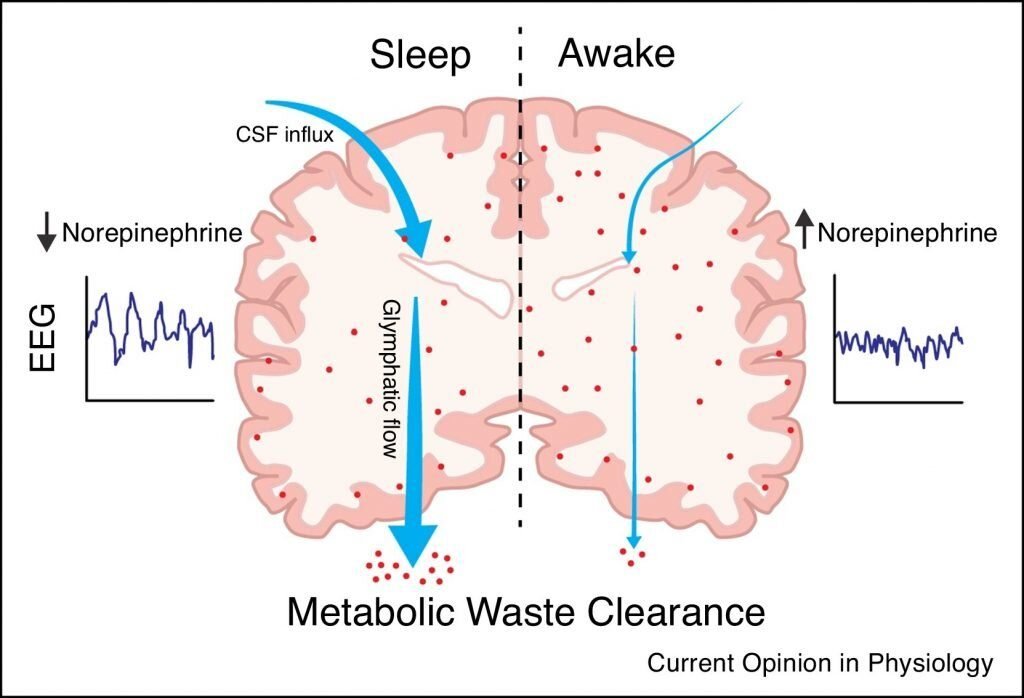
Here is the most crucial part of this discovery: the glymphatic system is overwhelmingly active during sleep and largely shut off when we are awake.
Why? Groundbreaking research revealed a dramatic physical change in the brain's structure between the sleep and wake states.
Sleep Drives Metabolite Clearance from the Adult Brain - PMC
The scientific paper 'Sleep Drives Metabolite Clearance from the Adult Brain' was one of the first to demonstrate this link. Reading the summary of their findings is a powerful way to understand the core discovery.
Please read the 'Abstract' at the very beginning of the paper, and then the short section describing Figure 2, which you can find by searching for 'TMA method'. This will explain the key finding about the interstitial space.
The key finding is that during sleep, the brain's cells appear to shrink, causing the interstitial space (the volume between the cells) to increase by about 60%.
This expansion dramatically lowers the resistance to fluid flow, allowing the CSF to wash through the brain tissue much more effectively. When we are awake, the space is constricted, and the cleaning process is suppressed by more than 90%.
This image provides a simple visual summary of the difference:
This process is most prominent during the deep NREM sleep that dominates the first half of the night—the same sleep stage we identified as crucial for HGH release and physical repair.
Why This Nightly Cleaning is Essential: Preventing Disease
What exactly is the glymphatic system cleaning out? It removes various metabolic byproducts, but some of the most important are proteins that can become toxic if they accumulate.
Two of these proteins are beta-amyloid and tau. You may have heard of these, as their buildup in the brain is the pathological hallmark of Alzheimer's disease.
The glymphatic system is the brain's primary pathway for clearing beta-amyloid. By flushing these proteins out every night, sleep actively helps protect the brain from the changes that can lead to this devastating neurodegenerative disease. This provides a direct, mechanistic explanation for the long-observed link between poor sleep and increased risk for dementia.
Test your understanding!
A person consistently gets only 5-6 hours of sleep per night and often complains of not feeling fully rested. Based on your understanding of the glymphatic system, explain the specific physiological process that is being compromised and what long-term health risk this might pose.
Show answer
The compromised process is the nightly activation of the glymphatic system. By cutting sleep short, the person is reducing the time spent in deep sleep, which is when the brain's interstitial space expands significantly.
This lack of expansion means the clearance of metabolic waste, particularly toxic proteins like beta-amyloid, is inefficient. Over many years, this chronic failure to "clean the brain" can lead to the accumulation of these proteins, posing a significant long-term risk for developing neurodegenerative diseases like Alzheimer's.
Unconscious Cleaning and the Pursuit of Conscious Rest
This lesson reveals another layer of the body's incredible unconscious intelligence. Just as HGH automatically repairs tissues, the glymphatic system performs its vital cleaning service without any conscious input from us. All it requires is that we surrender to the state of sleep.
This brings us back to the central tension of our course. From a scientific viewpoint, the unique physiological state of deep sleep—characterized by reduced neuronal activity and low norepinephrine levels—is not an optional state of rest but an absolute requirement for the brain to physically clean itself.
This poses a profound question for the path of Preksha Dhyaan and the goal of maintaining awareness. Can a meditative state, even a very deep one, replicate the specific physiological conditions required for glymphatic clearance? Is it possible to achieve the brain's waste removal and maintain the state of perception (preksha) that prevents karmic influx?
We are not yet ready to answer this, but by understanding the non-negotiable biological functions of sleep, we are building the necessary foundation to explore these advanced questions with the required depth and nuance.
Conclusion
In this lesson, we have uncovered one of the most critical functions of sleep: to enable the brain's self-cleaning process.
Key Takeaways:
- The glymphatic system is the brain's waste clearance pathway, functioning like a lymphatic system by using cerebrospinal fluid (CSF) to flush out toxins.
- The system is highly active during deep sleep because the space between brain cells expands by ~60%, allowing fluid to flow more freely.
- A key function of this system is to clear potentially neurotoxic proteins, such as beta-amyloid and tau, which are linked to Alzheimer's disease.
- This nightly cleaning process is a primary reason why sleep is considered essential for long-term brain health.
Preview of the Next Lesson:
We have now explored sleep's role in general physical repair and specific brain cleaning. In our next lesson, we will continue examining the benefits of sleep by focusing on another crucial bodily system. We will learn about sleep's role in immune system function, exploring how our nightly rest acts as a powerful booster for our ability to fight off illness.