
Good to see you again. In the previous lesson, you treated charts and tables as structured inputs: identify the required quantity, extract the relevant fields, and only then calculate. Verbal aptitude rewards the same habit. A sentence is also structured input: grammar constrains its form, while nearby words constrain its meaning.
This lesson focuses on three frequent GATE General Aptitude tasks: spotting grammatical faults, completing sentences precisely, and solving word relationships. The aim is not to memorize a large vocabulary list. It is to make the words already present in the question do most of the elimination work.
Context clues: treat the sentence as evidence
An unfamiliar word rarely appears without evidence about what it must mean. Context clues are the surrounding signals that restrict the possible meaning of a word or phrase.
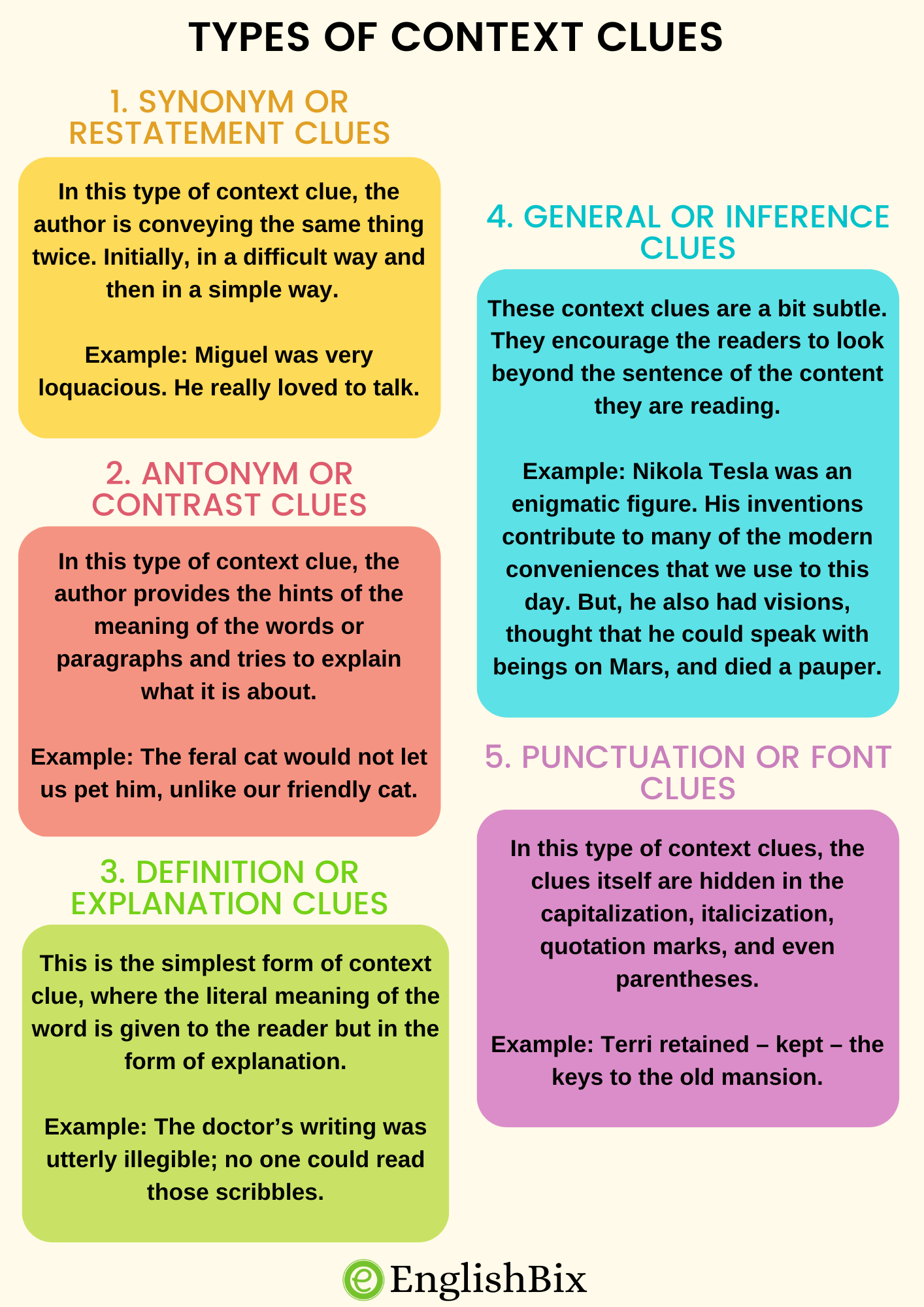
The five useful clue types are:
| Clue type | What to look for | Example |
|---|---|---|
| Restatement | A simpler rewording nearby | “The database was redundant; it stored the same information repeatedly.” |
| Contrast | Words such as but, although, unlike, despite, whereas | “Unlike the volatile cache, the disk retains data after power loss.” |
| Definition | An explicit explanation | “A deadlock, a state in which processes wait indefinitely for one another, can halt progress.” |
| General inference | Overall tone, cause, effect, or situation | “The developer ignored warnings, skipped tests, and deployed unstable code; the decision was reckless.” |
| Punctuation | Dashes, commas, parentheses, or quotation marks | “The file was immutable—it could not be modified after creation.” |
The image’s categories overlap in real questions. A dash may introduce a definition; despite may signal contrast; the overall situation may reinforce both. The point is not to label every clue perfectly. The point is to turn the sentence into constraints.
Before considering options, ask three questions:
-
What part of speech belongs in the blank?
Is the blank asking for a noun, verb, adjective, adverb, or phrase? -
What logical direction does the sentence require?
Is the blank positive, negative, uncertain, contrasting, causal, or emphatic? -
What exact relationship do nearby words establish?
Look especially at contrast markers, repetitions, definitions, and time words.
Consider the official GATE-style item:
Despite his initial hesitation, Rehman’s _________ to contribute to the success of the project never wavered.
The phrase despite his initial hesitation tells us there was doubt at first. The phrase never wavered then demands a noun meaning firm determination. The blank must also be a noun because it follows the possessive form “Rehman’s.”
- Ambivalence means conflicting feelings, which clashes with “never wavered.”
- Satisfaction is a feeling of contentment; it does not fit “to contribute.”
- Resolve means firm determination and satisfies every clue.
- Revolve is a verb meaning to turn around something.
The answer is resolve. Notice that you do not need a dictionary-style definition of every option before reasoning. You need enough meaning to test each option against the sentence’s constraints.
Read two official GATE General Aptitude questions: one sentence-completion item and one word-relationship analogy. They are useful benchmarks for the concise, clue-based reasoning expected in one-mark verbal questions.
On pages 1 and 2, read Q.1 and Q.2. Start at the two questions. For Q.1, identify the grammatical role of the blank and the meaning forced by “never wavered.” For Q.2, state the relationship in words before looking at the answer options.
For context-clue questions, do not choose an option merely because it is a familiar word or a word that “sounds positive.” The correct option must fit the meaning, grammar, and tone of the complete sentence.
Grammar questions: first find the sentence skeleton
Grammar questions become much easier when you stop reading a long sentence as one uninterrupted stream. Instead, locate its structural skeleton:
- the subject of each clause,
- the finite verb that agrees with that subject,
- the connection between clauses,
- and any list that requires parallel structure.
Modifiers and prepositional phrases can make the sentence look complicated without changing its basic structure.
For example:
The list of cache blocks that require replacement is maintained by the controller.
The subject is list, not blocks. The phrase “of cache blocks” merely describes the list. Since list is singular, the verb is is.
Compare:
A number of cache blocks are dirty.
The number of cache blocks is increasing.
In the first sentence, a number of means “many,” so the verb is plural. In the second, the number refers to one count, so the verb is singular. These are exactly the small distinctions that GATE options exploit.
Proofreading for Errors - Purdue OWL
Use this concise Purdue OWL guide to reinforce four grammar checks that matter most for sentence-completion and error-spotting questions: complete clauses, clause joining, agreement, parallelism, and clear pronoun reference.
Read the subsections “Sentence Fragments” and “Run-on Sentences” in the opening section. Follow sentence completeness, then read the run-on checklist beginning clause joining. Next, in “Subject/Verb Agreement,” use the agreement method. In “Parallelism,” read from the parallel-structure guidance. Finally, scan “Pronoun Reference/Agreement,” focusing on why an unclear pronoun can make a sentence ambiguous.
Completeness and clause boundaries
A complete independent clause normally has a subject and a finite verb and can stand by itself.
-
Fragment: “While tracing the recursive calls.”
This gives a condition or time context but no complete statement. -
Complete sentence: “While tracing the recursive calls, the student recorded each stack frame.”
A second frequent error is joining two independent clauses with only a comma:
The packet was corrupted, the receiver discarded it.
Both parts can stand alone. A comma alone is insufficient. Valid repairs include:
The packet was corrupted, so the receiver discarded it.
or:
The packet was corrupted; the receiver discarded it.
In a GATE option, punctuation is not decoration. It signals whether two ideas are grammatically connected.
Agreement: ignore distracting phrases
When checking agreement, mentally cross out phrases between the true subject and verb.
The set of functional dependencies determines the candidate keys.
The noun nearest the verb, dependencies, is plural, but it is not the subject.
Similarly:
Each of the transactions has a unique timestamp.
The subject is each, which is singular.
Parallelism: a list should use one grammatical pattern
Parallel structure means equivalent items should have equivalent forms.
Incorrect:
The algorithm reduces memory usage, improving locality, and it speeds up execution.
The list begins with verbs but ends with a full clause.
Better:
The algorithm reduces memory usage, improves locality, and speeds up execution.
Or:
The algorithm is designed to reduce memory usage, improve locality, and speed up execution.
When an option contains a list, check whether every item answers the same implied question. Here, each item answers “What is the algorithm designed to do?”
Pronouns: identify one clear antecedent
Pronouns such as it, they, this, and which must refer clearly to the intended noun.
Ambiguous:
The compiler informed the programmer that it contained an error.
What contained an error: the compiler, the programmer, or the program? The sentence does not say.
Clear:
The compiler informed the programmer that the source file contained an error.
In verbal questions, ambiguity is often the entire issue. Do not infer a likely meaning if the sentence fails to state one unambiguously.
Sentence completion: satisfy two locks
A good completion must pass two tests:
- The grammar lock: Does the option have the correct form?
- The meaning lock: Does it produce the intended meaning in context?
Many distractors pass one lock but fail the other.
Consider:
If the administrator _________ the configuration error earlier, the outage could have been avoided.
The result clause, “could have been avoided,” describes an unreal past situation. The missing phrase must describe an earlier unreal past action:
If the administrator had detected the configuration error earlier, the outage could have been avoided.
The context provides both the time clue (earlier) and the logical clue (the outage happened, so this is a hypothetical alternative).
A useful minimum set of conditional patterns is:
| Situation | Usual pattern | Example |
|---|---|---|
| Unreal present or future | If + past form; would/could + base verb | “If the server were faster, it would handle more requests.” |
| Unreal past | If + past perfect; would/could have + past participle | “If the server had been faster, it would have handled more requests.” |
Do not apply a remembered rule mechanically. Read the timeline first: did the event happen, is it merely possible, or is it an imagined alternative?
Small grammar clues with large effects
Articles are selected by sound, not simply by the first written letter:
- a university because university begins with a consonant sound: “yoo.”
- an hour because hour begins with a vowel sound.
- a useful technique because useful begins with “yoo.”
Sentence completion also depends on natural word combinations, called collocations. For example, we say:
- “reach a conclusion,” not usually “do a conclusion”;
- “make an assumption,” not “create an assumption” in standard exam usage;
- “conduct an experiment,” not “perform an experiment” in every context.
If two choices are grammatically possible, prefer the one that forms the most natural and precise expression.
Verbal Aptitude (English Grammar) Part 1 | Many GATE PYQs | English Grammar Concepts for GATE
Watch selected portions of GO Classes for GATE CS’s “Verbal Aptitude (English Grammar) Part 1.” The instructor demonstrates how GATE questions use context to test ambiguity, event order, and conditional verb forms.
First watch ambiguity and tense. Focus on how a pronoun can produce two possible readings and how the earlier of two past events is identified. Then watch sentence completion. Focus on the meaning of hypothetical conditions before noticing the corresponding verb pattern. Pause briefly before each explanation and identify the tense clue yourself.
A reliable completion procedure under time pressure is:
- Read the entire sentence without looking at the options.
- Predict the blank’s role: noun, verb form, adjective, adverb, article, or phrase.
- Mark clue words such as although, despite, therefore, earlier, never, and unless.
- Eliminate choices that fail grammar immediately.
- Compare the remaining choices for exact meaning and natural usage.
- Reread the completed sentence once, normally and silently.
That final reread matters. An option may look plausible in isolation but become awkward or contradictory when inserted.
Word relationships: name the relationship before choosing
An analogy asks you to preserve a relationship, not merely find an associated word.
For the official question:
Bird : Nest :: Bee : _______
Do not jump straight to “hive” because you have seen the pair before. First state the relationship:
A nest is the dwelling or shelter associated with a bird.
Then apply the same relationship:
A hive is the dwelling or shelter associated with a bee.
So the answer is hive.
A weak approach is: “Bee and hive are related.” Every answer choice may be related to an animal somehow. A strong approach is: “The second term is the usual dwelling place of the first term.”
Common relationship patterns include:
| Relationship | Example | Question to ask |
|---|---|---|
| Synonym | kind : type | Do both words have nearly the same meaning? |
| Antonym | expand : contract | Do they express opposites? |
| Degree or intensity | walk : jog : sprint | Does intensity increase in a consistent order? |
| Object and location | bird : nest | Where does it live, belong, or occur? |
| Tool and function | compiler : translate | What does it do? |
| Part and whole | page : book | Is one a component of the other? |
| Cause and effect | infection : fever | Does one commonly produce the other? |
| Category and member | graph : tree | Is one a type of the other? |
Direction matters. A tree is a kind of graph, but a graph is not a kind of tree. A compiler translates a program, but a program does not compile a compiler. State the relationship as a complete sentence and test it in both pairs.
For intensity analogies, look for an ordered scale rather than simple synonymy:
walk, jog, sprint
These are all forms of running-related movement, but they differ in speed and exertion. The correct replacement in a parallel analogy must occupy the equivalent position on the second scale: mild, medium, or strong.
For synonym analogies, do not demand perfect interchangeability in every sentence. Words often differ slightly in tone or usage. The exam usually asks for the closest relationship among the options, not philosophical identity.
A compact GATE verbal routine
For one-mark grammar, completion, or analogy questions, aim for a deliberate but short process:
| Question type | First check | Second check | Common trap |
|---|---|---|---|
| Grammar error | Clause skeleton | Agreement, parallelism, pronoun clarity | Matching the verb with the nearest noun |
| Sentence completion | Required word form | Meaning, tone, collocation | Choosing a familiar word that contradicts a clue |
| Word meaning | Contrast or restatement clue | Part of speech and tone | Using only a dictionary association |
| Analogy | Exact relationship and direction | Apply it to all options | Choosing a loosely related word |
Add precise labels to your error log after a verbal set:
- Grammar-skeleton error: missed the true subject, main verb, or clause boundary.
- Form error: selected the wrong tense, article, preposition, or part of speech.
- Context-clue error: overlooked a contrast word, definition, or tone cue.
- Relationship-direction error: recognized an association but reversed or weakened the relation.
- Vocabulary gap: did not know a necessary word even after using context.
- Careless reread error: chose an option without inserting it back into the full sentence.
For revision, do not merely reread the corrected answer. Write one compact note, such as:
“Despite” introduces contrast; “never wavered” requires firmness. Resolve fits as a noun.
Then reattempt the question from memory a few days later. This converts a one-time explanation into a reusable decision rule.
Key takeaways
Grammar, sentence completion, and word relationships are all constraint problems.
- Use restatement, contrast, definition, inference, and punctuation as context clues.
- In grammar questions, identify the subject, finite verb, clause boundaries, parallel items, and pronoun antecedents.
- In sentence completion, an answer must satisfy both grammar and meaning.
- Time words and conditional language reveal the necessary verb form.
- In analogies, state the relationship in a complete sentence before choosing an option.
- Reread the entire sentence after selecting an answer; many errors become visible only in the completed form.
- Record verbal mistakes by cause, not simply as “English weak.”
Next, you will move from sentence-level accuracy to verbal reasoning: identifying assumptions, conclusions, and logically valid inferences in short passages.
Can't find a good explanation? Sign up and we'll make it for you
Sign up