
Good to see you again. In the previous lesson, you treated a sentence as a set of constraints: grammar, contrast words, and context narrow the possible answer. Verbal reasoning uses the same discipline at the passage level. Instead of asking “Which option sounds sensible?”, ask: What is stated? What is being claimed? What unstated link is required? What follows with certainty?
This final lesson in the General Aptitude module builds a compact method for arguments and inference questions. It is especially useful for avoiding negative marking: many wrong options are plausible, related, or even true in real life, but they do not follow from the given passage.
First separate the jobs performed by statements
A short reasoning passage can contain four different kinds of claims.
| Role | Function in the passage | Useful question |
|---|---|---|
| Background | Sets the scene but does not support the reasoning | “Could this sentence be removed without changing the argument?” |
| Premise / support | Evidence offered for another claim | “What is this trying to establish?” |
| Conclusion | The claim the author wants you to accept | “What is the author’s point?” |
| Assumption | An unstated claim required to connect support and conclusion | “What must be true for this reasoning to work?” |
Consider this passage:
The department found that students who reattempted questions from their error logs scored better in later topic tests. Therefore, the department should schedule regular error-log reattempts. The online platform already stores each student’s incorrect responses.
Its structure is:
- Support: Students who reattempted error-log questions later scored better.
- Main conclusion: The department should schedule regular error-log reattempts.
- Additional support or feasibility information: The platform stores incorrect responses.
The conclusion is not necessarily the last sentence. Nor is it automatically true just because the author states it. It is the claim being argued for.
A useful diagnostic is the because test:
The department should schedule regular error-log reattempts because students who reattempted questions later scored better.
That sounds like an argument. Reversing it does not:
Students later scored better because the department should schedule reattempts.
The first statement is the conclusion; the second is evidence offered for it.
Finding the main conclusion, not merely a related claim
Words such as therefore, hence, thus, so, and consequently often introduce conclusions. Words such as because, since, and given that often introduce support. These are useful clues, but do not rely on them blindly. An author can state the conclusion first, last, or in the middle.
The more reliable question is:
Which claim is supported by the rest of the passage, but is not itself used to support a further claim?
Sometimes an argument has an intermediate conclusion. It is supported by earlier premises, but then becomes support for the main conclusion.
For example:
Naturally green flowers are rare. Thus, breeding green carnations is difficult. Therefore, florists should stock white carnations that can be dyed green.
“Breeding green carnations is difficult” is a conclusion from the first statement, but it is not the main conclusion. It supports the recommendation that florists stock white carnations.
Identify the conclusion | Learn more (article) | Khan Academy
Read Khan Academy’s “Identify the conclusion” for a precise distinction between support, background, main conclusions, and intermediate conclusions. Its Apatosaurus example is useful because several answer choices are relevant to the passage, but only one states the author’s actual point.
In the opening section, “How do we identify the main conclusion of an argument?”, read the definitions under “The basics.” Then, in the section beginning with the Apatosaurus example, read the explanation of the main conclusion. Focus on the instruction to paraphrase the argument’s overall point before looking closely at answer choices, and on the distinction between a premise and a conditional restatement of a conclusion.
A conclusion-identification routine
For a GATE-style passage, use this sequence:
- Read the whole passage once. Do not evaluate truth from general knowledge.
- State the author’s point in 5–10 words. For example: “Regular reattempts should be scheduled.”
- Locate the reasons offered for that point.
- Reject choices that merely repeat a premise, add a stronger claim, or state a side fact.
- Preserve the author’s strength. If the passage says probably, an option saying certainly is too strong.
That last rule matters. These claims are not equivalent:
- “The policy may reduce errors.”
- “The policy will reduce errors.”
- “The policy will eliminate errors.”
Each makes a stronger commitment than the previous one.
Assumptions: locate the missing bridge
An assumption is not just any unstated idea that seems related. In argument questions, the important kind is a necessary assumption: a claim that must hold for the stated evidence to justify the conclusion.
Return to the error-log passage:
Students who reattempted questions from their error logs scored better in later topic tests. Therefore, the department should schedule regular error-log reattempts.
There is a jump from an observed association to a recommendation. One necessary bridge is approximately:
The higher later scores were not entirely due to those students already being more prepared, motivated, or otherwise different from students who did not reattempt.
Why is this needed? If the reattempting students would have scored better anyway, then the observation no longer supports scheduling reattempts as the cause of improvement.
Notice the wording. A necessary assumption need not prove that reattempting is the only cause of improvement. It only needs to prevent an alternative explanation from destroying the argument.
Necessary versus sufficient
This distinction prevents a common error.
- A necessary condition must be present for the argument to survive.
- A sufficient condition would guarantee the conclusion.
For the recommendation above:
- “Regular reattempts improve performance for at least some comparable students” is close to a necessary bridge.
- “Every student who reattempts will score at least 20 marks higher” would be far stronger than necessary.
In answer options, distractors are often too strong. Be suspicious of unnecessary words such as all, only, always, never, and guaranteed. They are not automatically wrong, but the passage must demand that degree of strength.
Necessary assumptions | Learn more (article) | Khan Academy
Read Khan Academy’s “Necessary assumptions” to practise identifying the gap between evidence and conclusion and using the negation test carefully. The examples are longer than typical GATE General Aptitude items, but the reasoning method transfers directly.
In “How do we identify a necessary assumption?”, begin with the rocket-fuel analogy, then read the distinction between necessary and sufficient assumptions. Next, in “Mind the gap,” follow the educator example: identify the conclusion, list its support, and ask what alternative explanation would break the reasoning. Finally, under “Test choices by negating,” read the negation-test procedure. Use negation only after narrowing the options; it is a verification method, not a shortcut to apply mechanically to every choice.
The negation test
To test whether a candidate assumption is necessary:
- State the option clearly.
- Assume it is false.
- Ask whether the argument loses its support.
If the argument collapses, the option is necessary. If the argument remains intact, becomes stronger, or merely changes slightly, the option is not necessary.
For example:
Argument: “Most students have already chosen an answer before seeing the explanatory solution. Therefore, showing the solution immediately will rarely change their answer.”
A likely assumption is:
Students rarely change an answer once they have chosen it.
Negate it:
Students often change an answer once they have chosen it.
Now the conclusion is seriously undermined: immediate solutions might indeed change many answers. So the original assumption is necessary.
Be precise when negating quantifiers:
| Original statement | Safe negation |
|---|---|
| All students reattempt | Not all students reattempt |
| Some students reattempt | No students reattempt |
| Most students reattempt | Not most students reattempt |
| The method always works | The method does not always work |
The negation of “all” is not “none.” One counterexample is enough to make “all” false.
Valid inferences: what must follow from the information?
A valid inference is different from an author’s conclusion.
- An argument conclusion is what an author tries to establish. The support may be weak.
- A valid inference is a claim that cannot be false if the given statements are true.
In a “must be true” question, treat every statement in the passage as true for the purpose of the question. Do not import outside knowledge, personal experience, or a likely real-world explanation.
Conditional logic
Conditional statements are a major source of careless errors.
If a candidate is selected for the national team, then the candidate has a qualifying score.
Let:
- : selected for the national team
- : has a qualifying score
Two inference patterns are valid:
- Affirming the antecedent: is true, so must be true.
- Contrapositive: is false, so must be false.
Two tempting patterns are invalid:
- Affirming the consequent: is true, therefore is true.
- Denying the antecedent: is false, therefore is false.
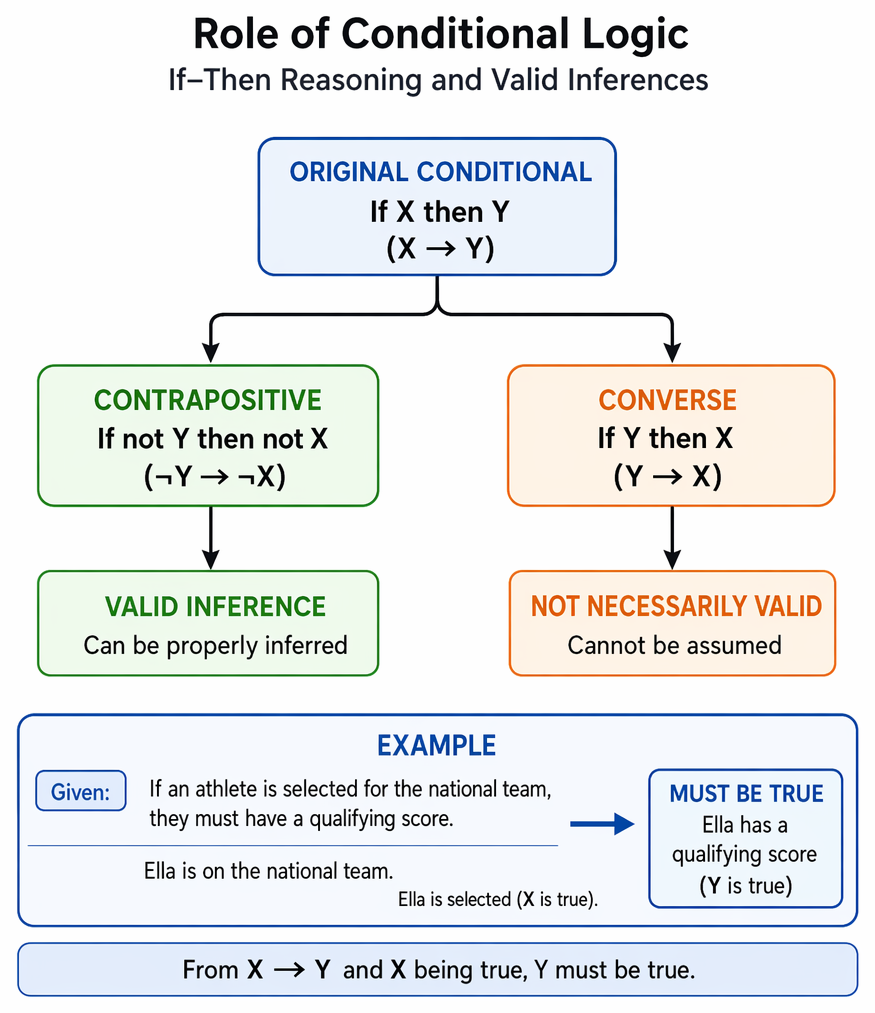
A qualifying score may be necessary for national-team selection, but it may not be sufficient. Many athletes could have qualifying scores without being selected.
Apply the same logic to GATE-style statements:
If a transaction holds an exclusive lock, then it may write the data item.
Transaction may write the data item.
You cannot conclude that holds an exclusive lock. The transaction might have permission for another stated reason. This is the invalid converse.
Quantifiers and direction
Pay close attention to all, some, none, only, and most.
All B+ trees are balanced search trees.
Index is a B+ tree.
It follows that is balanced.
But this does not follow:
Index is balanced. Therefore, is a B+ tree.
Other balanced search trees may exist.
Similarly:
Some students solve graph questions quickly.
You cannot infer:
All students solve graph questions quickly.
Nor can you infer that a particular named student does.
A valid inference preserves both the direction and the strength of the original statement.
One workflow for three question types
Before evaluating answer choices, classify the question stem.
| Stem asks for… | Your task | Core test |
|---|---|---|
| Conclusion | Find the author’s main claim | “What is the passage trying to prove?” |
| Assumption | Find the required unstated bridge | “If this were false, would the argument collapse?” |
| Must be true / follows logically | Find a logically entailed claim | “Can this be false while every given statement remains true?” |
Use this compact scratch structure:
For an inference question, replace “Gap” with:
This is deliberately similar to tracing a program: do not jump from an input condition to an output unless the stated rule permits that transition. In verbal reasoning, the most common “bug” is reversing a condition or silently adding an unstated premise.
Common distractors
When two options seem plausible, identify their error type.
- Premise repetition: True statement from the passage, but not its conclusion.
- Strengthened conclusion: Changes may to will, some to all, or likely to certain.
- Necessary versus sufficient confusion: Treats one required condition as a guarantee.
- Converse error: Reverses an “if” statement.
- Outside-knowledge option: Sounds true in real life but is unsupported by the passage.
- Relevant but unnecessary assumption: Would strengthen the argument, but the argument could survive without it.
For your error log, record the logical cause rather than writing “verbal mistake.” Useful labels are:
- Conclusion/support reversal
- Intermediate conclusion mistaken for main conclusion
- Missing-bridge error
- Negation-test error
- Converse error
- Quantifier or strength error
- Outside-knowledge error
A short revision note might be:
“If , then : does not prove . Check contrapositive, not converse.”
That note is more reusable than simply rereading the correct option.
Key takeaways
Short verbal-reasoning passages become manageable when you assign each statement a role.
- A conclusion is the claim the author is trying to establish; support is offered for it.
- An intermediate conclusion is both supported by earlier claims and used to support a later claim.
- A necessary assumption is an unstated bridge without which the evidence no longer supports the conclusion.
- Use the negation test to verify a close assumption choice.
- A valid inference must follow with certainty from the given statements, not merely sound plausible.
- In conditionals, use the original direction or the contrapositive; do not assume the converse.
- Preserve qualifiers such as some, most, probably, and may exactly.
This completes the General Aptitude module. Next, you will begin Engineering Mathematics with systems of linear equations, Gaussian elimination, and matrix rank—another area where disciplined step-by-step reasoning prevents both concept errors and careless mistakes.
Can't find a good explanation? Sign up and we'll make it for you
Sign up