
Hello again. In the last lesson, you learned to expose an argument’s structure: premises are the reasons offered, and the conclusion is the claim those reasons are meant to support. Now comes the next question: how strongly do the premises support that conclusion?
This distinction matters whenever you are making sense of an investigation, a safety decision, a public claim, or an engineering fault report. Some arguments claim that their conclusion is unavoidable if the premises hold. Others make the more realistic claim that the conclusion is likely. By the end of this lesson, you will be able to distinguish deductive validity from inductive strength, and evaluate each using the right test.
Two kinds of support: necessity and probability
Arguments can support conclusions in two fundamentally different ways.
A deductive argument aims to establish its conclusion with necessity. If its premises were true, the conclusion could not be false. We call such an argument valid.
An inductive argument aims to make its conclusion probable. Even if all its premises are true, the conclusion could still turn out false; the issue is whether that would be unlikely. We call such an argument strong when the evidence makes the conclusion highly probable.
Here is the central contrast:
| Kind of argument | What the premises aim to provide | Correct evaluation |
|---|---|---|
| Deductive | A guarantee, assuming the premises are true | Valid or invalid |
| Inductive | Good probabilistic evidence, assuming the premises are true | Strong or weak |
The words assuming the premises are true are doing important work. At this stage, you are evaluating the connection between premises and conclusion, not yet deciding whether the premises are factually accurate.
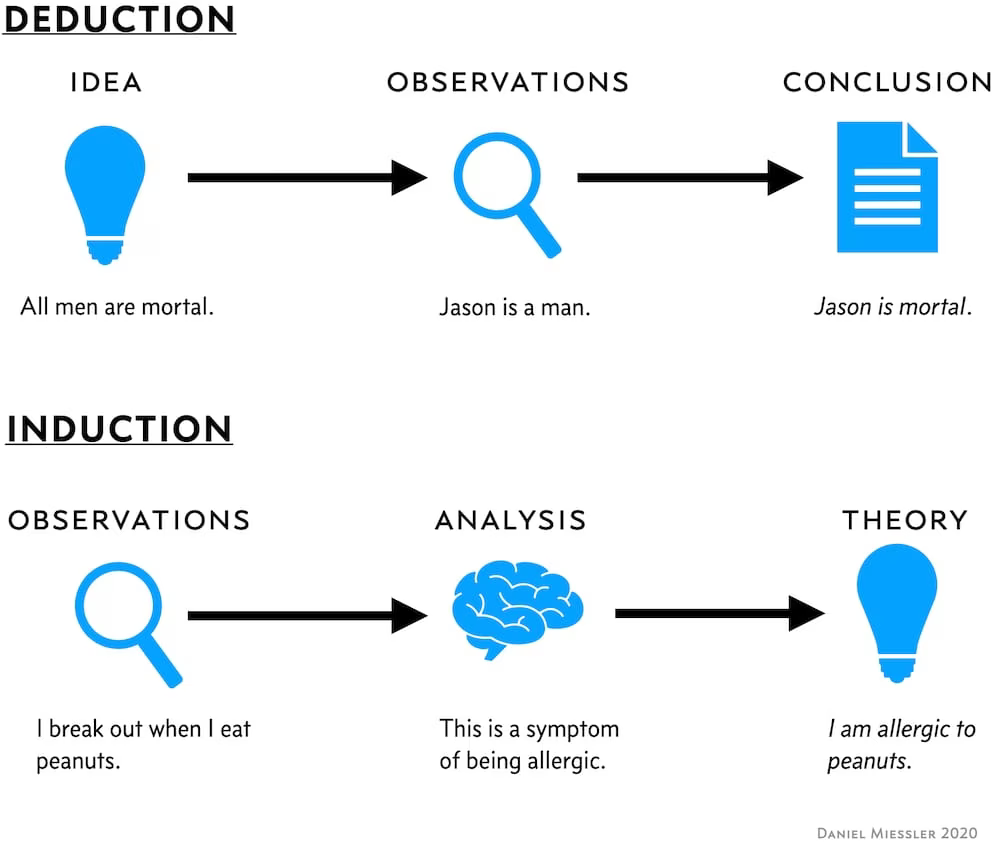
The graphic is a useful first picture, but do not treat “general to specific” as the definition of deduction, or “specific to general” as the definition of induction. What matters is the type of support:
- If true premises would force the conclusion to be true, the reasoning is deductive.
- If true premises would make the conclusion likely but leave room for error, the reasoning is inductive.
For example:
All emergency exit doors must remain unlocked while a building is occupied.
Door C is an emergency exit door in an occupied building.
Therefore, Door C must remain unlocked.
This is deductive in form. If the premises are true, the conclusion has to be true.
Now compare:
In the last six months, most reported bike thefts in this area occurred after dark.
Therefore, a bike left unsecured here tonight is more likely to be stolen than one left here during the day.
This is inductive. The reported pattern gives a reason for concern, but it does not guarantee what will happen to one particular bike tonight.
Deductive vs Inductive Reasoning FLOW CHART | Valid, Sound, Strong, & Cogent
Watch “Deductive vs Inductive Reasoning FLOW CHART | Valid, Sound, Strong, & Cogent” from Let’s Get Logical. It gives a compact visual account of the distinction and then applies the proper test to each kind of argument.
Watch the two aims to anchor the difference between certainty and probability. Then watch validity testing and strength testing. Finish with truth and soundness for the separate question of whether the premises are actually true. Notice that the presenter temporarily grants the premises in each example before judging the reasoning.
Deductive validity: can the conclusion be false?
The practical test for a deductive argument is:
Imagine that every premise is true. Is there any possible situation in which the conclusion is false?
- If no, the argument is valid.
- If yes, it is invalid.
Consider a simple equipment check:
- If a radio battery is fully depleted, the radio cannot transmit.
- This radio battery is fully depleted.
- Therefore, this radio cannot transmit.
If premises 1 and 2 are true, conclusion 3 cannot be false. The argument is valid.
Notice that this does not tell us whether the battery really is depleted. A technician might have misread the charge indicator. Validity only says: given those premises, the conclusion follows correctly.
Validity is not the same as truth
An argument can be valid even if its premises are false:
- All patrol vehicles can fly.
- Vehicle 12 is a patrol vehicle.
- Therefore, Vehicle 12 can fly.
The reasoning pattern is valid. If the premises were true, the conclusion would have to be true. But because the first premise is false, this is not a good real-world argument.
An argument can also have a true conclusion but still be invalid:
- All steel beams are metal.
- This bridge contains steel beams.
- Therefore, this bridge is safe.
The conclusion might happen to be true. But it does not follow necessarily from the premises. A bridge can contain steel beams and still be unsafe because of corrosion, design errors, overload, damaged joints, or poor foundations.
A useful way to expose invalidity is to construct a counterexample: a scenario where the premises are true and the conclusion is false.
Consider:
- If the intrusion alarm is triggered, the control panel displays an alert.
- The control panel displays an alert.
- Therefore, the intrusion alarm was triggered.
This is invalid. The panel could display an alert because of a system test, a sensor fault, or a fire alarm connection. Those alternatives are counterexamples: they preserve the premises but make the conclusion false.
The reasoning has treated one possible cause as if it were the only possible cause. That can be a serious error in investigation and fault-finding.
1.2 Validity, Soundness, Strength, Cogency - Manifold @CUNY
Read the selected parts of “Validity, Soundness, Strength, Cogency” from Manifold at CUNY. The reading reinforces the conditional nature of validity and shows why true statements alone do not make an argument valid.
In the section “Validity and Soundness,” begin at the definition of validity. Read the validity discussion, including the examples with strange premises. Focus on the question: could all the premises be true while the conclusion is false? Then move to “Strength and Cogency.” Starting with the contrast between the two standards, read the inductive parallel. Pay attention to the point that a strong inductive argument can still lead to a false conclusion, even when its premises are true.
Inductive strength: how likely is the conclusion?
Inductive reasoning is the normal mode of reasoning when dealing with incomplete information. You see patterns, assess evidence, compare explanations, and reach a conclusion that is justified but not guaranteed.
The practical test is:
Assume the premises are true. Do they make the conclusion likely?
- If they make it highly likely, the argument is inductively strong.
- If they give little reason to expect the conclusion, it is weak.
Consider this quality-control argument:
- A random sample of 200 batteries from a shipment was tested under the required load.
- Forty batteries in that sample failed the test.
- Therefore, other batteries in the shipment are likely to have a substantial defect rate.
This is potentially strong inductive reasoning. The sample is reasonably large, comes from the relevant shipment, and was tested under conditions connected to the conclusion. Still, the conclusion is not certain: the untested batteries might differ from the sample by chance.
Now reduce the evidence:
- Two batteries from a shipment failed.
- Therefore, the entire shipment is defective.
This is much weaker. The two failed batteries may have been damaged during transport, selected because they already looked faulty, or simply be unusual cases. The conclusion goes beyond what the evidence can reasonably support.
What usually makes an inductive argument stronger?
There is no single magic number of observations. Strength depends on whether the evidence is fit for the conclusion. Four questions are especially useful:
-
Is the evidence relevant?
Does it genuinely bear on the conclusion? A person’s clothing, reputation, or unrelated past behaviour is usually weak evidence for what happened in a specific incident. -
Is there enough evidence?
Two examples rarely justify a sweeping claim about thousands of cases. More evidence can help, though quantity alone is not enough. -
Is the evidence representative?
A sample should resemble the wider group the conclusion concerns. A survey of one social-media page does not establish what the public as a whole thinks. -
Are there plausible alternative explanations?
If several explanations fit the same evidence, confidence in one explanation should be lower. A wet pavement may result from rain, cleaning, a burst pipe, or a leaking vehicle.
This is why real investigation is not about producing a dramatic single clue. It is about assembling relevant, reliable evidence and checking whether alternative accounts survive.
Strong does not mean certain
Suppose weather records show that a route has been ice-free every winter morning for ten years, and the forecast, temperature, and road-treatment record all indicate safe conditions tomorrow. It may be highly reasonable to conclude that the route will probably be ice-free tomorrow.
But a local water leak could still freeze overnight. Induction allows for that possibility. Its standard is not “impossible to be wrong”; it is “well supported by the available evidence.”
For practical decisions, the stakes matter too. A strong inductive case may justify carrying an umbrella. It may not justify entering a structurally questionable building without further inspection. The required level of evidence should rise with the seriousness and irreversibility of the potential harm.
Keep the evaluations separate
A reliable thinker makes two passes over an argument.
First pass: assess the reasoning conditionally
Temporarily accept the premises and ask what they support.
| If the argument is intended as… | Ask… | Possible result |
|---|---|---|
| Deductive | Must the conclusion be true if the premises are true? | Valid or invalid |
| Inductive | Is the conclusion likely if the premises are true? | Strong or weak |
Second pass: assess the premises in the real world
Only after examining the support should you ask whether the premises are accurate, complete, current, and fairly interpreted.
Two additional terms name arguments that succeed on both passes:
| Argument type | Logically successful | Plus true premises | Full evaluation |
|---|---|---|---|
| Deductive | Valid | Premises are actually true | Sound |
| Inductive | Strong | Premises are actually true | Cogent |
A sound argument is valid and based on true premises. A cogent argument is inductively strong and based on true premises.
The distinction is useful, but do not let the vocabulary distract from the core method. When reading a claim, first identify the conclusion and premises, as you did last lesson. Then decide whether the argument promises necessity or probability. Finally, apply the appropriate test.
A compact field checklist is:
- What exactly is the conclusion?
- What premises are being offered?
- Is the conclusion meant to be guaranteed or merely probable?
- Could the premises be true while the conclusion is false? If so, a deductive argument is invalid.
- If the premises are true, do they make the conclusion genuinely likely? If so, an inductive argument may be strong.
- Are the premises actually trustworthy? That is a separate evidence question.
Key takeaways
Deductive and inductive arguments are not competitors; they do different jobs.
- Deductive validity means that true premises make the conclusion unavoidable.
- Inductive strength means that true premises make the conclusion highly probable, not guaranteed.
- To test validity, look for a possible case where the premises are true but the conclusion is false.
- To test inductive strength, assess whether the evidence is relevant, sufficient, representative, and resistant to alternative explanations.
- Truth and logical support are separate. A valid argument can rest on false premises, and a strong inductive argument can occasionally reach a false conclusion.
- Soundness means valid reasoning plus true premises; cogency means strong inductive reasoning plus true premises.
Next, you will build on this evaluation skill by learning to recognise common informal fallacies: persuasive-looking patterns of reasoning that fail to provide the support they appear to offer.
Can't find a good explanation? Sign up and we'll make it for you
Sign up