
Hello again. Previously, you separated premises from conclusions and learned that deductive arguments are evaluated for validity, while inductive arguments are evaluated for strength. That gives you a reliable starting point for this lesson: before naming a fallacy, identify what conclusion is being pushed and what reasons are supposed to support it.
Now you will learn to recognise several common informal fallacies: recurring reasoning errors in ordinary language. They show up in headlines, comment sections, adverts, debates, workplace conversations, and public-policy arguments. The aim is not to become someone who fires fallacy labels at every disagreement. It is to spot when a claim has not earned the confidence its presentation demands—and to replace the weak move with a better question.
What a fallacy is—and is not
An informal fallacy is a defect in reasoning that weakens the support for a conclusion. Unlike a formal logical error, it usually cannot be detected from a bare logical pattern alone. Context matters: what words mean, what evidence is available, whether a comparison is relevant, and whether important alternatives have been ignored.
A fallacy can be:
- Accidental: someone reasons too quickly, uses an unclear word, or relies on a memorable personal experience.
- Deliberate: someone distracts an audience, exaggerates an opponent’s view, or exploits fear and group loyalty.
- Persuasive: confidence, repetition, anger, humour, or a familiar speaker can make poor reasoning feel convincing.
Most importantly, a fallacious argument does not prove that its conclusion is false. It only shows that this particular argument has not adequately established the conclusion.
For example:
“This building must be unsafe because the person warning us is an arrogant idiot.”
That is an attack on a person rather than evidence about the building. The building might indeed be unsafe—but the insult does not establish it. A proper response would ask for inspection results, damage reports, maintenance records, or other relevant evidence.
This distinction prevents the fallacy fallacy: assuming that because someone argued badly for a claim, the opposite claim must be true.
19 Common Fallacies, Explained.
Watch 19 Common Fallacies, Explained from Jared Henderson for a compact orientation to the most useful patterns in this lesson. The opening caution is worth taking seriously: fallacies can be difficult to diagnose in real disputes, so treat them as tools for checking reasoning, not as debate-winning labels.
Watch the introduction first. Then continue through common patterns, focusing on the difference between attacking a person, misrepresenting a position, excluding alternatives, shifting word meanings, and reasoning in a circle. Finish with causation and popularity, noting that time order and popular belief do not by themselves prove a claim.
A practical method will keep the labels connected to real reasoning:
- State the conclusion precisely. What are you being asked to believe, do, or reject?
- Identify the offered reason. What evidence or consideration is meant to support that conclusion?
- Test the connection. Is the reason relevant and sufficient?
- Look for what is missing. Alternatives, definitions, evidence, or an accurate version of an opposing view may have been left out.
- Restate the issue fairly. A good critique says what would be needed to support the conclusion better.
Fallacies of evidence: too little, too fast, or the wrong kind
Hasty generalisation
A hasty generalisation draws a broad conclusion about a group from a sample that is too small, unusual, or unrepresentative.
“Two people on my street had their bicycles stolen this month. This whole town is unsafe.”
The thefts matter. But two incidents alone do not justify a conclusion about an entire town. The events might be concentrated in one location, involve unsecured bicycles, reflect a short-term spike, or be part of a larger pattern. We do not yet know.
Watch for language such as “all,” “none,” “everyone,” “always,” “never,” “they’re all like that,” and “I saw it myself.” Strong universal claims require unusually strong evidence.
A better conclusion matches the evidence:
“Two recent thefts on this street may indicate a local risk. We should check whether reports show a wider pattern.”
False cause
The false cause fallacy treats one event as the cause of another without enough evidence for that causal link. A common version is post hoc: “after this, therefore because of this.”
“A new patrol plan started in April. Reported burglaries fell in May. The patrol plan caused the reduction.”
The timing may justify investigation, but it does not prove causation. Seasonal changes, reporting practices, a concurrent security initiative, chance variation, or displacement to another area could also matter.
To assess a causal claim, ask:
- Is there a plausible mechanism by which the proposed cause could produce the effect?
- Did other relevant conditions change at the same time?
- Is the pattern repeated over time or across comparable places?
- Could the apparent relationship run in the opposite direction?
Later in the course, you will examine correlation and causation in more detail. For now, the key habit is simple: sequence is not proof of cause.
Weak analogy
Arguments by analogy can be useful. They say that because two cases are alike in relevant respects, what is true of one may also be true of the other. A weak analogy relies on similarities that do not matter to the conclusion.
“A high-visibility jacket is safety equipment, and so is a body-worn camera. High-visibility jackets never need charging, so body-worn cameras should not need charging either.”
Both are used in safety-related work, but the relevant engineering properties are different. A camera contains electronics, storage, and a power supply; a jacket does not. The comparison does not support the conclusion.
The test is not “Are these things identical?” It is: Do they share the features that matter for this conclusion?
Fallacies – The Writing Center
Read the University of North Carolina Writing Center’s guide, Fallacies, for clear definitions, examples, and practical repair strategies. It will reinforce the difference between a claim that needs more evidence and an argument whose evidence is simply not relevant.
Begin in “What are fallacies?” and read the opening explanation. Then, in “So what do fallacies look like?”, read the subsections “Hasty generalization,” “Post hoc (also called false cause),” and “Weak analogy.” In “Hasty generalization,” follow the full example and repair. For each fallacy, identify the conclusion that exceeds the evidence and notice how the suggested fix narrows the claim or adds the missing support.
Fallacies that substitute people or popularity for evidence
Arguments should be judged by their reasons and evidence. Information about a speaker can sometimes matter—for example, a financial conflict of interest may be relevant when assessing credibility. But it does not automatically settle whether the speaker’s claim is true.
Ad hominem and tu quoque
An ad hominem attacks the person presenting a claim rather than addressing the claim itself.
“Ignore her recommendation to replace the faulty wiring. She is always trying to sound clever.”
Whether she is annoying, popular, or unpleasant has no bearing on the wiring’s condition. Examine the inspection, the design specifications, and the safety standards instead.
A common subtype is tu quoque, meaning “you too”:
“You say I should wear a helmet, but you did not wear one when you were younger.”
The speaker may be hypocritical, but inconsistency does not show that helmets are ineffective or that wearing one is unwise.
A useful response is:
“The speaker’s conduct may be worth discussing separately. What is the evidence for the claim?”
Appeal to authority
An appeal to authority treats a person’s status as sufficient proof. Expertise is not irrelevant: in practice, we often reasonably rely on qualified specialists. The fallacy occurs when someone uses a name, title, or celebrity reputation in place of relevant evidence.
“A famous athlete says this supplement improves reaction time, so it works.”
An athlete may know about training experience, but that alone does not establish the supplement’s effects, risks, dose, or performance under controlled testing.
When assessing an authority, ask:
- Is this person qualified in the relevant field?
- Are they giving reasons or citing evidence that can be checked?
- Do other credible experts and sources broadly corroborate the claim?
- Could bias, incentives, or limited information affect their judgement?
This connects directly to the next lesson’s source-evaluation skills.
Bandwagon or appeal to popularity
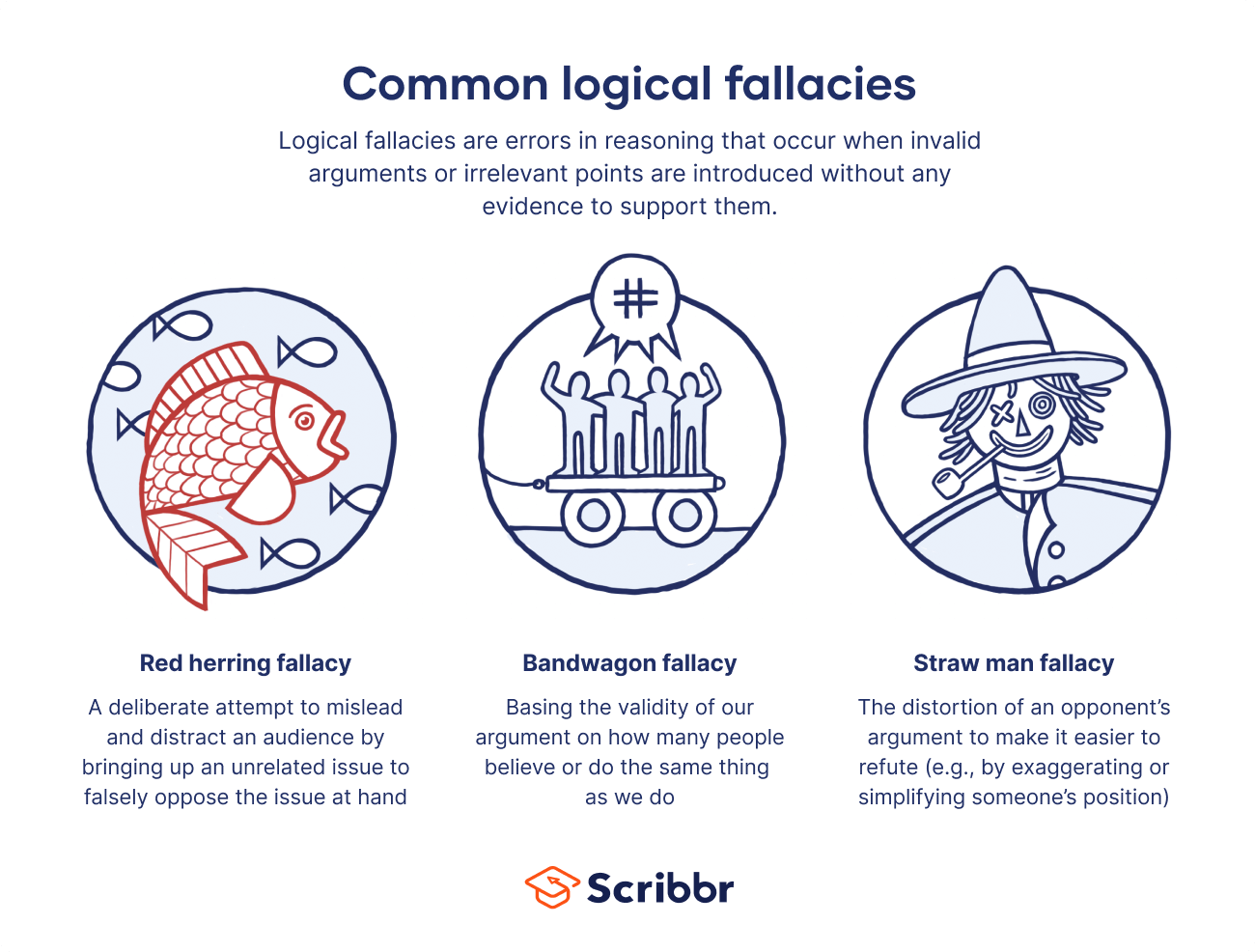
The bandwagon fallacy—also called ad populum or appeal to popularity—claims that a belief or action is correct because many people accept it.
“Everybody in the group chat says this video proves the incident was staged, so it must be true.”
The number of people repeating a claim may show that it is widespread, not that it is accurate. A crowd can be relying on the same misleading clip, incomplete account, or confident but unreliable source.
There is one important nuance: popularity can be relevant to some questions. If the question is “Which name will be most recognisable?” a survey of recognition is directly relevant. But if the question is “Is this claim true?” popularity is not enough.
Fallacies of distraction and distortion
These fallacies are especially common in arguments where people feel defensive, loyal to a side, or eager to score a rhetorical point.
Straw man
A straw man fallacy misrepresents, exaggerates, or oversimplifies someone’s actual position, then attacks the weaker substitute.
Person A: “The council should add better lighting and secure cycle storage near the station.”
Person B: “So you want to waste the entire budget on cyclists and ignore everyone else.”
Person B has not answered the real proposal. Adding lighting and storage does not imply spending the entire budget or ignoring other needs.
To check for a straw man, compare the response with the original claim:
- What did the person actually propose?
- What version is being criticised?
- What additions, exaggerations, or omissions changed the proposal?
The antidote is sometimes called steel-manning: state the strongest fair version of the other position before criticising it. You may still reject the proposal—but you should reject the proposal that was actually made.
Red herring
A red herring introduces an irrelevant issue that pulls attention away from the question that needs answering.
“Why should we investigate whether the contractor followed fire-safety requirements? They have created hundreds of local jobs.”
Local employment may be valuable, but it does not answer whether the safety requirements were followed. The argument has changed the subject.
A red herring can feel persuasive because the new issue is emotionally powerful or genuinely important. The critical question is not “Is this new point important in general?” but “Does it support this conclusion?”
False dilemma
A false dilemma presents only two options when there are more.
“Either we install surveillance cameras everywhere, or we do nothing about public safety.”
The statement omits many possibilities: improved lighting, trained staff, targeted patrols, secure design, community reporting, narrowly placed cameras with safeguards, or a combination of measures.
The existence of the word “either” does not automatically make an argument fallacious. Sometimes there truly are only two available options. The problem is claiming that a choice is exhaustive without showing that the other alternatives are impossible, unacceptable, or irrelevant.
Fallacies hidden in language and assumptions
Begging the question
Begging the question is circular reasoning: the conclusion is assumed in a premise, often restated in different words.
“This security policy is justified because it is the right policy to use.”
The premise gives no independent reason. Saying “justified” and “right” merely repeats the conclusion.
A more subtle form hides a disputed assumption:
“The suspect should be punished because criminals deserve punishment.”
This only works if the person is already established to be a criminal in the relevant sense. If that is precisely what is contested, the argument has assumed the point it needs to prove.
To diagnose circularity, ask:
“If I doubt the conclusion, do the premises give me a reason to change my mind—or do they just restate it?”
Equivocation
Equivocation shifts the meaning of an important word during an argument.
“The public has a right to feel safe. Therefore, the public has a right to any measure that makes people feel safe.”
The word “right” shifts from a legitimate interest or entitlement to safety into an unlimited entitlement to any chosen policy. Those are not the same claim.
Words that deserve extra scrutiny include:
- “safe”
- “freedom”
- “fair”
- “reasonable”
- “natural”
- “right”
- “proof”
- “risk”
These words often have several meanings. Good arguments define their key terms and keep those meanings stable.
Fallacies – The Writing Center
Return to Fallacies for the patterns most likely to appear in public debate: attacks on people, distorted positions, distractions, false choices, circular claims, and shifting language.
In “So what do fallacies look like?”, read the subsections “Appeal to authority,” “Ad populum,” “Ad hominem and tu quoque,” “Straw man,” “Red herring,” “False dichotomy,” “Begging the question,” and “Equivocation.” Give special attention to the straw man discussion and the false dichotomy discussion. Finish in “So how do I find fallacies in my own writing?” with the self audit checklist, turning each tip into a question you can use when evaluating public claims.
A field method: identify, explain, improve
Naming the fallacy is less important than explaining the defect. A strong short critique has three parts:
| Step | What to do | Example response |
|---|---|---|
| Identify | Name the pattern, if useful | “This appears to be a false dilemma.” |
| Explain | Show exactly why the reason does not support the conclusion | “It assumes there are only two safety options and ignores targeted measures.” |
| Improve | State what evidence or reasoning would be needed | “Compare feasible alternatives, their costs, effectiveness, and privacy effects.” |
For any public claim, run this compact scan:
- Evidence: Is the sample adequate and representative, or is this a hasty generalisation?
- Causation: Has a cause been shown, or have events merely occurred together or in sequence?
- Relevance: Is the argument addressing the claim, or attacking a person, invoking popularity, or changing the subject?
- Fairness: Has an opponent’s actual position been represented accurately?
- Options: Are the stated choices really exhaustive?
- Assumptions and language: Is the conclusion being assumed, or has a key word changed meaning?
Use the fallacy label with humility. Sometimes an apparent red herring is a genuinely relevant consideration that has not been explained. Sometimes criticism of a source is legitimate because credibility is the issue. Sometimes there really are only two options. Your task is to make the missing reasoning visible, not to treat a label as a substitute for reasoning.
Key takeaways
Informal fallacies are persuasive-looking patterns that fail to provide the support they appear to offer.
- Hasty generalisation reaches too far from too little or unrepresentative evidence.
- False cause mistakes sequence or correlation for evidence of causation.
- Ad hominem, appeal to authority, and bandwagon substitute characteristics of people or groups for evidence.
- Straw man distorts an opposing view; red herring distracts from the real issue.
- False dilemma wrongly limits the available choices.
- Begging the question assumes the conclusion; equivocation shifts a key term’s meaning.
- A fallacious argument does not automatically make its conclusion false. It means the conclusion needs better support.
Next, you will move from evaluating the argument itself to evaluating its inputs: how to assess a source’s authority, evidence, currency, purpose, and corroboration.
Can't find a good explanation? Sign up and we'll make it for you
Sign up