
Hello again. Last lesson separated observations, interpretations, assumptions, and conclusions. That discipline is the foundation for this one: once you know what claim someone has made, you can ask whether they have actually given reasons for it.
In logic, an argument is not a quarrel. It is a set of claims in which one claim is supported by others. This lesson gives you a practical method for finding the premises and the conclusion inside everyday speech, headlines, public debates, and fictional detective-style reasoning. You will not yet be judging whether the reasoning is strong; first, you need to see its structure clearly.
An argument is a support structure
An argument contains:
- a conclusion: the main claim the speaker wants you to accept;
- one or more premises: the reasons offered in support of that claim.
In its clearest, stripped-down form:
| Role | Claim |
|---|---|
| Premise 1 | The building’s smoke alarm is sounding. |
| Premise 2 | There is a visible haze in the corridor. |
| Conclusion | The building should be evacuated while the situation is checked. |
The conclusion is not necessarily the last sentence spoken, and premises are not automatically true. “Premise” names the job a claim is doing in the reasoning: it is being offered as support. Later, critical thinking asks whether that support is sufficient and reliable.
The key diagnostic question is:
What is this person trying to persuade me to believe, do, or accept?
That is usually the conclusion. Then ask:
What reasons are they offering for it?
Those are the premises.
Identifying Premises and Conclusions
Watch Identifying Premises and Conclusions by Kevin deLaplante. It shows how natural-language arguments hide a logical structure that becomes easier to assess once you locate the main claim and its supporting reasons.
Watch the basic method, especially the use of “because” and conclusion indicators. Then watch arguments without signals, focusing on the distinction between a speaker’s main point and claims offered as support. Finish with the recap to consolidate the two questions above.
Statements, reasons, and claims that are not arguments
Arguments are built from statements: claims that can be true or false.
- “The side door was open at 07:30.” — statement
- “Was the side door open?” — question
- “Close the side door.” — command
- “What an unsafe design!” — exclamation or reaction
Questions, commands, and exclamations can occur around an argument, but they are not normally premises or conclusions by themselves.
More importantly, not every group of statements is an argument. Compare these three passages:
-
Report: “The bus arrived at 08:10. It was crowded. The driver opened the rear doors.”
This is a sequence of reported events, not an argument. No claim is being supported. -
Explanation: “The bus was late because roadworks slowed traffic.”
In ordinary conversation, this often explains an already accepted fact: that the bus was late. -
Argument: “The bus service needs a revised timetable because roadworks regularly delay this route.”
Here the second claim is being offered as a reason to accept the first. This is an argument.
Context matters. The word because often signals a premise, but it does not magically create an argument. Ask whether the speaker is trying to establish a claim or merely explain a claim everyone already accepts.
A useful distinction from the previous lesson:
- An assumption can be an unstated bridge in the reasoning.
- A premise is a reason that the speaker actually states or clearly relies upon.
- A conclusion is the claim the reasoning is intended to establish.
For example:
“The park needs better lighting because people avoid it after dark.”
- Stated premise: People avoid the park after dark.
- Conclusion: The park needs better lighting.
- Possible unstated assumption: Better lighting would make the park safer, more usable, or both.
Do not silently promote that assumption into a stated premise. Put it in brackets or label it as implicit.
Signal words: useful clues, not automatic answers
Writers and speakers sometimes label their reasoning with indicator words. These clues can save time, but always check what the sentence is doing.
| Likely premise indicators | Likely conclusion indicators |
|---|---|
| because, since, given that | therefore, so, thus |
| for, as, due to | hence, consequently |
| after all, in view of | as a result, it follows that |
For example:
“The bridge should be closed temporarily because inspectors found cracking near a load-bearing joint.”
The phrase after because gives the reason.
| Role | Claim |
|---|---|
| Premise | Inspectors found cracking near a load-bearing joint. |
| Conclusion | The bridge should be closed temporarily. |
Now reverse the order:
“Inspectors found cracking near a load-bearing joint; therefore, the bridge should be closed temporarily.”
The structure is unchanged. The conclusion has simply moved to the end.
Be careful with ambiguity. Since does not always introduce a reason:
-
“I have been waiting since noon.”
Here, since marks time, not a premise. -
“The equipment should be checked since it has failed twice this week.”
Here, since introduces a reason.
Signal words are evidence about the structure, not substitutes for understanding it.
Chapter 2 An Introduction to Arguments – Logic and Critical Thinking Exercises
Read the selected parts of Logic and Critical Thinking Exercises from Oklahoma State University. The chapter gives a compact philosophical definition of an argument, a practical “detective” method for finding its parts, and a useful warning about unstated reasoning.
Start with Section 2, “Chapter 2 An Introduction to Arguments.” Read the introductory definition and examples, noticing how standard argument form separates reasons from the point being argued for. Then read Section 2.2, “Arguments,” especially the detective strategy. Use its central question: did the speaker give a reason for saying what they said? Continue to Section 2.3, “Premise and Conclusion Indicators.” Read the discussion of indicators, treating the word lists as clues rather than rigid rules. Finally, in Section 2.4, “Implicit Premises and Conclusions,” read the material on unstated parts. Focus on why a conclusion can be present even when no sentence states it directly.
Put the argument into standard form
Everyday arguments are often packed into one sentence, mixed with emotion, examples, background detail, or rhetorical flourishes. Standard argument form removes that clutter.
Use this layout:
- Premise
- Premise
- Premise, if needed
- Therefore, conclusion
Consider this public-service claim:
“Community libraries should be funded because they provide learning resources for all ages and safe spaces for people to read, study, and gather.”
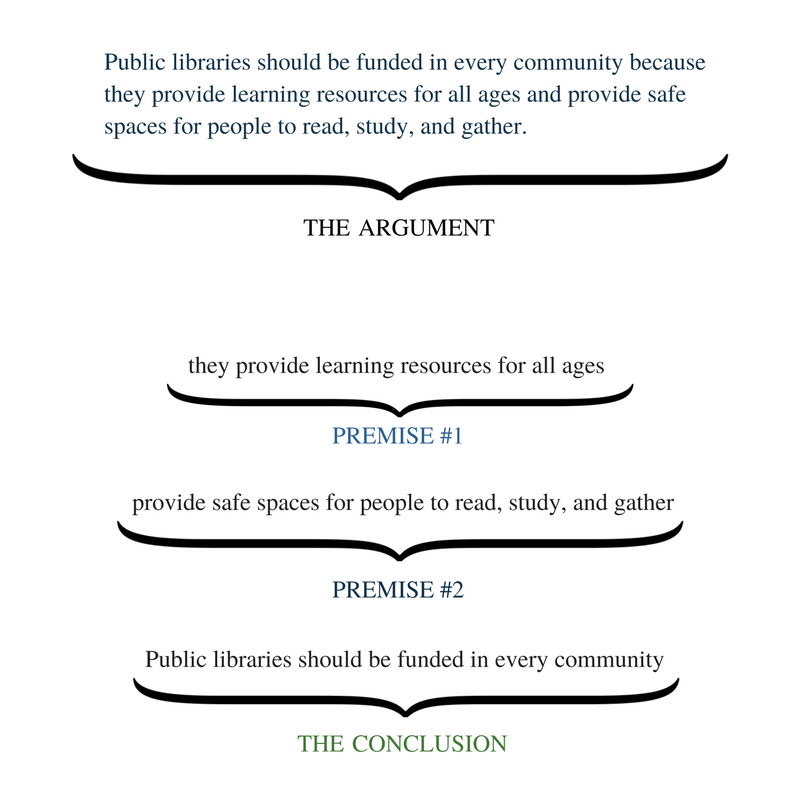
In standard form:
- Public libraries provide learning resources for people of all ages.
- Public libraries provide safe spaces for people to read, study, and gather.
- Therefore, public libraries should be funded in every community.
This does not yet prove the conclusion. A person might challenge whether those benefits justify funding in every community, how funding should be prioritised, or whether alternatives could provide the same benefits. Those are evaluation questions for later. At this stage, the job is simply to make the structure visible.
Keep the arguer’s claim intact
When translating into standard form, do not improve the argument for them.
Suppose someone says:
“We should install cameras in the car park because theft has been reported there.”
A fair reconstruction is:
- Theft has been reported in the car park.
- Therefore, cameras should be installed in the car park.
You might notice a missing assumption:
- [Implicit assumption: cameras would reduce theft enough to justify their cost and privacy impact.]
But that is not a stated premise. Identifying missing support is different from supplying it yourself.
This matters in real decisions. If an argument seems persuasive only after you add several unstated claims on the speaker’s behalf, its stated case may be weaker than it first appeared.
A reliable extraction method
When an argument is messy, use this six-step routine.
-
Separate the claims.
Break a paragraph or spoken statement into individual assertions. Ignore scene-setting, repetition, insults, jokes, and unsupported emphasis for the moment. -
Look for indicator words.
Notice terms such as because, since, therefore, and so. They provide an initial clue about where support is being offered. -
Find the main point.
Identify the claim the speaker most wants the audience to accept. This is the conclusion. -
Collect the offered reasons.
Mark each claim presented as a reason to accept that conclusion. These are the premises. -
Rewrite in standard form.
Put premises first and the conclusion last. Use “Therefore” before the conclusion even if the speaker did not. -
Mark what is missing.
If the reasoning depends on an unstated bridge, label it explicitly as an implicit assumption rather than confusing it with evidence.
A quick test helps when you are unsure: temporarily remove a statement. If the remaining passage loses a reason for accepting the main claim, the removed statement was probably a premise. If it loses the point being defended, it was probably the conclusion.
Worked analysis: a practical scenario
Consider this claim:
“The damaged safety rail should not be used today. The mounting bolts are visibly loose, and the rail shifts when weight is applied to it. It could fail under load.”
The final sentence may sound dramatic, but the main recommendation is the first sentence.
Standard form:
- The safety rail’s mounting bolts are visibly loose.
- The safety rail shifts when weight is applied to it.
- The rail could fail under load.
- Therefore, the damaged safety rail should not be used today.
Notice that premise 3 is itself an inference from premises 1 and 2. It functions as an intermediate conclusion: it is supported by earlier claims and then helps support the final conclusion.
A more detailed reconstruction makes that visible:
- The mounting bolts are visibly loose.
- The rail shifts when weight is applied.
- Therefore, the rail could fail under load.
- If a safety rail could fail under load, it should not be used.
- Therefore, the damaged safety rail should not be used today.
This kind of layered reasoning appears constantly in engineering fault-finding, investigations, and policy decisions. One claim supports a second claim; that second claim then supports a practical decision.
Do not confuse the strongest-sounding statement with the conclusion. “It could fail under load” is serious, but in this passage it supports the actual decision: do not use the rail.
Linked reasons and separate reasons
Premises can work in two broad ways.
Linked premises
Some premises need each other. Neither does the required job alone.
“The access code was used at 02:14, and only authorised staff have that code. Therefore, an authorised person likely entered the system.”
The first premise says what happened; the second connects that event to a group. Taken together, they support the conclusion.
Independent premises
Other premises provide separate support for the same conclusion.
“The event should be postponed because the forecast predicts severe winds. It should also be postponed because the main access road is flooded.”
Each premise independently supports postponement. If the weather improved but the road remained flooded, one reason would still remain.
This distinction becomes useful when evaluating arguments: linked premises can fail together if one key connection is unreliable, while independent reasons may provide backup. For now, simply learn to list every premise and see whether it supports the conclusion on its own or as part of a group.
The conclusion may be unstated
Sometimes a speaker expects you to finish the argument yourself.
“The door was locked from the inside. There are no signs of forced entry. The resident says nobody else had a key.”
The likely conclusion is something like:
Therefore, entry by an outside intruder is unlikely.
That conclusion is implicit. State it cautiously and in your own notes mark it as an inferred conclusion, not a direct quotation.
Likewise, an argument can rely on an implicit premise:
“Riley has completed the training and should be assigned to the task.”
Likely implicit premise:
[People who complete this training are qualified to be assigned to this task.]
Sometimes the missing premise is reasonable; sometimes it is exactly where the argument needs scrutiny. Your first responsibility is to expose it accurately.
Key takeaways
An argument is a reason-giving structure, not necessarily a disagreement. Its conclusion is the main claim being argued for; its premises are the claims offered in support.
To break an argument down:
- identify the statement the speaker wants accepted;
- find the reasons offered for accepting it;
- use words such as because and therefore as clues, not proof;
- rewrite the reasoning in standard form;
- keep stated premises separate from implicit assumptions;
- recognise that a conclusion can also serve as an intermediate step in a longer argument.
Next, you will move from identifying an argument’s structure to assessing the kind of support it offers: deductive validity versus inductive strength.
Can't find a good explanation? Sign up and we'll make it for you
Sign up