
Good to see you again. In the last lesson, you learned to separate a claim from the reasons offered for it, and to recognise when those reasons are distorted, irrelevant, or insufficient. That matters here because even a perfectly structured argument is only as dependable as the information it starts with.
This lesson gives you a practical way to assess that information. You will evaluate a source through five lenses: authority, evidence, currency, purpose, and corroboration. The goal is not to decide that a source is simply “good” or “bad.” It is to decide how much weight a particular source and claim deserve in a particular situation.
Start with the claim, not the webpage’s appearance
A polished site, a confident speaker, a blue verification badge, a professional logo, or a dramatic video can all create an impression of credibility. None settles whether a particular claim is true.
Think like an investigator: separate two questions.
- What exactly is being claimed?
- What reason do we have to trust this source on that claim?
For example:
“This new neighbourhood lighting scheme reduced crime by 40%.”
That sounds precise, but it raises immediate questions:
- Reduced which offences?
- Compared with what period or area?
- Who collected the data?
- Was the change sustained?
- Did another change happen at the same time?
- Is “crime” being confused with recorded reports, calls for service, or residents’ perceptions?
A source can be reliable for one job and weak for another. A local council page may be authoritative about the date a road closes; it may not be the best independent source for whether its own policy was effective. A company selling protective equipment may accurately state product specifications, while being a poor sole source for broad claims about how well its product reduces injury.
So source evaluation is claim-specific. Do not ask only, “Do I trust this website?” Ask, “Is this source well placed to support this particular statement?”
The five-lens check
The ANU Library’s short overview uses a useful framework called TRAP: timeliness, relevance, authority, accuracy, and purpose. For this lesson, we will concentrate on the five checks that most directly answer whether to rely on a source: authority, evidence, currency, purpose, and corroboration.
Evaluating Information Sources
Watch “Evaluating Information Sources” from ANU Library for a compact overview of source evaluation. It provides the questions you should have in mind before treating a source as reliable.
Watch timeliness, then authority, paying attention to the difference between relevant qualifications and a merely impressive title. Continue with accuracy and purpose for cross-checking, limitations, financial backing, advertising, and provocative language.
1. Authority: who is responsible, and are they qualified for this claim?
Authority concerns the people and institutions behind a source. Look for a named author, publisher, organisation, editor, or sponsoring body. Then ask whether their expertise fits the subject.
A qualified structural engineer can be a relevant authority on whether a cracked beam is dangerous. The same engineer is not automatically an authority on trauma psychology. A celebrity may have personal experience of a product, but that is not the same as having evidence of the product’s general effects.
Useful questions include:
- Who wrote, published, or funded this?
- Is the author identifiable and accountable?
- What are their relevant qualifications, experience, or institutional role?
- Does the organisation have recognised responsibility for this kind of information?
- Do independent sources describe the organisation as credible, partisan, satirical, commercial, or unreliable?
- Is there a conflict of interest?
A web address can offer an initial clue, but it is never proof. A government domain usually indicates an official government source; a university domain usually identifies an educational institution. But an official source can still be mistaken, incomplete, or motivated to present its own work favourably. Likewise, a commercial site can contain accurate information. Check the actual author, evidence, and claim rather than treating a domain ending as a verdict.
2. Evidence: what supports the statement?
Evidence is what the source gives you to check its claim. Strong sources show their work: data, methods, original documents, direct quotations in context, links to research, named experts, or clear reasoning.
Weak signs include:
- an assertion with no source beyond “experts say”;
- anonymous claims;
- screenshots without a traceable original;
- a graph with no labels, sample size, dates, or data source;
- a dramatic anecdote used to establish a broad trend;
- references that merely link to other opinion pieces repeating the same claim.
Evidence needs to fit the conclusion. A video of one confrontation may establish that a confrontation occurred; it cannot by itself establish that a whole area is lawless, that a group behaves a certain way, or that a particular policy will work. That would repeat the hasty-generalisation and false-cause errors from the previous lesson.
When a source cites research, do not stop at the headline summary. If possible, trace it to the original study, report, official dataset, court judgment, recording, or full interview. Check whether the claim has been fairly represented. A real study can be used misleadingly through selective quotation, an exaggerated headline, or a conclusion that goes beyond what was measured.
3. Currency: is the information recent enough for the question?
Currency means whether the information is timely for the claim you are evaluating. Check the publication date, update date, dates of the underlying evidence, and whether links still work.
But newer is not always better. The appropriate age depends on the question:
| Question | What currency requires |
|---|---|
| Current emergency guidance, law, public-health advice, product safety notice | Very current, ideally from an official or regularly updated source |
| Recent local crime trend | Recent data and a clearly stated time period |
| Explanation of a historical event | Older primary sources may be exactly what is needed |
| Fundamental scientific or engineering principle | An older textbook or landmark study may remain valuable, though current reviews can show later developments |
An old source is not automatically wrong. It may still be excellent evidence about what someone said or what was officially known at the time. The question is whether later law, data, technology, or research could have changed the answer.
4. Purpose: why does this source exist?
Purpose means the source’s intended function. It may aim to inform, teach, persuade, sell, recruit, entertain, advocate, satirise, or defend an institution. Purpose is not a disqualifier. A charity may advocate for a cause and provide valuable evidence; a company may make accurate technical documentation; a government body may provide dependable procedural guidance.
The issue is whether the purpose creates incentives to omit, frame, exaggerate, or selectively present information.
Look for:
- advertising or affiliate links;
- a product, service, party, candidate, or campaign being promoted;
- emotionally loaded language designed to provoke anger, fear, or tribal loyalty;
- one-sided presentation with no acknowledgement of uncertainty or drawbacks;
- sponsorship or funding that benefits from a particular conclusion;
- satire or parody presented in a way that could be mistaken for reporting.
Purpose helps you predict where to check harder. A manufacturer’s claim that its equipment is effective should lead you to seek independent testing. A pressure group’s report may identify a real problem, but its recommendations should be assessed alongside counterarguments, methods, and evidence it may have left out.
5. Corroboration: do independent sources support it?
Corroboration means checking whether other genuinely independent and credible sources support the important claim.
The word independent matters. Ten social-media accounts repeating the same viral clip are not ten pieces of evidence. Ten articles relying on the same press release are not ten separate confirmations. They may all share one weak original source.
Better corroboration might involve different forms of evidence:
- an official record;
- reporting from reputable outlets that have independently verified facts;
- a full research report or dataset;
- an expert body’s assessment;
- direct documents, recordings, or imagery whose origin and context can be checked.
Corroboration is not just vote-counting. If one reliable primary source directly records an event, it can be stronger than many vague reposts. Conversely, if several independent, high-quality sources disagree, do not hide the disagreement. It may show that the evidence is unsettled, definitions differ, or the issue is genuinely uncertain.
Read laterally: leave the source to investigate it
Reading vertically means staying on the page: examining its About section, credentials, citations, and wording. This is useful, but the page controls what it tells you about itself.
Lateral reading means opening new tabs and checking what credible outside sources say about the publisher, author, central claim, and evidence. Professional fact-checkers use this move because it is faster and usually more revealing than spending twenty minutes scrutinising an unfamiliar site’s design.
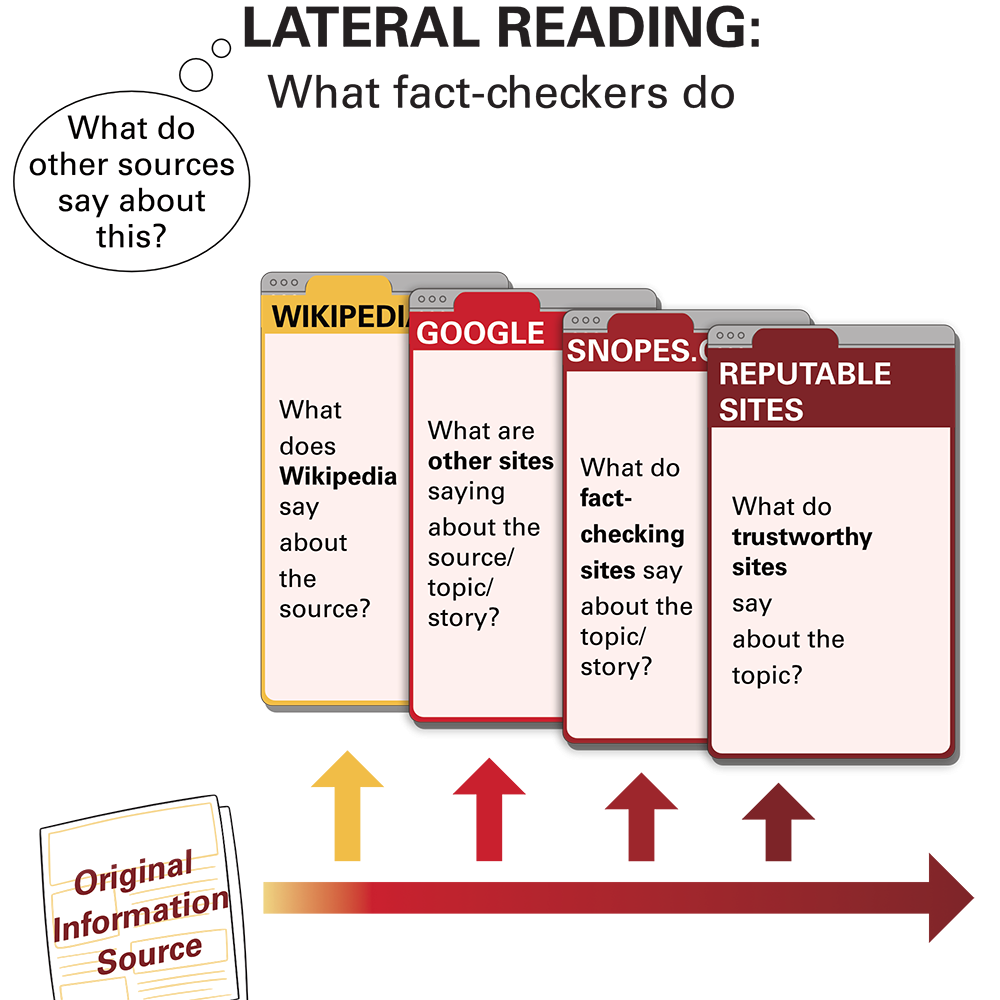
A basic lateral-reading routine is:
- Pause before sharing or accepting the claim. Notice your reaction, especially if the content makes you instantly angry, smug, frightened, or delighted.
- Search the source or author’s name. Add terms such as “funding,” “about,” “bias,” “controversy,” or “reputation,” while preferring well-established reporting and institutional information.
- Search the key claim in neutral language. Do not just search the source’s dramatic headline, because that can reproduce its framing.
- Look for better coverage. Seek reporting, official information, research summaries, or specialist sources that explain the issue and evidence.
- Trace the evidence backward. Find the original report, full quotation, data release, video, study, or document.
The SIFT method gives this routine a useful name: investigate the source, find better coverage, and trace claims, quotations, and media to their original context.
The SIFT Method - Evaluating Resources and Misinformation
Read the University of Chicago Library’s “The SIFT Method: Evaluating Resources and Misinformation.” It turns lateral reading into a practical method for checking authority, corroboration, and the original evidence behind a claim.
In the “I - Investigate the Source” section, read the investigation guidance. Focus on why the source’s own About page is not enough. Next, in “F - Find Better Coverage,” read the coverage and tracing guidance. Continue through the rest of “T - Trace Claims, Quotes, and Media to their Original Context,” especially the questions about cherry-picking, context, and sensationalised reporting.
Wikipedia can be useful as a starting point for orientation or for locating names, dates, and references, but it is generally not the endpoint for a high-stakes claim. Use it to find stronger primary or specialist sources, then assess those sources themselves.
Apply the five lenses to a realistic claim
Imagine seeing this post:
“Our new wrist device cuts assaults against night-shift staff by 50%. Every hospital should buy it now.”
The post appears on the device manufacturer’s website. It links to a short “research summary,” but not to the full study or raw data. The summary says that 20 staff members used the device for four weeks. It was published three years ago.
Here is how a disciplined evaluation might look:
| Lens | What you find | Provisional judgement |
|---|---|---|
| Authority | The manufacturer knows its product but benefits financially if hospitals buy it. The author is unnamed. | Relevant practical knowledge, but a clear conflict of interest and limited accountability. |
| Evidence | A small study is mentioned, but no methods, comparison group, definition of “assault,” or full results are available. | The evidence does not yet justify a strong causal claim or a universal recommendation. |
| Currency | Three years may be acceptable for a device study, but only if the model, software, safety standards, and conditions remain comparable. | Check for updated independent evidence and current product documentation. |
| Purpose | The page is selling a product and urges immediate purchase. | Treat persuasive wording with caution; it is not neutral evaluation. |
| Corroboration | You would search for independent workplace-safety studies, regulator guidance, hospital evaluations, and reporting that is not based on the company’s press release. | Do not rely on the company as the sole source. |
Notice the conclusion is not “the device does nothing” or “the company is lying.” Those claims would go beyond the evidence. A fair conclusion is:
The manufacturer’s claim is plausible enough to investigate, but its current evidence does not establish that the device halves assaults or that every hospital should adopt it. Independent, up-to-date evaluations with transparent methods are needed.
That is the right intellectual posture: neither gullible acceptance nor automatic cynicism.
A compact source-evaluation record
For a claim that matters, write a short record rather than relying on a vague feeling. This is particularly useful when reading about public safety, health, psychology, technology, or controversial events.
| Check | Notes to record |
|---|---|
| Claim | What precise statement is the source asking you to accept? |
| Authority | Who is responsible? What relevant expertise, accountability, incentives, or conflicts exist? |
| Evidence | What data, documents, examples, or reasoning are provided? Can you find the original material? |
| Currency | When were the page and its underlying evidence published or updated? Does the date fit the question? |
| Purpose | Is the aim to inform, persuade, sell, entertain, recruit, or advocate? What framing might that encourage? |
| Corroboration | Which independent credible sources agree, disagree, or add important context? Are they all relying on one original source? |
| Verdict | Reliable enough for what purpose? What remains uncertain? |
The California State University, Fullerton Library guide gathers many of the questions behind this record. Use it as a reference checklist, especially when you need to explain why a source deserves more or less weight.
CRAAP Test - Source Evaluation - LibGuides at California ...
Read the California State University, Fullerton Library guide’s sections on currency, authority, accuracy, and purpose. Its questions are useful for turning an instinctive “this seems dodgy” reaction into a clear, defensible assessment.
Start with “Currency” and read the timeliness questions; distinguish current topics from historical ones. In “Authority,” read the authority checklist, treating domain endings as clues rather than proof. Then read the “Accuracy” questions from evidence and verification. Finish with “Purpose,” from purpose and conflicts, noting that bias is something to investigate, not an excuse to ignore evidence automatically.
Avoid two common mistakes
The first mistake is credential worship: “This person has a title, so their claim must be true.” Credentials matter when they are relevant, but no expert is infallible, and expertise does not transfer automatically between fields. Check the evidence and the wider expert picture.
The second is source cynicism: “Everyone has an agenda, so nobody can be trusted.” People and organisations do have perspectives and incentives. That is exactly why we use transparent evidence, lateral reading, and corroboration. The presence of a purpose does not make a source worthless; it tells you what questions to ask.
The best judgement is usually calibrated:
- High confidence: authoritative, current, transparent evidence; important claims independently corroborated.
- Cautious use: some relevant expertise and evidence, but meaningful limitations or incomplete corroboration.
- Low confidence: anonymous or unaccountable source, weak or missing evidence, unclear date, strong incentive to persuade, and no independent confirmation.
- Unable to assess yet: not enough information. Withhold judgement and investigate further.
Key takeaways
To evaluate a source, assess five connected features:
- Authority: Who is responsible, and are they qualified and accountable for this particular claim?
- Evidence: Can you inspect the data, reasoning, documents, or original material supporting the claim?
- Currency: Is the source and its evidence current enough for the question?
- Purpose: Why was it created, and what incentives or framing could shape it?
- Corroboration: Do independent credible sources support, complicate, or challenge the claim?
Lateral reading is the core practical habit: leave an unfamiliar page, investigate the source from outside, seek better coverage, and trace claims back to their original context. Your final judgement should match the evidence: a source may justify confidence, cautious use, low confidence, or simply further investigation.
Next, you will focus on a particularly important evidence mistake in reporting about crime and behaviour: confusing correlation with causation.
Can't find a good explanation? Sign up and we'll make it for you
Sign up