
Hello, and welcome. This course builds a practical foundation for thinking clearly about people, claims, evidence, ethics, public services, and technical problems. The first module is about a discipline that sits underneath all of those: separating what happened from the story we tell ourselves about what happened.
This lesson focuses on four layers that are often blended together in everyday speech:
- Observations — what was directly noticed or measured.
- Interpretations — the meaning assigned to what was noticed.
- Assumptions — unstated claims treated as true.
- Conclusions — judgements reached from observations, interpretations, and assumptions.
This is the difference between noticing a muddy boot print and declaring who made it. Good investigation, sound public decisions, and even sensible day-to-day judgement begin by keeping those apart.
From data to story
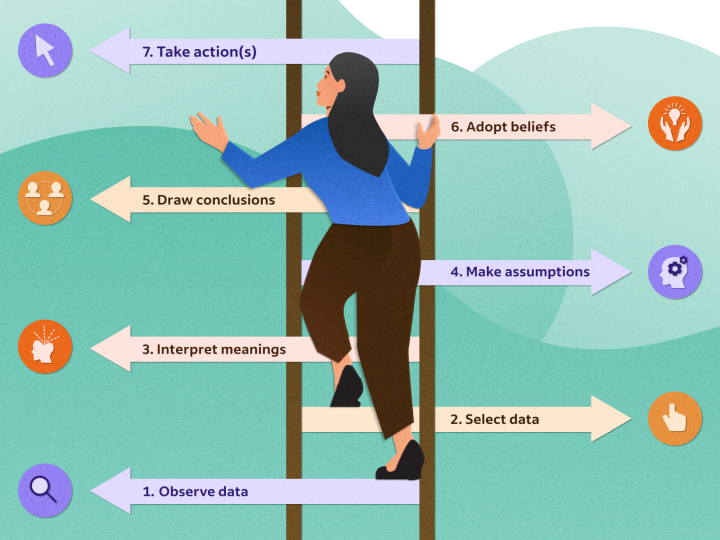
The Ladder of Inference is a useful model for how rapidly the mind moves from raw experience to action. It does not say that inference is bad; without it, you could never make decisions. Its warning is that we often climb the ladder so quickly that a guess feels like a fact.
Rethinking thinking - Trevor Maber
Watch “Rethinking thinking” from TED-Ed. It introduces the Ladder of Inference and then traces an ordinary parking-lot incident from raw observation to an angry action.
Watch the ladder model first. Notice the distinction between the camera-like record of an event, the details we select, and the meanings we add. Then watch the parking example, pausing mentally when the driver moves from a visible fact to a claim about the other person’s character. Finish with walking down for a practical method of checking your own assumptions.
The speed of this process is why disagreements sometimes feel bizarre. Two people can witness the same event and sincerely report sharply different “facts,” when in reality they have agreed on much of the raw event but assigned it different meanings.
Consider this bare scene:
At 22:10, a person in a dark jacket is standing outside a closed pharmacy. They look at their phone twice and walk away when a vehicle turns into the street.
That is not a complete description of everything happening. It is a deliberately limited set of selected details. But it stays close to what a camera, timestamp, and observer might record.
Now compare these claims:
- “The person seems nervous.”
- “They are waiting for someone.”
- “They know the pharmacy is closed.”
- “They are planning to break in.”
Each claim adds material that is not directly visible. Some may eventually turn out to be correct. None becomes an observation merely because it sounds plausible.
The intellectual habit to build is:
State the observable data first; label the rest according to how far it goes beyond the data.
The four categories
1. Observation: what was perceived, recorded, or measured
An observation describes what someone directly noticed through the senses or what an instrument recorded. It should be specific enough that another person could, in principle, check it.
Examples:
- “The shop window has a crack running from its lower-right corner.”
- “A clock display reads 22:10.”
- “The caller said, ‘I heard glass break.’”
- “The device recorded a temperature of 38 degrees Celsius.”
Observations can be:
- Qualitative, describing a quality: “The liquid is cloudy”; “There is a sharp smell.”
- Quantitative, giving a number or measurement: “The door is open by approximately 15 centimetres”; “The call lasted 42 seconds.”
Observations and Inferences- What's the Difference ?
Watch “Observations and Inferences—What’s the Difference?” from MooMooMath and Science for a concise account of observation as sensory or measured information, followed by inference as an explanation built from it.
Watch observations to distinguish descriptive from numerical observations. Then watch inferences and listen for the central point: background knowledge can help explain an observation, but the explanation is not itself what was observed.
A crucial real-world refinement: a person’s report is itself observable as a statement, but that does not automatically make the content of the statement verified.
For example:
- Observation: “Jordan said they saw a blue car leave quickly.”
- Not yet an established observation by you: “A blue car left quickly.”
The first is a fact about what Jordan reported. The second is a claim about the event that still needs corroboration, such as video, another witness, or vehicle records. This distinction protects against accidentally converting hearsay into fact.
2. Interpretation: the meaning added to an observation
An interpretation proposes what an observation means. It often uses ordinary language and prior knowledge. Interpretations can be reasonable, useful, and sometimes well supported — but they should remain distinguishable from the observation itself.
| Observation | Interpretation |
|---|---|
| “Sam’s voice is quiet, and they are looking at the floor.” | “Sam appears upset.” |
| “The engine does not start when the key is turned.” | “There may be a battery or ignition problem.” |
| “A person looks over their shoulder several times.” | “They may be worried about being followed.” |
Words such as appears, seems, suggests, may indicate, and is consistent with are not weak writing. They accurately signal the difference between evidence and explanation.
Interpretation becomes dangerous when it is phrased as a camera-recordable fact:
- Loaded phrasing: “The suspect was lurking outside the shop.”
- More precise phrasing: “The person stood outside the shop for approximately six minutes and looked through the window several times.”
“Lurking” already implies suspicious purpose. The second version preserves the observable conduct while leaving room for competing explanations: waiting for a lift, checking whether a shop is open, looking for someone, or something more concerning.
3. Assumption: the missing bridge
An assumption is something accepted without adequate proof in the current situation. Often it is not spoken aloud. It is the invisible bridge between an observation and an interpretation or conclusion.
Suppose someone says:
“Taylor did not reply to my message, so they are ignoring me.”
Possible observations:
- “A message was sent at 16:00.”
- “No reply has been received by 20:00.”
Interpretation:
- “Taylor is ignoring me.”
Possible assumptions:
- Taylor saw the message.
- Taylor had access to their phone.
- Taylor had enough time and capacity to reply.
- A delayed reply means deliberate disregard.
The point is not that every assumption is false. Some could be true. The point is that they require checking before they carry the weight of a conclusion.
A reliable way to expose one is to ask:
“For this conclusion to follow, what would have to be true?”
That question is more productive than simply asking, “What am I assuming?” because hidden assumptions can be hard to spot directly.
4. Conclusion: the judgement reached
A conclusion is the judgement that the reasoning arrives at. It may guide a decision or action. A conclusion can be provisional rather than final.
For example:
- Observations: “The rear door is damaged. The alarm is sounding. No staff member is visible.”
- Interpretation: “There may have been forced entry.”
- Assumption: “The damage is recent and was not caused by scheduled maintenance.”
- Conclusion: “This should be treated as a possible break-in until further checks are made.”
Notice the careful wording. The conclusion does not claim certainty that the offence occurred. It identifies the sensible current judgement while leaving room for new evidence.
A conclusion is not simply the strongest-sounding statement. It is the statement that the available evidence and reasoning justify. Where evidence is incomplete, a well-formed conclusion includes a limit:
- Overconfident: “The person caused the damage.”
- Proportionate: “The available information places the person near the damage, but does not establish who caused it.”
One scenario, carefully unpacked
Imagine a fictional case from a detective story — without the cinematic leap from one clue to a solved case.
At 07:30, a building caretaker finds a side door open. A ground-floor window is broken. On the pavement beneath it are several shards of glass. A delivery driver tells the caretaker that they saw an unfamiliar person wearing a grey hoodie near the building at about 06:45.
Here is a disciplined analysis.
| Category | Statements |
|---|---|
| Direct observations | The caretaker found the side door open at 07:30. A ground-floor window was broken. Glass shards were on the pavement. The delivery driver made a report. |
| Interpretations | The glass may have come from the window. The open door may be relevant to the broken window. The reported person may be relevant to the event. |
| Assumptions | The window was intact before 06:45. The glass was not from an earlier incident or repair. The delivery driver accurately perceived the person, time, clothing, and location. The person was not simply passing by. |
| Possible conclusion | There may have been an unauthorised entry or attempted entry; the scene needs further checking and the driver’s account needs corroboration. |
Now see how easy it would be to overreach:
“A person in a grey hoodie broke in through the window.”
This single sentence quietly treats at least four untested propositions as established: that a break-in occurred, that the person was at the scene, that they damaged the window, and that they entered the building. The claim might later be supported, but it is not supported by the scenario as given.
This distinction is not nit-picking. It affects fairness, safety, and accuracy. A wrong interpretation can direct attention toward an innocent person and away from the real explanation. In engineering, an equivalent error would be treating one machine symptom as proof of a particular fault without testing alternative failure modes. A sensible technician records the symptom, identifies hypotheses, tests them, and revises the diagnosis.
Walking back down the ladder
The goal is not to avoid all judgement. It is to slow the jump from data to action when the stakes are high. When you catch a strong reaction or a confident story forming, walk down the ladder deliberately.
Use this four-part audit:
-
Write the raw data.
Include what was seen, heard, measured, recorded, or directly reported. Use concrete language, times, locations, and quotations where possible. -
Mark the interpretation.
Ask what meaning you have assigned. Replace categorical labels such as “aggressive,” “lazy,” or “guilty” with a description of behaviour where you can. -
Surface the assumptions.
Identify what must be true for the interpretation to hold. Consider both background assumptions and missing information. -
State a proportionate conclusion.
Say what the evidence currently supports, what it does not establish, and what information would strengthen or weaken the conclusion.
A compact note format can make the separation routine:
| Field | Example |
|---|---|
| Observation | “Pat crossed their arms, raised their voice, and said, ‘Leave me alone.’” |
| Interpretation | “Pat may be angry, frightened, or trying to create distance.” |
| Assumptions to check | “Raised voice indicates anger; crossed arms are deliberate hostility; Pat understood the situation.” |
| Working conclusion | “Maintain space and use calm communication; the cause of Pat’s behaviour is unclear.” |
The method does not remove uncertainty. It makes uncertainty visible, which is far safer than hiding it behind certainty.
Read the sections on types of information, assumptions, and conclusions. The guide gives a useful vocabulary for separating evidence from the claims that go beyond it.
In Section 4, “Distinguish Types of Information,” read from why categories matter through the definition of evidence. Then read subsection 4B, “Identify Assumptions,” from the definition and difficulty. Continue into subsection 4C, “Identify Conclusions,” focusing on the difference between an inference and a conclusion. Finally, in the following practical example, read the inference method and apply its question — “what did I assume?” — to the fictional building scenario above.
Common traps — and better replacements
Treating a label as an observation
Labels compress many claims into one word.
- “He was acting suspiciously.”
- “She was being disrespectful.”
- “The design is unsafe.”
These may be useful preliminary judgements, but they are not raw observations. Unpack them:
- “He checked the locked door handle three times and looked through the window.”
- “She interrupted twice and said, ‘This is ridiculous.’”
- “The guard bends noticeably under the stated load, and its mounting bolts are loose.”
The unpacked account can be checked. It also allows someone else to agree about the facts while disagreeing about the meaning.
Confusing plausibility with proof
A story can be coherent and still unsupported. Humans are excellent at constructing narratives from fragments, particularly when a narrative fits familiar stereotypes or prior expectations.
A better discipline is to identify at least one plausible alternative explanation. This does not mean treating every possibility as equally likely. It means refusing to confuse the first explanation that comes to mind with the only explanation.
Mistaking absence of evidence for evidence of absence
“No reply,” “no visible injury,” or “no alarm activation” can matter. But each absence depends on what the system, person, or situation could realistically reveal.
For example, no alarm may mean there was no intrusion, but it may also mean the alarm was not set, malfunctioning, bypassed, or disconnected. The missing evidence needs interpretation too.
Letting emotion certify a conclusion
Strong feelings can signal that something matters, but they do not verify the story behind the feeling. Anger after being cut off in traffic is real; the belief that the other driver acted out of selfishness is a separate claim.
The practical move is not “ignore emotion.” It is: treat emotion as information about your response, not proof of another person’s motive.
A short field routine
When reading a headline, watching a clip, hearing a claim, or assessing a tense situation, use this quick checklist:
- What is directly known or recorded?
- What has been reported by someone else?
- What meaning is being added?
- What assumptions make that meaning seem compelling?
- What conclusion is actually justified right now?
- What evidence would change my mind?
These questions are the mental equivalent of checking equipment before relying on it. They reduce avoidable errors without demanding impossible certainty.
Key takeaways
An observation stays close to what was directly perceived, measured, or recorded. An interpretation assigns meaning to that information. An assumption is an unproven claim, often hidden, that links information to a judgement. A conclusion is the judgement reached and should be no stronger than the evidence permits.
The Ladder of Inference explains why these layers blur: we select data, interpret it through past experience, make assumptions, and form conclusions very quickly. The corrective is to walk back down: name the data, reveal the interpretation, test the assumptions, and state a proportionate conclusion with its limits.
Next, you will build on this skill by breaking an argument into its premises — the reasons offered — and its conclusion.
Can't find a good explanation? Sign up and we'll make it for you
Sign up