
Hello. In the previous lesson, you learned to factor expressions by reversing expansion and by recognising common factors and standard identities. That work now becomes operational: when an equation contains brackets, your first job is often to expand and simplify correctly before isolating the variable.
This lesson develops a reliable method for solving one-variable linear equations, including equations with integer coefficients, fractional coefficients, brackets, and the variable on both sides. The target is not merely to get an answer, but to make each algebraic step defensible under exam pressure.
Equality and inverse operations
A linear equation in one variable can be simplified to a form such as
where are numbers and the highest power of is .
An equation is a statement that the two sides have equal value. To preserve that equality, perform the same operation on both sides. The main inverse-operation pairs are:
| Operation affecting | Undo it by |
|---|---|
| subtracting | |
| adding | |
| multiplying by | dividing by , if |
| dividing by | multiplying by , if |
The practical order for a multi-step equation is:
- Expand brackets and combine like terms on each side.
- Use addition or subtraction to collect all -terms on one side.
- Use addition or subtraction to collect constants on the other side.
- Divide by the coefficient of .
- Check the result in the original equation.
“Moving a term across the equals sign” is convenient shorthand, but write the actual operation. For instance, to remove from the right side, subtract from both sides. This prevents most sign errors.
Consider:
First expand and simplify the left side:
Now subtract from both sides:
Add to both sides:
Finally, divide by :
A fractional answer is completely acceptable. Do not round unless a question explicitly asks for an approximation.
Fractional coefficients: use the reciprocal
A fraction multiplying is simply a coefficient. For example,
First isolate the fractional -term:
The reciprocal of is . Multiply both sides by it:
The reason this works is that reciprocal factors multiply to :
So the general rule is:
provided and .
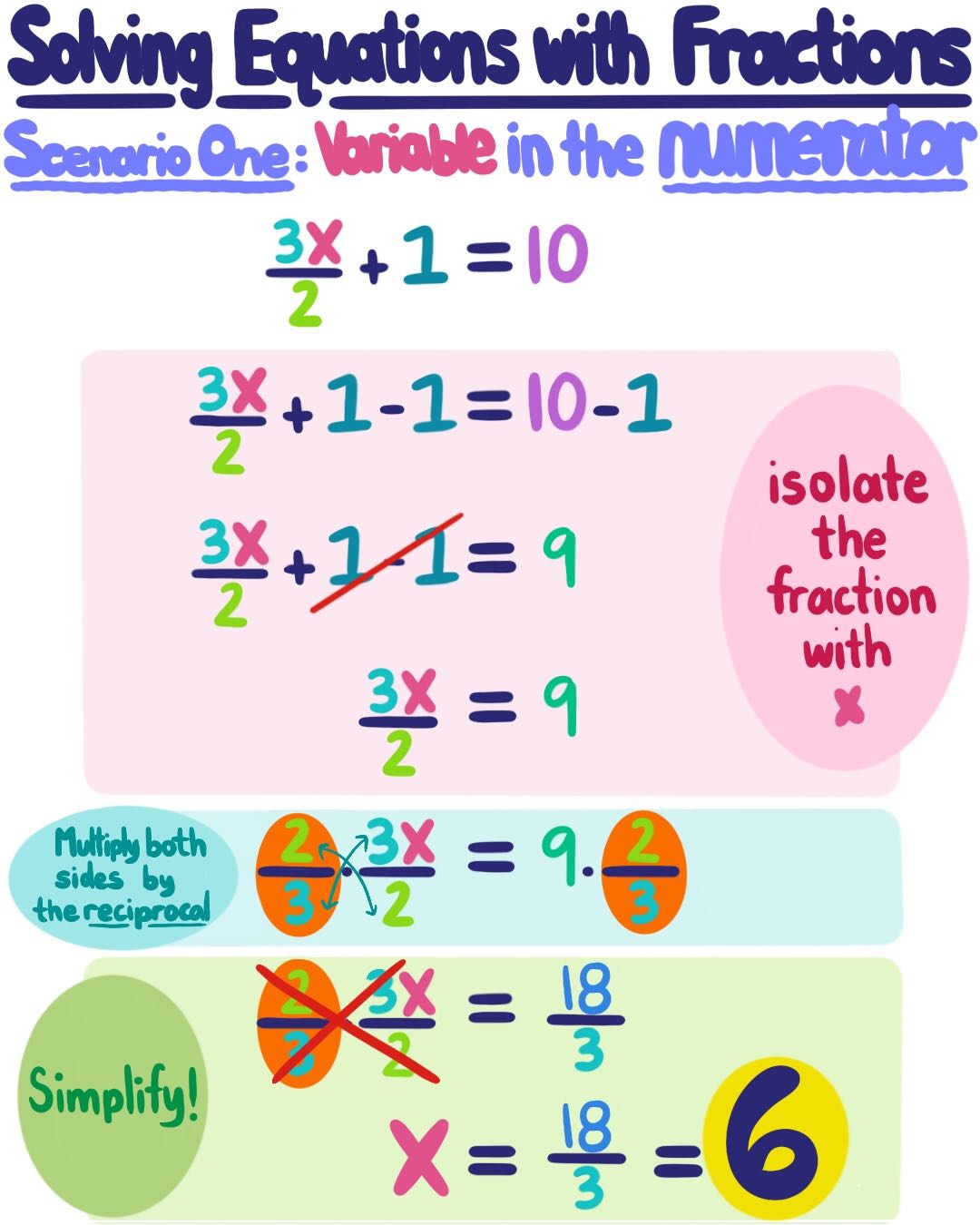
The image’s method is useful when one fractional coefficient is already easy to isolate. Notice that “multiply by the reciprocal” means multiply both sides, not just the left side.
A related form requires careful attention to the fraction bar:
Here the denominator applies to the entire numerator . Multiply both sides by :
Do not try to “cancel” the with just or just . Cancellation works only with factors, not separate terms joined by addition or subtraction.
Solving Linear Equations with Fractions in Just Two Steps│Algebra
Watch Solving Linear Equations with Fractions in Just Two Steps from GoTutor Math for a visual demonstration of the two central phases: clear fractions, then solve the resulting linear equation.
Watch the first example to see an equation cleared using the LCM of its denominators. Then watch whole number terms, where the instructor stresses that the multiplier must apply to integer terms as well as fractional terms. Track what is multiplied on both sides at every stage.
Clearing several fractions with the LCD
When an equation has several denominators, repeatedly using reciprocals can be slow and error-prone. Instead, multiply the entire equation by the least common denominator (LCD), also called the LCM of the denominators.
For example:
The denominators are , , and . Their LCD is .
Multiply every term on both sides by :
Now simplify each multiplier:
The equation contains no fractions. Expand:
The essential discipline is to multiply every term. An LCD does not give permission to multiply only the fractions you find inconvenient.
2.5 Solve Equations with Fractions or Decimals - Elementary Algebra 2e | OpenStax
OpenStax Elementary Algebra 2e gives a clear formal version of the LCD method and explains why it creates an equivalent equation without fractions.
In the section “Solve Equations with Fraction Coefficients,” begin at the paragraph starting the explanation of clearing fractions. Continue through the “Strategy to solve equations with fraction coefficients” list, ending with the three-step strategy. Focus on the idea that multiplying by the LCD changes the appearance of the equation but not its solution.
Here is an example with variables on both sides:
The LCD of and is . Multiply every term by :
Subtract from both sides:
Add to both sides:
The fraction work ended as soon as the LCD was applied. From there, it was an ordinary integer-coefficient linear equation.
Choosing the efficient method
In an entrance exam, choose the method that reduces clutter while remaining reliable.
| Equation structure | Efficient first move |
|---|---|
| , with integer | Isolate , then divide by |
| Multiply by the reciprocal | |
| One fraction with a complete numerator | Multiply the whole equation by its denominator |
| Several denominators | Multiply the whole equation by their LCD |
| Brackets, fractions, and variables on both sides | Clear fractions, expand, combine like terms, then isolate |
For example, in
the first efficient choice is to clear denominators using . Do not expand the numerators unnecessarily before doing so:
A quick check confirms it:
and
Both sides agree.
Verification and exceptional outcomes
Checking is particularly valuable when fractions or negative signs appear. Substitute your answer into the original equation, simplify each side independently, and confirm that the two values match.
Most exam equations have one solution. However, after simplifying, you may occasionally find that the variable disappears.
If the result is a true statement, such as
then every real value of satisfies the original equation. For example,
expands to , so it is true for every .
If the result is false, such as
then there is no solution. For example,
becomes , then , which is impossible.
Do not divide by an expression that has simplified to zero. Instead, first classify whether the final statement is always true or impossible.
Key takeaways
A linear equation is solved by preserving equality while isolating . Simplify first: expand brackets, combine like terms, collect variable terms, collect constants, and divide by the final coefficient.
For a single fractional coefficient, isolate the term and multiply by its reciprocal. For multiple denominators, multiply every term on both sides by the LCD. Once the fractions are cleared, continue with ordinary linear-equation steps.
Most avoidable errors come from three places:
- failing to distribute a negative sign or bracket multiplier;
- multiplying only some terms by the LCD;
- treating “moving” a term as a sign trick instead of performing the same operation on both sides.
Next, you will use these equation-solving skills to form and solve problems involving ratios, proportions, and variation—contexts in which fractional algebra appears constantly.
Can't find a good explanation? Sign up and we'll make it for you
Sign up