
Hello. In the previous lesson, you solved linear equations by preserving equality, clearing denominators with an LCD, and checking the final value in the original equation. Those skills are now used in word problems: the difficult part is often not the algebra, but deciding which equation the words require.
This lesson covers ratios, proportions, direct variation, and inverse variation. By the end, you should be able to turn common entrance-exam statements into equations, solve them efficiently, and distinguish relationships that look similar but behave differently.
Ratios: parts, not necessarily actual quantities
A ratio compares quantities in a specified order. For example,
means that for every equal parts of , there are equal parts of . It does not mean and . The actual values could be:
All have the same ratio because each is obtained by multiplying both parts by the same number.
The most dependable algebraic translation is:
where represents the value of one ratio-unit. This automatically preserves the relationship.
When a total is given
Suppose boys, girls, and teachers are in the ratio
and their total number is .
Write each quantity using one common multiplier:
Since the total is ,
Therefore,
The key shortcut is: add the ratio parts first.
So each part is
When a difference is given
Suppose two quantities are in the ratio , and their difference is .
Let the quantities be and . Their difference gives the equation:
Thus the quantities are
For a ratio-and-difference question, use the difference of the ratio parts. For a ratio-and-total question, use the sum of the ratio parts.
Ratio and Proportion Word Problems - Math
Watch “Ratio and Proportion Word Problems - Math” by The Organic Chemistry Tutor for a clear visual method for scaling ratios and handling three-part ratios with a total.
Watch unknown ratios to see a ratio converted into a proportion and solved by cross-multiplication. Then watch ratio with total, which develops the same “common multiplier” idea for three quantities. Focus on why the sum of ratio parts represents the total number of equal units.
Proportions: equality of two ratios
A proportion says that two ratios are equal:
provided and .
A ratio is a comparison, such as . A proportion is an equation, such as
To solve a proportion, multiply both sides by the product of the denominators. This produces the familiar cross-product rule:
Cross-multiplication is therefore not a separate magic trick; it is simply the fraction-clearing method from the previous lesson.
Keep units in the same positions
Suppose a machine makes identical components in minutes at a constant rate. How many components, , does it make in minutes?
Keep components in numerators and time in denominators:
Now cross-multiply:
The equation is valid because both fractions mean the same thing: components per minute.
A frequent setup error is reversing only one ratio:
This compares components per minute on the left with minutes per component on the right, so it is invalid. Before solving, inspect the units: numerator units must match numerator units, and denominator units must match denominator units.
Direct variation: a constant ratio
When varies directly with , the relationship has the form
where is a fixed number called the constant of variation.
Equivalently,
So in direct variation, the quotient stays constant. If doubles, also doubles; if becomes three times as large, becomes three times as large.
For example, suppose the cost of a material varies directly with the number of kilograms . If kg costs rupees, find the equation and then the cost of kg.
Start with the direct-variation model:
Use the known pair , :
Thus the complete equation is
For ,
Here, has a useful meaning: the material costs rupees per kilogram.
Not every straight-line equation is direct variation. Compare:
and
The first is direct variation because it has the form and passes through the origin. The second has a fixed extra amount of , so the ratio is not constant. A taxi fare with a base charge plus a per-kilometre rate is usually linear, but not directly proportional.
Inverse variation: a constant product
When varies inversely with , the relationship is
Multiplying by gives the form most useful in exams:
Thus, in inverse variation, the product stays constant. If doubles, halves. If becomes three times as large, becomes one-third as large.
Suppose the time required to finish a fixed job varies inversely with the number of equally efficient workers. If workers take days, how long will workers take?
Because this is inverse variation,
Use the known values:
Therefore,
For ,
The answer is sensible: more workers should require less time. This model assumes all workers are equally productive and that the total job remains fixed.
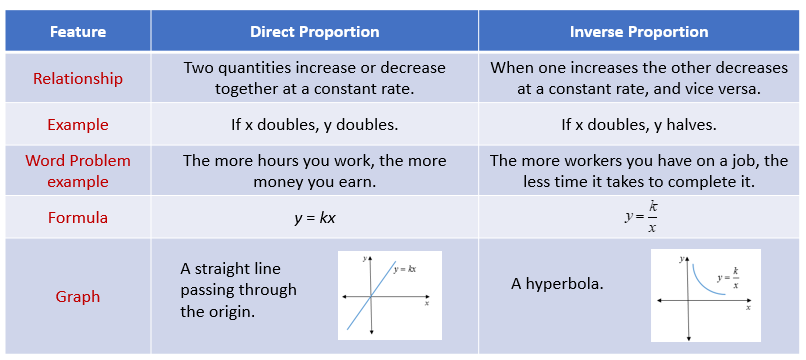
The fastest recognition test is:
| Relationship | Constant quantity | Standard equation |
|---|---|---|
| Direct variation | ||
| Inverse variation | ||
| Neither necessarily | Neither is constant | Must inspect the equation |
For instance, consider the pairs :
Their ratios are
The ratio is constant, so this is direct variation:
Now consider:
Their products are
The product is constant, so this is inverse variation:
Direct and inverse variation | Rational expressions | Algebra II | Khan Academy
Watch “Direct and inverse variation” by Khan Academy to make the distinction between a constant ratio and a constant product visually automatic.
Watch direct variation for the model y=kx and the idea that both variables scale by the same factor. Then watch inverse variation for y=\frac{k}{x}, the opposite scaling pattern, and a final method for classifying a relationship from its equation.
Turning wording into the right equation
Certain phrases should trigger a particular model immediately:
| Wording in the question | Algebraic model |
|---|---|
| “ is directly proportional to ” | |
| “ varies directly as ” | |
| “ is inversely proportional to ” | |
| “ varies inversely as ” | |
| “” | |
| “For every units, there are units” | Set up equal ratios with matching units |
A reliable four-step routine is:
- Name the quantities and attach units where possible.
- Identify the relationship: ratio, direct variation, inverse variation, or a general equation.
- Write the general model before substituting numbers.
- Check direction and units after solving.
The direction check catches many errors quickly:
- In direct variation, an increase in one positive quantity should produce an increase in the other.
- In inverse variation, an increase in one positive quantity should produce a decrease in the other.
- In a ratio-total question, the individual quantities must add to the stated total.
- In a ratio-difference question, the computed quantities must have the stated difference.
7.5 Solve Applications with Rational Equations - Intermediate Algebra 2e | OpenStax
Read the direct- and inverse-variation portions of OpenStax’s Intermediate Algebra 2e. It reinforces the model-first method: find the constant of variation from one known pair, write the complete equation, then use it for the required value.
In Section 7.5, begin at the subsection “Solve Direct Variation Problems.” Read the definition beginning the direct definition, then follow Example 7.52’s sequence of finding k, writing an equation, and using it. Next read the subsection “Solve Inverse Variation Problems,” especially the inverse method. Focus on the changed equation form: direct variation keeps a ratio fixed, whereas inverse variation keeps a product fixed.
An exam-speed decision routine
When a question presents two quantities, do not begin calculation immediately. Classify it first.
- If it gives a comparison such as , introduce a common multiplier .
- If it equates two rates or scale relationships, form a proportion with matching units.
- If it states “directly proportional,” use .
- If it states “inversely proportional,” use .
- If it gives an equation such as , do not force it into direct variation merely because rises when rises.
For IPMAT-style questions, this classification step usually takes only a few seconds, but it prevents spending a minute solving the wrong equation.
Key takeaways
A ratio such as describes relative parts, best written as and . Use the sum of ratio parts when a total is given, and their difference when a difference is given.
A proportion equates two ratios. Keep units in the same order, then clear fractions or cross-multiply. Direct variation has the model
so is constant. Inverse variation has the model
so is constant.
Next, you will move into simultaneous linear equations, where two related equations determine two unknown quantities. The equation-formation discipline from this lesson will remain essential.
Can't find a good explanation? Sign up and we'll make it for you
Sign up