
Hello. In the previous lesson, you expanded brackets and established three key identities: the squares of a sum and difference, and the product of conjugates. Factorisation reverses that process: instead of multiplying factors to produce an expression, you recognise an expression’s structure and write it as a product.
This is a high-return skill for entrance exams. A factored form often exposes cancellation, makes substitution quicker, and later lets you solve equations efficiently. In this lesson, you will learn a disciplined sequence: first extract any common factor, then look for an exact standard-identity pattern, and finally check whether further factorisation is possible.
Factorisation is reverse distribution
To factorise an expression means to rewrite it as multiplication. For example,
has in both terms. Since
we can factorise it as
The number or expression placed outside the bracket is a common factor: it divides every term exactly.
A useful way to avoid mistakes is to divide each original term by the factor you are taking out:
The greatest common factor of the coefficients and is . Both terms also contain , so the greatest common factor is .
Therefore,
The signs inside the bracket come directly from division. Never change a sign merely because it “looks more natural.”
Finding the greatest common factor
For a polynomial with several terms, construct the GCF from two parts:
- The greatest common numerical divisor of all coefficients.
- Every variable common to all terms, taken to its lowest exponent.
Consider:
The coefficient GCF is . For the variables:
- the lowest power of is ;
- the lowest power of is .
So the GCF is :
Check it by multiplying back:
A variable missing from even one term cannot belong to the common factor. For example, in
the GCF is , not , because the final term has no .
How To Factor The Greatest Common Factor In a Polynomial | Algebra
Watch How To Factor The Greatest Common Factor In a Polynomial by The Organic Chemistry Tutor. It reinforces the divide-each-term method and shows how the smallest exponent determines the variable part of the GCF.
Begin with variable GCFs, focusing on why a common variable is taken only to its lowest shared power. Then watch polynomial examples, especially the examples with several terms and higher powers. Pause briefly before each displayed answer and verify the factor by division.
A repeated bracket can also be a common factor
The common factor need not be a number or a single variable. Sometimes an entire bracket repeats:
Both terms contain . Treat that bracket as one object:
This is still reverse distribution:
The key visual habit is to scan for a repeated complete bracket before doing any expansion.
Factor out the GCF first
A standard exam rule is:
Why? A hidden common factor can conceal an identity.
For example:
All terms are divisible by :
Now the bracket is a perfect-square trinomial:
Therefore,
Stopping at is partially correct, but not fully factorised.
Sometimes extracting a negative factor makes the remaining structure clearer:
The bracket is now a difference of squares:
So,
Taking out a negative GCF is not compulsory, but it is often the cleanest choice when the leading term is negative.
Perfect-square trinomials
From the previous lesson:
Reversing these identities gives the factorisation forms:
A perfect-square trinomial must meet all three conditions:
- the first term is a perfect square;
- the last term is a perfect square;
- the middle term is exactly twice the product of their square roots.
Consider:
The first and last terms are squares:
Now test the middle term:
It matches exactly, so:
The sign of the middle term decides the sign inside the bracket:
| Expression pattern | Factorised form |
|---|---|
Do not factor an expression as a perfect square merely because its first and last terms are squares. For instance,
has square end terms, but the relevant middle term for would be
not . So this is not a perfect-square trinomial.
How do we Factorise Polynomials using Identities? Part 1 | Don't Memorise
Watch How do we Factorise Polynomials using Identities? Part 1 from Sri Chaitanya Academy NEET. This mostly Hindi walkthrough shows the essential test for a perfect-square trinomial: square roots of the end terms must generate the exact middle term.
Watch the worked factorisation of 9m^2+12m+4. Notice how the presenter identifies 3m and 2, then verifies that the middle term is twice their product. Continue with sign choice and checking, focusing on the link between the middle-term sign and the sign in the squared bracket.
Difference of two squares
The third essential identity from the previous lesson was:
Reversing it gives:
Use this identity only when all of the following are true:
- There are exactly two main terms.
- The terms are separated by subtraction.
- Both terms are perfect squares.
For example:
can be written as
Therefore,
The two factors are conjugates: the terms are the same, but the internal signs differ.
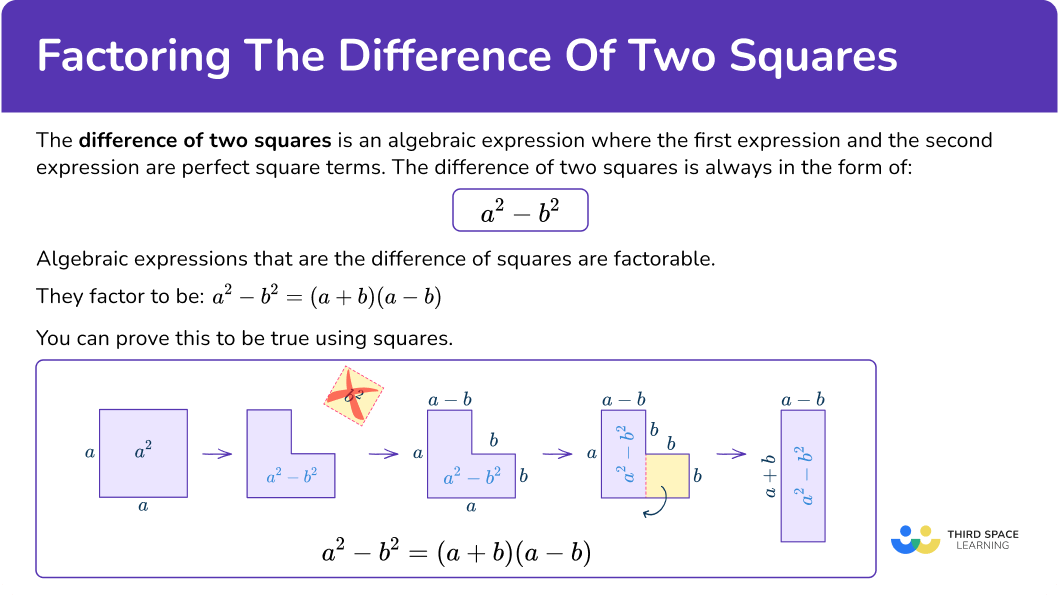
The image also explains why this identity is geometrically sound: the leftover L-shaped region from the larger square can be rearranged into a rectangle. Its area has not changed, only its shape has.
Be alert to what the identity does not say:
is a sum of squares, not a difference of squares. It does not factor using this identity over integers.
Combining methods: factor completely
Entrance-exam expressions are often designed in layers. After extracting a GCF, inspect the remaining bracket again.
Consider:
First take out the GCF :
The bracket is a difference of squares:
Factor it again:
This is the fully factorised form.
The following recognition sequence is reliable under time pressure:
- Count terms and scan for a GCF. Look for common numbers, variables, or complete brackets.
- Extract the GCF. Divide every term carefully.
- Inspect what remains. Check for a perfect-square trinomial or a difference of squares.
- Repeat if necessary. A factored bracket may itself factor further.
- Verify by expansion. This is especially useful when signs or powers are involved.
For the final check of the previous example:
and then
The original expression is recovered.
Key takeaways
Factorisation is reverse expansion: you rewrite a sum or difference as a product.
Start with the GCF. For monomials, it consists of the numerical GCF and the lowest shared exponent of each common variable. A complete bracket can also be a common factor.
The three core identity patterns are:
The most important habit is structural recognition: do not force an identity because an expression merely resembles one. Confirm the exact middle term in a perfect-square trinomial, and confirm two perfect squares separated by subtraction for a difference of squares.
Next, you will use algebraic manipulation in a more operational setting: solving one-variable linear equations with integer and fractional coefficients.
Can't find a good explanation? Sign up and we'll make it for you
Sign up