
Welcome back. In the previous lesson, you learned to locate the real level of a disagreement: facts, definitions, or values. That helps you avoid arguing past someone. Now we add a way to assess the argument itself.
When someone gives a reason for a conclusion, two questions matter:
- Is the reason true or reasonably acceptable?
- Even if it is, does it actually support the conclusion?
By the end of this lesson, you will be able to use that truth-and-support check on a short everyday argument—without needing to turn a family discussion into a formal logic class.
The two-part check: foundation and bridge
Think of an argument as having a foundation and a bridge.
- The foundation is the set of reasons or premises.
- The bridge is the connection from those reasons to the conclusion.
A weak argument can fail in either place:
- Its reasons may be false, exaggerated, vague, or unsupported.
- Its reasons may be true, yet still not justify the conclusion.
For example:
“The sky is blue, so everyone should wear sunglasses today.”
“The sky is blue” may be true. But it does not, by itself, support the conclusion. The colour of the sky is not enough to show that sunlight is bright, that someone will be outside, or that sunglasses are needed.
This is an important discipline in disagreement: do not dismiss a conclusion merely because you dislike it, and do not accept it merely because one reason is true. Assess the path from reason to conclusion.
Watch this short segment from How to evaluate logical arguments by teachphilosophy. It introduces the two ways arguments can fail, then models the order of the check: temporarily accept the premises, test the connection, and then assess the premises themselves.
How to evaluate logical arguments
Watch “How to evaluate logical arguments” by teachphilosophy for a compact visual explanation of the foundation-and-bridge idea.
Begin with two failures, which contrasts false starting claims with a faulty logical connection. Then watch the method for the two-step evaluation. Continue through worked examples, pausing when useful to ask: “Is the problem the premise, or the link?”
In formal logic, a deductive argument has a particularly strict kind of support: if its premises were true, the conclusion could not be false. Such an argument is valid. If it is valid and its premises are true, it is sound.
Most real-life arguments, especially arguments about what people should do, are less strict. Their reasons need not guarantee the conclusion; they need to make it reasonable or likely enough. For this course, use the more practical question:
If I grant these reasons for a moment, how far do they really get us?
First: check the reasons
Before deciding whether an argument works, separate the conclusion from its supporting reasons. The earlier argument map remains useful here.
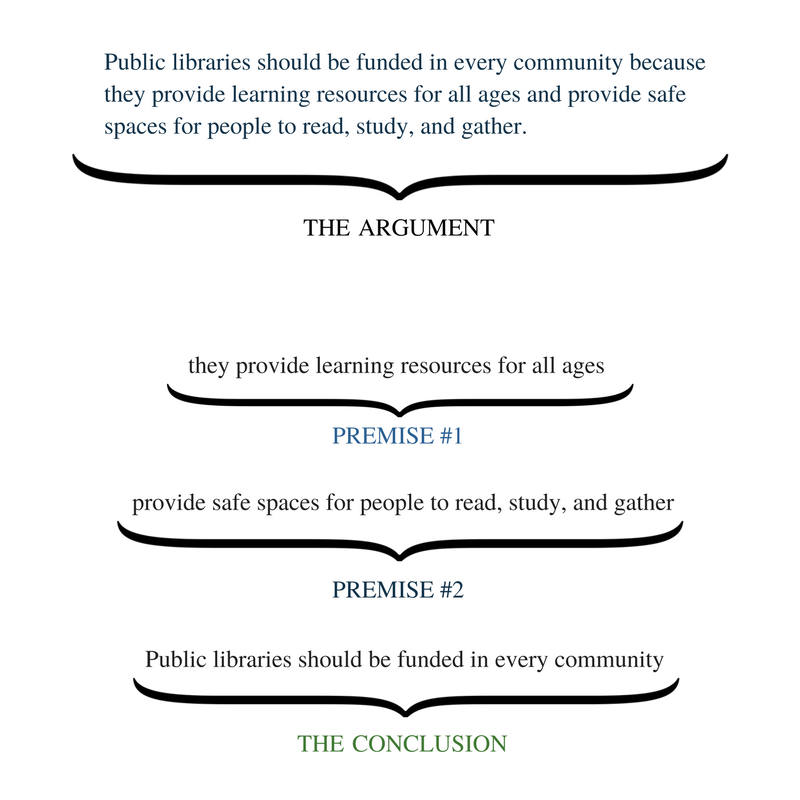
The library reasons are plausible. Libraries often do provide learning resources and places to read, study, and gather. But “plausible” is not the same as “settled beyond question,” and different kinds of premises call for different checks.
Factual reasons: check accuracy, scope, and source
A factual premise says that something happened, exists, causes something, or is likely to occur.
Suppose someone says:
“We should avoid that restaurant because three people got sick after eating there.”
Ask:
- Accuracy: Did those people actually become ill?
- Scope: Was it really three people, and over what period?
- Connection to the source: Is there evidence the restaurant caused the illness, rather than another shared cause?
- Source: Is this firsthand knowledge, a reliable report, or repeated hearsay?
You do not need to demand a research report during an ordinary conversation. The point is to match confidence to evidence. A claim heard secondhand should not carry the same weight as a carefully documented one.
Value reasons: check whether the principle is acceptable
Not every premise is a simple fact. Many arguments include a value principle:
“We should not embarrass family members in public.”
This cannot be checked in the same way as a claim about a date, number, or event. Instead, ask whether the principle is clear, consistent, and appropriate to the situation:
- What counts as “embarrassing” here?
- Does this principle apply to everyone, or only in certain relationships?
- Are there competing values, such as honesty, safety, or accountability?
- Would the speaker accept the principle when it applies to them?
A value premise is not automatically beyond criticism because it is “an opinion.” It can still be examined thoughtfully.
For everyday argument assessment, it is often better to say a premise is acceptable, uncertain, or unacceptable rather than pretending every premise is simply proven true or false.
A useful response is:
“I can see why you believe that reason. What would help us tell whether it is true in this case?”
That question keeps the focus on the reason, rather than on the other person’s intelligence or motives.
Second: check whether the reasons support the claim
Now temporarily set aside whether you agree with the premises. Imagine they are true. Then ask whether they provide the right kind and enough support for the conclusion.
This has two parts:
| Support question | What it asks | Common problem |
|---|---|---|
| Relevance | Does this reason bear on the conclusion at all? | A true but unrelated fact is offered as support. |
| Sufficiency | Does the relevant reason provide enough support for this conclusion? | The conclusion is too broad or too certain for the evidence. |
Relevance: is there a real connection?
Consider:
“We should not hold a review session because the textbook was expensive.”
The textbook may indeed have been expensive. But its cost does not seem to bear on whether a review session would help students prepare. The reason fails the relevance check.
Now compare:
“We should hold a review session because several students are confused about the material, and the exam is next week.”
Whether or not this is enough support, the reasons are at least relevant: student confusion and an approaching exam are connected to the purpose of a review session.
Sufficiency: is the support enough?
A reason can be relevant and still too weak.
“We should permanently ban phones at dinner because you checked your phone once last Tuesday and I felt ignored.”
Let us grant the premise: a phone was checked, and someone felt ignored. That gives a relevant reason to care about phone use at dinner. Yet it is probably not enough to support a permanent rule for every dinner and every person.
Why not? Several possibilities remain open:
- the message may have been urgent;
- the problem may have been repeated interruption rather than phone use itself;
- a more limited rule might solve the problem;
- one incident may not show a general pattern.
The conclusion has reached farther than the reason can carry it.
This does not mean the speaker’s concern should be dismissed. A stronger, better-matched conclusion might be:
“Could we keep phones away during dinner unless there is an urgent reason to check one?”
That revised conclusion is narrower and more directly supported by the experience described.
A good argument is not always the one with the most forceful conclusion. It is often the one whose conclusion is properly sized for its evidence.
A practical counterexample test
One fast way to test support is to look for a possible case in which the reason is true but the conclusion is not.
Ask:
“Could these reasons be true, while the conclusion still turns out to be false or unwise?”
Return to the restaurant argument:
“Three people got sick after eating there; therefore, the restaurant is unsafe and no one should eat there.”
A possible counterexample is that all three people had eaten the same spoiled food somewhere else earlier that day. Or perhaps they had different minor illnesses unrelated to the restaurant. These possibilities do not prove the restaurant is safe. But they show that the stated reason alone does not establish the strong conclusion.
The counterexample test is not a game of inventing far-fetched possibilities to avoid ever accepting a conclusion. The relevant question is whether the alternative is plausible enough that the conclusion needs more evidence.
Read the following focused sections from Judging Arguments – Studies in Critical Thinking. The author uses the terms acceptability, relevance, and sufficiency—a more detailed version of the truth-and-support check—and explains the counterexample method.
Judging Arguments – Studies in Critical Thinking
Read these sections for a careful account of what makes grounds acceptable and what it means for reasons to be relevant and sufficient.
In Section 4.3, begin with the ARS framework. Continue through the discussion of relevance, then read the explanation of sufficiency. Focus on the distinction between a reason having some bearing on a conclusion and providing enough evidence for it. Then move to Section 4.4, “Testing by possible counter-examples.” Read the counterexample method. Notice that counterexamples test the premise-to-conclusion link; they do not, by themselves, show that a premise is false.
A complete check on an everyday argument
Let us put the method together.
Argument: “We should stop discussing politics at family dinners, because the last two discussions became tense and people left upset.”
1. Map it
- Reason: The last two political discussions became tense and people left upset.
- Conclusion: We should stop discussing politics at family dinners.
There may also be an unstated principle:
- Possible hidden premise: If a topic has recently caused distress, it should not be discussed at family dinners.
Making this hidden premise visible is useful. It reveals that the argument is not only about past events; it is also about what a family meal should be for.
2. Truth-and-acceptability check
Ask:
- Did both conversations really become tense?
- Did people leave because of the political topic, or for another reason?
- Is “people left upset” a shared observation, or one person’s interpretation?
- Is the hidden principle acceptable without qualification?
Suppose the factual report is accurate. The argument may still face questions about the principle. A family might value peace at dinner, but also value respectful conversation about difficult issues.
3. Support check
Now grant that the last two conversations did become tense.
- Is that relevant to whether politics should be discussed? Yes.
- Is it sufficient to justify never discussing politics at family dinners? Probably not.
A counterexample is easy to imagine: perhaps the conversations became tense because people interrupted one another, raised their voices, or brought up old grievances. If so, the better conclusion may concern the way politics is discussed rather than a total ban.
A more proportionate conclusion could be:
“Since the last two conversations became tense, we should either avoid politics tonight or agree to discuss one issue at a time without interrupting.”
Notice the difference. The revised claim is not necessarily the final answer, but it is more closely matched to the evidence.
Speak the assessment without escalating the conflict
The truth-and-support check is meant to improve judgment, not to give you a way to announce, “Your logic is bad.” In emotionally charged conversations, critique the reasoning, not the person.
Instead of:
“That makes no sense.”
Try one of these:
- “I understand that experience mattered to you. I am not yet sure it supports such a broad conclusion.”
- “Can we separate whether that happened from what we should do about it?”
- “Even if we agree on that point, what makes this solution the best one?”
- “That reason seems relevant. I think we may need more before deciding.”
- “Could there be another explanation that fits the same facts?”
These sentences are useful because they slow the discussion down. They also give you a speaking structure when your thoughts begin to scatter:
- Name the reason: “You are saying the last two talks became tense.”
- Give your assessment: “I agree that matters, but I do not think it settles the question.”
- Name the missing link: “We still need to ask whether banning the topic is the only response.”
For independent spoken practice, choose one short argument you encounter this week—perhaps in a conversation, a video, or an online post. Say the three sentences aloud. Aim for clarity rather than speed. If recording yourself feels comfortable, listen once for whether you stayed with the single argument rather than expanding into side issues.
Key takeaways
A simple argument check has two essential parts:
- Truth or acceptability: Are the reasons accurate, credible, clear, and reasonable to rely on?
- Support: If the reasons are granted, are they relevant to the conclusion and sufficient for it?
Keep three reminders in mind:
- A conclusion can be true even when the offered argument for it is weak.
- A premise can be true while being irrelevant or insufficient.
- A plausible counterexample can reveal that the conclusion is too broad, too certain, or missing an important condition.
The calm, useful response is often: “That may be true—but does it get us all the way to that conclusion?”
Next, you will learn to recognize three common ways arguments go wrong in conversation: the straw man, the personal attack, and the false dilemma.
Can't find a good explanation? Sign up and we'll make it for you
Sign up