
Welcome back. In the previous lesson, you learned to test an argument by asking whether its reasons are acceptable and whether they genuinely support its conclusion. That method remains useful here—but some exchanges fail even before we reach that check. A person may answer a distorted version of a claim, dismiss the speaker instead of the claim, or pretend that only two choices exist.
This lesson gives you three patterns to notice in short everyday exchanges: the straw man, the personal attack (or ad hominem), and the false dilemma. The aim is not to score points by naming fallacies. It is to keep a conversation attached to the actual issue, especially when a discussion starts to become emotionally charged.
When an argument changes the target
A fallacy is a mistake in reasoning. These three mistakes have something important in common: instead of dealing fairly with the real claim and its reasons, the response changes what is being assessed.
| Pattern | What gets substituted | What to notice |
|---|---|---|
| Straw man | A distorted version of the other person’s claim | “That is not actually what they said.” |
| Personal attack | The speaker’s character, history, or identity | “This attacks the person, not the reason.” |
| False dilemma | An artificially narrow set of options | “Those are not the only possible choices.” |
Recognizing a fallacy does not automatically prove that the other person’s final conclusion is false. It shows that the particular route they used does not settle the matter.
For example, if someone attacks a proposal through a straw man, the proposal might still be mistaken. But it has not been shown mistaken by that response. The original argument still deserves to be addressed.
A useful habit is to pause and identify three things:
- The original claim: What was actually proposed?
- The reply’s target: What is the response criticizing?
- The shift: Did the target change into a more extreme claim, a person, or a forced choice?
That small mental map can prevent you from getting swept into defending something you never said.
Straw man: attacking a distorted position
A straw man occurs when someone replaces another person’s actual position with a weaker, simpler, or more extreme version—then attacks that replacement.
Suppose a family member says:
“Could we keep phones off the table during dinner so we can talk?”
Another person replies:
“So you want to control everyone and ban phones in this house?”
The original position is a limited proposal about phones during dinner. The reply turns it into a sweeping demand for control and a total phone ban. Arguing against the exaggerated version avoids the actual question: would a phone-free dinner be worthwhile?
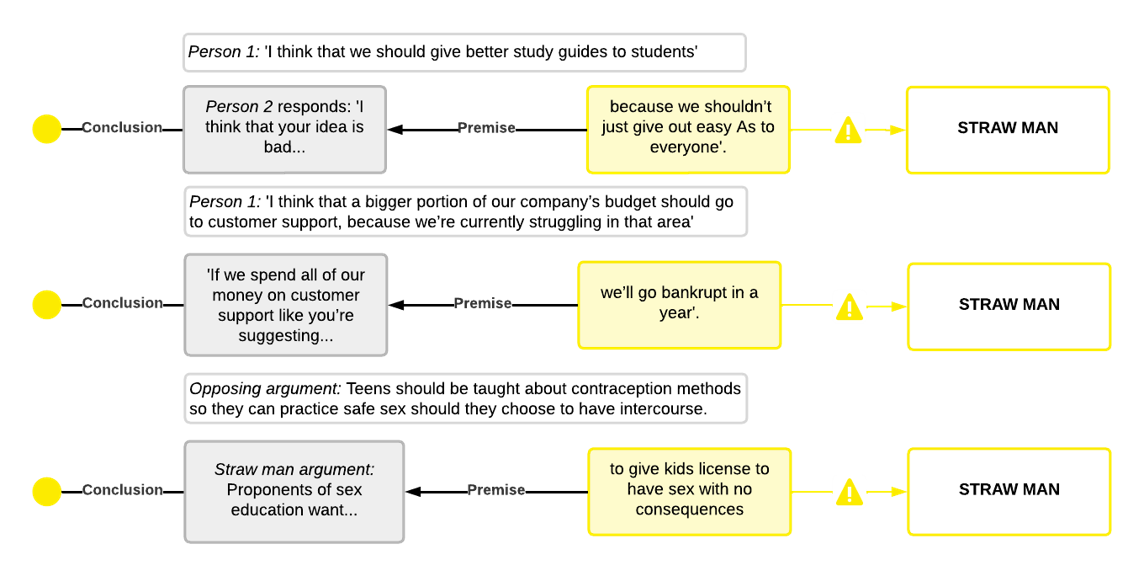
The key comparison is:
| Original claim | Distorted claim |
|---|---|
| “Let’s give better study guides to students.” | “You want to give easy grades to everyone.” |
| “Put a bigger portion of the budget into customer support.” | “Spend all the company’s money on customer support.” |
| “Teach teens about contraception so they can make safer choices.” | “Give children permission to have sex without consequences.” |
A straw man does not have to be deliberately dishonest. Sometimes people genuinely misunderstand, especially when a topic is sensitive or the original claim was stated too quickly. Still, once the distortion appears, the constructive move is to correct it before debating further.
Watch Wireless Philosophy’s short explanation. It gives a clear original-claim versus distorted-claim comparison, then shows that distortion can involve exaggerating a position or oversimplifying it.
CRITICAL THINKING - Fallacies: Straw Man Fallacy [HD]
Watch “CRITICAL THINKING - Fallacies: Straw Man Fallacy [HD]” by Wireless Philosophy for a compact visual model of how a straw man is built.
Begin with the beer ads example, where a proposal to ban television advertisements is wrongly treated as a proposal to ban drinking beer itself. Then watch the four step pattern and note the difference between the original position and its distorted replacement. Finish with a second distortion, which shows that a straw man can also arise by making an idea absurdly simple rather than merely more extreme.
A quick straw-man test
Before using the label, check all three conditions:
- A person stated a position—for example, “We should spend less money on fireworks this year.”
- Someone restated or implied a different position—“You want to cancel all celebrations.”
- They attacked the altered position as though it defeated the original.
If the reply merely disagrees strongly but accurately—“I think cutting the fireworks budget would disappoint people and save little money”—that is not a straw man. It is a direct response to the actual proposal.
Calm ways to correct one
You do not need to say, “That is a straw man fallacy,” particularly in a family conversation. A direct correction is usually more effective:
- “I am not saying we should ban phones altogether. I mean just during dinner.”
- “That is broader than my point. My suggestion was only for this event.”
- “Before we argue about that, can we return to what I actually proposed?”
- “I agree that a total ban would be excessive. That is not the policy I am defending.”
Notice the structure: correct the version, narrow the scope, return to the claim. This is a practical form of staying on topic.
Personal attack: judging the speaker instead of the claim
A personal attack, often called an ad hominem attack, dismisses an argument because of something about the person making it rather than addressing their reasons.
For instance:
A: “The neighborhood should add a pedestrian crossing near the park because cars move quickly there and children cross the road.”
B: “Why listen to you? You do not even have children.”
Whether A has children does not answer the safety reasons offered. B may dislike A or find them inexperienced, but neither fact by itself shows that the crossing is unnecessary.
Personal attacks can take several forms:
- Insult: “Your idea is foolish because you are lazy.”
- Label: “She is just an extremist, so ignore her proposal.”
- Background attack: “He used to work in marketing, so his concerns about the budget are worthless.”
- Hypocrisy charge: “You have broken this rule before, so you cannot say the rule is good.”
The last form is sometimes called tu quoque, meaning “you too.” Hypocrisy may matter in a conversation about trust, consistency, or a person’s conduct. But it does not, by itself, refute a claim. Someone who has failed to follow good advice can still give good advice.
Read the sections on personal attack and false dichotomy in OpenStax’s Introduction to Philosophy. The reading makes an especially useful distinction: information about a speaker can affect how carefully we assess a source, but it does not automatically decide whether their reasoning or conclusion is correct.
5.5 Informal Fallacies - Introduction to Philosophy
Read the “Ad Hominem Attacks” and “False Dichotomy” subsections from OpenStax’s Introduction to Philosophy. Focus on what each move distracts us from: the merits of a claim in one case, and overlooked options in the other.
In the “Ad Hominem Attacks” subsection, read from the explanation beginning with the definition of an ad hominem attack through the examples of direct insult and hypocrisy. Pay particular attention to the tu quoque discussion: it explains why hypocrisy does not by itself disprove an argument. Then read the complete “False Dichotomy” subsection. Begin with its definition and formal either-or pattern; follow formal pattern and then read the concrete citizenship example that follows. Focus on the hidden assumption that two choices are exhaustive.
Not every criticism of a person is a fallacy
This distinction matters. Sometimes a person’s connection to a claim is relevant.
Suppose someone says:
“This bridge is structurally safe.”
If they are the engineer who inspected it, their expertise may be relevant to how much weight we give their testimony. If they are being paid by a company that profits from the bridge’s approval, that possible conflict of interest may also be worth considering.
But neither observation settles the issue. The fair next step is to look for the evidence: inspection reports, methods, independent review, or reasons offered. A relevant concern about credibility is not the same as “They are a bad person, therefore they are wrong.”
When you hear a personal attack, mentally ask:
What did the person actually say—and what reason was given against that statement?
If no reason addresses the statement, the discussion has drifted from argument to personality.
A calm redirect might be:
“We can discuss my experience separately, but does the safety reason I gave hold up?”
False dilemma: pretending there are only two choices
A false dilemma—also called a false dichotomy—presents limited options as if they are the only possibilities, when reasonable alternatives have been left out.
For example:
“Either we allow everyone to speak without any limits, or we oppose free speech.”
This treats a complex issue as two mutually exclusive camps. But there may be many positions between those extremes: broad protection for speech with limits on threats, harassment, fraud, or speech that directly incites violence. The point is not that every middle position is automatically right; it is that the speaker must justify why only two options are available.
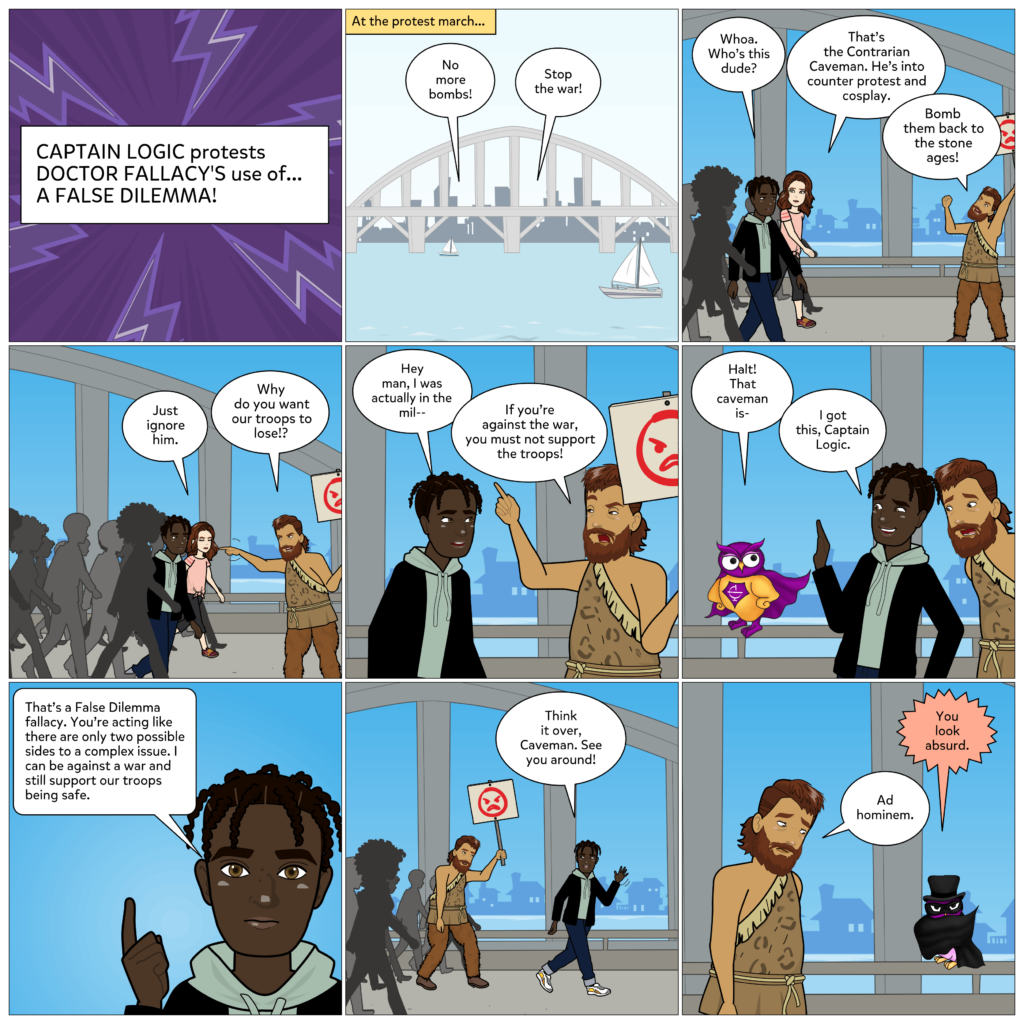
False dilemmas often use emotionally loaded wording:
- “You are either with us or against us.”
- “Either you support this rule, or you do not care about safety.”
- “We can spend money responsibly, or we can help people.”
- “Either we discuss this right now, or you never want to solve anything.”
The pressure comes from making you choose an identity or a moral label, not simply a policy option.
The test: are the options really exhaustive?
Some either-or statements are perfectly reasonable. For a particular light switch at a particular moment, it may be either on or off. In such a case, the two options genuinely cover the possibilities.
A false dilemma arises when the alternatives are presented as exhaustive without sufficient justification. Check:
- Are there really only two options?
- Can both options partly apply?
- Is there a third approach, compromise, delay, condition, or different framing?
- Has one option been defined so vaguely that it absorbs every alternative?
Consider:
“Either we stop discussing politics at family dinners, or every meal will become an argument.”
A third option is available: discuss politics under agreed conditions—one topic at a time, no interruptions, and a pause when voices rise. Another is to avoid the subject on particular occasions rather than permanently. The original two choices do not exhaust the possibilities.
A measured response is:
“I agree that tense dinners are a problem. I do not think a permanent ban and constant fighting are our only choices.”
This response does two useful things: it acknowledges the concern, then introduces a concrete alternative. That is far more productive than simply announcing, “False dilemma.”
A fast method for short exchanges
When a conversation moves quickly, do not try to mentally recite definitions. Use this three-part diagnostic:
| If the response... | Likely issue | Productive return |
|---|---|---|
| Changes “a limited proposal” into “an extreme demand” | Straw man | “My actual claim is narrower than that.” |
| Criticizes the speaker instead of their reasons | Personal attack | “What is the objection to the claim itself?” |
| Insists on only two options despite plausible alternatives | False dilemma | “There may be another option: …” |
Here is a short exchange that contains more than one possible error:
A: “I think the community center should offer one evening class on digital skills.”
B: “So you want the center to become a computer school? That is ridiculous. And you barely understand technology yourself.”
B first turns one evening class into a complete transformation of the center: a straw man. B then attacks A’s supposed lack of technical knowledge rather than the proposed class: a personal attack. A clear response would correct the first shift before even considering the second:
“No—the proposal is one class, not a new computer school. If you think one class would be a poor use of resources, let’s discuss that reason.”
For optional spoken practice, say that response aloud once at a calm pace. Keep it to two sentences: first state the actual claim; then invite a reasoned objection. This is a useful drill for moments when you feel your thoughts becoming scattered.
Key takeaways
Three common reasoning errors change the subject of an argument:
- A straw man distorts the original position and attacks the distortion.
- A personal attack dismisses a claim by attacking the person making it rather than their reasons.
- A false dilemma treats a narrow set of options as the only choices when other reasonable possibilities exist.
The most useful response is usually not a label but a redirection:
- “That is not my actual claim.”
- “Let’s discuss the reason rather than the person.”
- “Those are not the only options.”
You now have the basic tools for finding weak moves in an exchange while staying focused on the real issue. In the next module, the focus shifts from diagnosing arguments to delivering your own view clearly: beginning with how to state a position in one concise sentence before adding detail.
Can't find a good explanation? Sign up and we'll make it for you
Sign up