
Hello. In the last lesson, you learned to separate an argument’s main claim from the reasons offered for it. That map prevents a conversation from becoming a blur of details.
Now we address a different problem: two people can appear to be debating the same topic while actually disagreeing at different levels. One may be disputing what happened; another may be disputing what a word means; a third may agree on both but judge the situation differently. Recognizing the type of disagreement helps you respond to the real point rather than chasing every sentence.
By the end of this lesson, you should be able to classify a disagreement as primarily factual, definitional, or value-based, and use that classification to stay calm and on topic.
Three places a disagreement can live
Consider this statement:
“The community should restrict parking near the school during drop-off time.”
That is a proposed action, but people may disagree about it for very different reasons.
| Primary disagreement | Core question | Example response |
|---|---|---|
| Factual | What is true, happening, likely, or causing what? | “Is traffic actually dangerous at that time?” |
| Definitional | What does a key term mean, or what category does something belong to? | “Does a traffic delay count as a safety problem?” |
| Value-based | What is good, bad, fair, important, serious, or worth prioritizing? | “Even if traffic is risky, is restricting residents’ access fair?” |
These categories are tools for locating the live issue—the point that must be addressed before the discussion can genuinely move forward.
Factual disagreement: what is the case?
A factual disagreement concerns whether something happened, exists, causes something, or is likely to happen. It may involve past events, present conditions, predictions, or cause-and-effect claims.
Examples:
- “The road has become more dangerous.”
- “Most residents support the restriction.”
- “A parking limit would reduce congestion.”
- “The school has received three safety complaints this month.”
A factual claim can be true or false, but it is still factual in type. “There were no complaints” is a factual claim even if records later show that it is mistaken.
When the disagreement is factual, useful next questions are:
- “What evidence would help us decide that?”
- “Where did that number come from?”
- “Are we talking about this month, or the past few years?”
- “What would count as a counterexample?”
The aim is not to demand perfect proof in an everyday conversation. It is to notice that the dispute concerns the world as it is, rather than merely how someone feels about it.
Definitional disagreement: what exactly are we calling this?
A definitional disagreement concerns the meaning, boundaries, or classification of a key term. It asks whether a case belongs in a category, or what standard that category should have.
Examples:
- “Calling that censorship is misleading.”
- “A delayed reply is not the same as ignoring someone.”
- “That is not an emergency; it is an inconvenience.”
- “Is this rule discrimination, or is it equal treatment?”
Definition is not always solved by opening a dictionary. Dictionaries can tell us ordinary usage, but many live disputes concern the criteria that should govern a category in a particular context.
For instance, suppose one person says:
“Checking your phone during dinner is disrespectful.”
Another says:
“It is not disrespectful if I am responding to an urgent message.”
They may agree on the observable facts: the phone was checked, and a message was sent. The disagreement may instead be about what counts as disrespect. Is it any interruption? Repeated interruption? Ignoring a direct question? Breaking an agreed family rule? The conversation improves once the standard is made explicit.
Value-based disagreement: what matters most?
A value-based disagreement concerns evaluation: whether something is good or bad, fair or unfair, serious or minor, wise or unwise, more or less important.
Examples:
- “Privacy matters more than convenience.”
- “That punishment is too harsh.”
- “This is a serious breach of trust.”
- “It is unfair to expect one person to carry all the responsibility.”
Value disagreements are sometimes called normative disagreements because they concern standards for how people ought to act or how situations ought to be judged.
A value-based disagreement is not “just an opinion” in the dismissive sense. People can give reasons for a judgment: they can appeal to consistency, consequences, fairness, duties, harms, relationships, or the needs of those affected. But collecting more data alone may not settle the issue.
For example, two people might agree that a rule will reduce noise:
- Person A: “Then the rule is worthwhile because residents need quiet.”
- Person B: “The reduction is not worth limiting young people’s freedom to gather.”
The factual prediction may be agreed. The remaining disagreement is about how to weigh quiet, freedom, and perhaps community life.
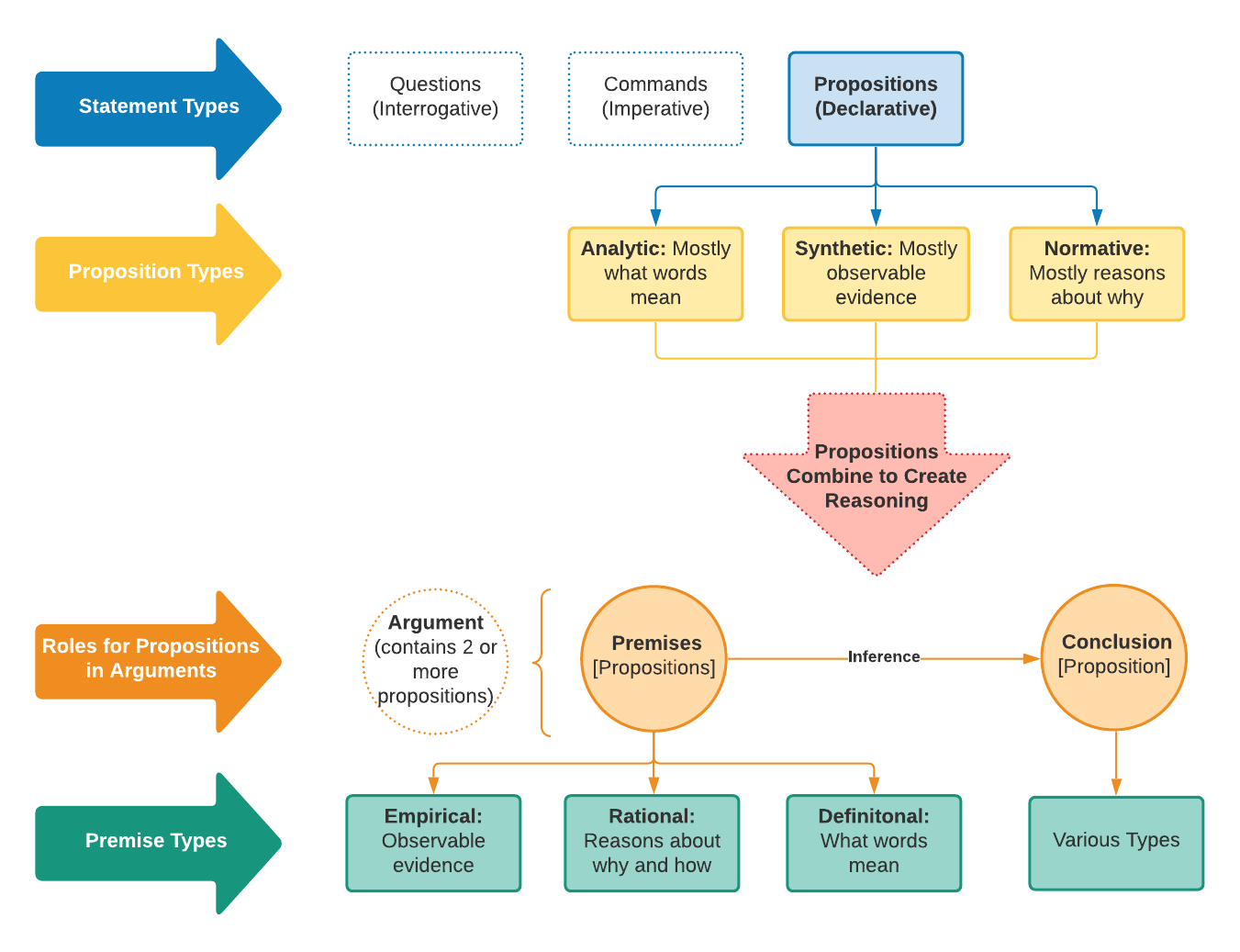
A short guide to fact, definition, and value
The following test is more reliable than hunting for a particular word.
| If the person’s real challenge is... | The disagreement is primarily... | A useful clarifying sentence |
|---|---|---|
| “That did not happen,” “That is not the cause,” or “That prediction is unlikely.” | Factual | “So we need to check what happened or what the evidence supports.” |
| “That is not what this word means,” or “That case does not belong in that category.” | Definitional | “It sounds as though we may be using that term differently. What would count as an example?” |
| “Even if that is true, it is not wrong, serious, fair, or important enough.” | Value-based | “It seems we are weighing the priorities differently.” |
Watch this brief segment for a second explanation of the distinction between factual and value claims. It is especially useful for seeing that factual claims include predictions and causal claims, not just simple reports of past events.
Claims of Fact, Value and Policy | COMMUNICATION STUDIES
In “Claims of Fact, Value and Policy,” Eric Robertson gives concise definitions and concrete examples of factual and value-based claims.
Watch fact claims for reports, descriptions, predictions, and causal assertions. Then watch value claims, focusing on why terms such as “better,” “important,” and “wrong” require a standard of judgment. The later policy category is useful background, but keep your attention on fact and value for this lesson.
One caution: words are clues, not verdicts.
- “Should” often introduces a recommendation: “The council should change the rule.” But the underlying disagreement may be factual (“Will the change work?”), definitional (“Is this really a safety issue?”), or value-based (“Is safety worth this cost to freedom?”).
- “Fair” often signals a value judgment, but the dispute might first be definitional: “What does fair treatment require here?”
- “Because” may introduce either factual support or a value principle.
So do not classify a disagreement based only on one word. Listen for what would have to be resolved for the speakers to make progress.
Find the disagreement beneath the proposed action
In everyday arguments, people often begin with a policy claim—something should be done—but that is rarely the deepest point of conflict.
Imagine this exchange at a community meeting:
A: “The town should add a security patrol to the park. Vandalism has increased.”
B: “I do not think it has increased. A few damaged benches do not prove there is a larger problem.”
This is primarily factual. The immediate issue is whether vandalism has increased. Checking reports, dates, and comparable periods would be relevant.
Now consider a different reply:
B: “Broken benches are a maintenance problem, but calling it vandalism makes it sound as if the park is unsafe.”
This is primarily definitional. The speakers may agree that benches are damaged but disagree about whether that damage should be classified as vandalism, and what that label implies.
Finally:
B: “Even if vandalism has increased, a permanent patrol is too intrusive for a public park.”
This is primarily value-based. The speakers may agree on the evidence and the label, yet differ over security, privacy, public space, cost, or freedom from surveillance.
The proposal—“add a patrol”—is the visible surface. The disagreement underneath determines what a useful response sounds like.
Stasis Introduction - Purdue OWL® - Purdue University
Purdue OWL’s “Stasis Introduction” presents a classical method for locating the exact point where a discussion is stuck. Its categories of Fact, Definition, and Quality closely match the factual, definitional, and value-based distinctions in this lesson.
In the page’s Introduction, read the Fact, Definition, and Quality question lists. Follow the category questions and notice the different questions each category calls for. Briefly notice the Policy list as well: it concerns what should be done, but an action proposal often rests on an earlier factual, definitional, or value disagreement. Then read the subsection “Achieving Stasis.” Read the explanation of stasis. Focus on the idea that discussion drifts when a response does not address the issue currently being disputed.
The word stasis here means a stopping point: the specific issue that must be settled, clarified, or at least recognized before the discussion can advance. You do not have to force agreement. Sometimes the useful achievement is simply being able to say, accurately, “We agree on the facts but judge them differently.”
Mixed disagreements: choose the primary one
Most serious disagreements have more than one layer. That does not make classification useless. It means you should identify the layer that is doing the work right now.
Consider:
“People should not be called selfish for declining invitations when they are exhausted.”
This could generate several disputes:
- Factual: “Does exhaustion make people less able to participate kindly or safely?”
- Definitional: “Does declining an invitation count as selfishness?”
- Value-based: “How much should someone prioritize their own limits over others’ expectations?”
Suppose both people agree that the person was exhausted and agree that declining is technically allowed. But one says, “Family obligations should come before personal comfort,” while the other says, “Personal limits deserve respect.” The disagreement is primarily value-based.
A helpful method is the agreement test:
- Imagine the factual issue were settled.
- Would the people still disagree?
- If yes, imagine the key term were clarified.
- Would they still disagree?
- If yes, the remaining issue is likely value-based.
For example:
- If everyone accepts that the road is dangerous, but they still disagree about whether a restriction is worth the inconvenience, facts were not the main obstacle.
- If everyone agrees that a message was sent during dinner, but they argue over whether that action counts as disrespect, evidence alone will not resolve it.
- If everyone accepts the meaning of “disrespect,” but they differ over how serious it is, the dispute is now value-based.
This is not a rigid sequence. Real conversation moves back and forth. The point is to avoid arguing at one level when the other person is actually speaking at another.
Use classification to stay composed and on topic
When a discussion starts to feel personal, the urge is often to answer the strongest emotional phrase immediately. A classification step gives you a smaller, more manageable task.
Silently ask:
“Are we disagreeing about what happened, what this means, or how it should be judged?”
Then use one calm sentence that identifies the issue without pretending it is already settled.
When the disagreement is factual
“Before we decide what to do, I think we disagree about whether that actually happened often enough to be a pattern.”
When it is definitional
“I think we may be using the word ‘disrespectful’ differently. What behavior would you include under that word?”
When it is value-based
“I understand the concern. I think our real difference is how we are weighing fairness against convenience.”
These are not magic phrases. The other person may reject the classification, change the subject, or introduce a new concern. But each sentence does three useful things:
- slows the pace;
- makes the topic more precise;
- avoids treating a difference in values as though the other person simply does not know the facts.
Avoid using the categories as weapons. Saying “That is just your opinion” usually dismisses a value concern rather than clarifying it. Similarly, saying “That is only semantics” can hide a genuine disagreement about who deserves a label, a right, a responsibility, or a protection.
A brief spoken routine can help when words are harder to track in the moment:
- State the subject in three words: “Phone at dinner.”
- Name the disagreement type: “Meaning of disrespect.”
- Ask one matching question: “What makes it disrespectful in this case?”
This is enough structure to prevent a discussion from expanding into every past conflict, every motive, and every possible solution.
Key takeaways
A disagreement can be primarily:
- factual: about what happened, exists, causes something, or is likely;
- definitional: about a term’s meaning, criteria, or category;
- value-based: about what is good, bad, fair, serious, important, or worth prioritizing.
Many debates include all three. To identify the primary disagreement, ask: What would need to be addressed for these people to move forward? Evidence helps with factual disputes; clearer criteria help with definitional disputes; explicit priorities and principles help with value-based disputes.
The practical payoff is significant: instead of replying to everything at once, you can locate the exact point of disagreement and respond to that point.
Next, you will build on the maps from the first three lessons by using a truth-and-support check: are the reasons offered true or plausible, and do they actually support the claim?
Can't find a good explanation? Sign up and we'll make it for you
Sign up