
Welcome back. In the previous lesson, you learned to locate the main claim: the point a speaker wants you to accept. That gives you an anchor in a fast or emotionally charged conversation.
Now we add the other half of the map: the reasons offered for that claim. By the end of this lesson, you should be able to hear or read a short argument and say, in a neutral way, “Their claim is ___, and their reasons are ___.” This is not yet about deciding whether those reasons are good. It is about accurately seeing what work each statement is meant to do.
A reason is a statement offered to support a claim
An argument has a direction:
- A conclusion is the claim the person wants accepted.
- A reason (also called a premise) is a statement presented as support for accepting that claim.
Consider this brief argument:
“The council should add a pedestrian crossing near the school. Cars move quickly on that road, and many children cross it every morning.”
The conclusion is:
The council should add a pedestrian crossing near the school.
The reasons are:
- Cars move quickly on that road.
- Many children cross it every morning.
A reason is not just any statement near the conclusion. It is a statement meant to make the conclusion more believable, reasonable, or urgent.
A helpful question is:
What has the speaker said that is supposed to support their main claim?
You can also use a temporary acceptance test:
“If I granted this statement for the moment, would it give me some reason to accept the conclusion?”
If yes, it is probably functioning as a reason.
For instance:
“We should postpone the decision. Several members have not read the proposal, and the financial estimate has not been checked.”
If you temporarily grant that members are unprepared and the estimate is unchecked, those facts do give some support to postponing. They are reasons.
Notice the modest language: they give some support. A reason does not have to be true, decisive, or sufficient to count as a reason. Someone can offer a weak reason, a mistaken reason, or a reason that does not really connect to the conclusion. For now, identify it before judging it.
Reasons can take several forms
In everyday discussions, reasons are not always statistics or hard evidence. A reason may be:
- a reported fact: “The bridge has cracks.”
- an observation: “The room was nearly empty last week.”
- a prediction: “Costs will rise next year.”
- a personal experience: “I tried that approach, and it created confusion.”
- a general principle or value: “People affected by a rule should have a chance to understand it first.”
- a comparison: “The neighboring town solved a similar problem this way.”
For example:
“The meeting should begin later, because several people finish work at the current start time.”
The reason is a fact about people’s schedules.
Now compare:
“The meeting should begin later, because participation should not depend on who has the most flexible work schedule.”
Here the reason is a value-based principle about fairness and participation.
Both are reasons. Later in the course, you will learn to distinguish factual disagreements from value-based ones. At this stage, the key point is simpler: both statements are being offered in support of the proposal to begin later.
Follow the direction of support
Words such as because, since, given that, so, and therefore can help you find reasons. But do not merely circle the word and stop. Ask which way the support is flowing.
Compare these two forms:
“The group should pause the discussion because the relevant information has not been checked.”
- Claim: The group should pause the discussion.
- Reason: The relevant information has not been checked.
Now reverse the order:
“The relevant information has not been checked, so the group should pause the discussion.”
The reason and conclusion are the same. Only the order has changed.
A useful pattern is:
| Wording pattern | What usually follows |
|---|---|
| “Claim because reason” | The reason comes after because. |
| “Since reason, claim” | The reason comes after since. |
| “Reason, so claim” | The conclusion comes after so. |
| “Reason. Therefore, claim.” | The conclusion comes after therefore. |
Here is another ordinary example:
“Jordan will probably get the promotion, given that they have been in the role the longest and have led the strongest recent projects.”
The claim is:
Jordan will probably get the promotion.
The offered reasons are:
- Jordan has been in the role the longest.
- Jordan has led the strongest recent projects.
The phrase given that introduces support, but the more important skill is recognizing the relationship: the facts about Jordan are presented to justify the prediction about the promotion.
Identifying Premises and Conclusions
Watch “Identifying Premises and Conclusions” by Kevin deLaplante for a compact demonstration of how ordinary language can be reorganized into claims and supporting reasons.
Watch the first example for the “because” pattern and common conclusion indicators. Then watch the no indicator example, where the speaker identifies the main point by asking what the other statements are meant to justify. Finish with the recap, especially the premise indicators and the distinction between a central message and a justification.
Do not confuse a reason with an explanation
The word because can introduce either a reason in an argument or a cause in an explanation. Context determines which is happening.
Consider:
“The bus was late because an accident blocked the road.”
This normally explains an accepted fact: the bus was late, and the speaker is telling you why. The speaker may not be trying to persuade you that the bus was late; everyone may already agree on that.
Now consider:
“You should not drive tonight because an accident has blocked the road.”
This is more clearly an argument. The speaker is asking you to accept advice: do not drive. The blocked road is offered as support for that advice.
The sentences after because may look similar, but their jobs differ:
- An explanation begins with something treated as already established and tells how or why it happened.
- An argument gives support for a claim the speaker is trying to establish.
In real conversation, the boundary can sometimes be unclear. You do not need to solve every ambiguous case perfectly. Ask: Is this person mainly trying to account for something, or trying to give me grounds to accept a claim or proposal?
Section 1.1: Identifying Arguments – The Art and Science of Critical Thinking
Read the selected parts of “Section 1.1: Identifying Arguments” from The Art and Science of Critical Thinking. It clarifies why “because” does not automatically make something an argument and shows why indicator words are useful but never decisive.
In the opening section, find the discussion immediately after the investment example. Read the argument example, then continue through the contrasting Earth-warming explanation and the following examples. Focus on the question: is the speaker trying to establish a claim, or explain one assumed to be true? Next, scroll to the subsection that begins “It is essential first that we be able to distinguish the argument's premises from the conclusion.” Read the conclusion-indicator discussion and indicator list. Then locate the table titled “Some Common Premise Indicators.” Read the table and the paragraph beginning the context warning. Keep the larger lesson in mind: words are clues; the role a statement plays is what matters.
Map the reasons before you answer
When a speaker gives several reasons, do not feel obliged to reply to them immediately. First make a simple map.
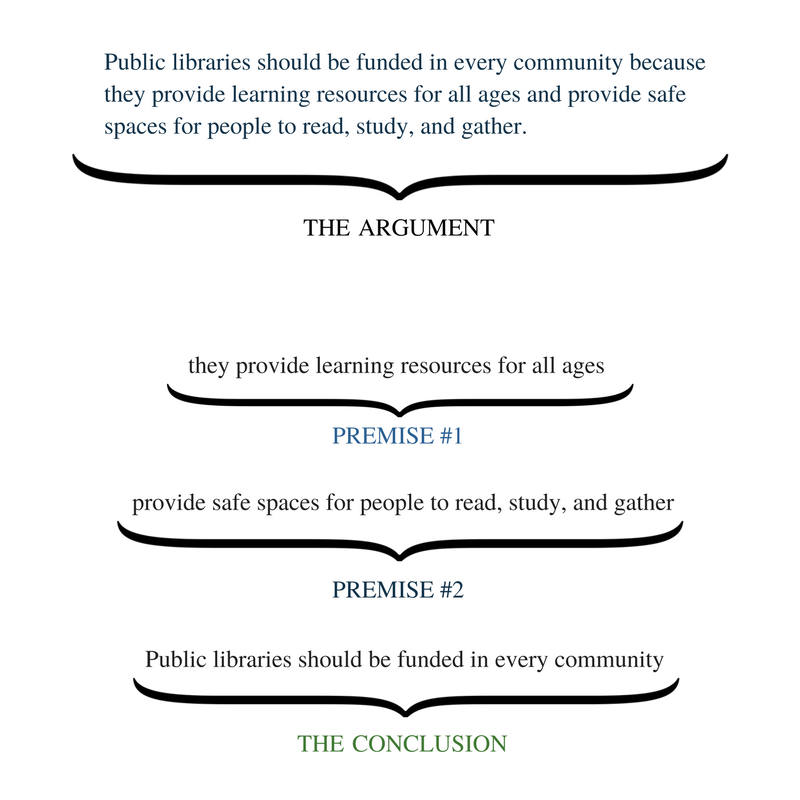
The library-funding diagram has this structure:
- Claim: Public libraries should be funded in every community.
- Reason 1: They provide learning resources for all ages.
- Reason 2: They provide safe spaces for people to read, study, and gather.
This map is more useful than trying to keep the full original sentence in your head. It turns a long statement into a few manageable pieces.
You may also notice that the reasons rely on an unstated thought such as: “Services that provide these public benefits deserve community funding.” That may be an important assumption when evaluating the argument later. But distinguish it from the reasons actually offered. Do not put words into someone’s mouth merely because their argument seems to rely on them.
Here is a second example:
“We should not change the community rules tonight. The proposal was distributed only this afternoon, several residents cannot attend this meeting, and the wording has not been translated for everyone affected.”
A clean map is:
- Claim: Do not change the community rules tonight.
- Reason 1: The proposal was distributed only this afternoon.
- Reason 2: Several residents cannot attend.
- Reason 3: The wording has not been translated for everyone affected.
All three reasons point toward the same practical conclusion. You do not have to decide immediately whether they prove the conclusion. First, make sure you have identified them accurately.
Separate reasons from nearby material
Real discussions include more than claims and reasons. A person might also add background, repetition, emotion, a rhetorical question, or a vivid example. These may matter, but they do not automatically count as separate reasons.
Consider:
“We need to repair the playground. Last week I saw a child trip near the broken gate. It was frightening. The gate has been damaged for months, and the loose metal could injure someone else.”
A useful map is:
- Claim: The playground needs repair.
- Reason 1: The gate has been damaged for months.
- Reason 2: The loose metal could injure someone.
- Example or illustration: A child tripped near the gate last week.
- Emotional reaction: It was frightening.
The story of the child may support the claim too, depending on how the speaker uses it. But “It was frightening” mainly tells you the speaker’s reaction. It does not, by itself, give a separate reason why the playground needs repair.
When listening, you can quietly sort statements into three mental boxes:
- The point: What do they want done or believed?
- The support: What reasons are they giving?
- The rest: Examples, tone, background, repetition, and reactions.
This sorting is especially useful when you feel your body becoming activated. It gives your attention a concrete task other than preparing a quick counterattack.
A spoken routine for staying oriented
In a family disagreement, a person may give five reasons at once, mix in an accusation, then repeat the conclusion more loudly. You do not need to memorize every word. Catch the structure.
Use this short internal routine:
-
Name the claim silently.
“They want us to postpone the decision.” -
Catch no more than two or three reasons.
“They say people are unprepared, key people are absent, and the wording is unclear.” -
Reduce each reason to a few words.
“Unprepared. Absent. Unclear.” -
Only then decide what to say.
This is not avoidance. It is a way of responding to what was actually argued rather than to the loudest phrase or the most irritating detail.
If you need to speak, a neutral sentence can buy you time and prevent drift:
“So your main point is that we should wait, mainly because people have not had time to review it and some affected people are missing.”
That sentence does not concede the conclusion. It shows that you have identified the structure. It also makes it easier to disagree precisely: perhaps you accept that people are missing but think a delay is unnecessary, or perhaps you question whether the proposal was truly unavailable.
A brief private practice method is to choose one short opinion from a conversation, podcast, or article and record yourself saying only:
“The claim is ___. The reasons offered are ___, ___, and ___.”
Aim for twenty seconds. The discipline is to name reasons rather than retell the whole conversation.
Key takeaways
A reason or premise is a statement offered in support of a claim. To identify reasons:
- first locate the main claim;
- ask what statements are meant to make that claim more acceptable;
- use words such as because, since, given that, so, and therefore as clues, not mechanical rules;
- distinguish arguments from explanations by asking whether the speaker is trying to establish a claim or explain an accepted fact;
- separate reasons from examples, emotional reactions, background, and repetition;
- map a spoken argument briefly: claim, reason one, reason two.
You are not yet deciding whether a reason is true or strong. Accurate identification comes first.
Next, you will examine a different source of confusion in disagreements: whether people are disagreeing mainly about facts, definitions, or values.
Can't find a good explanation? Sign up and we'll make it for you
Sign up