
Hello, and welcome. This course develops two connected abilities: recognizing the structure of an argument and participating in disagreement without losing clarity or composure. We begin with the smallest useful unit: finding the main claim—the point a person is trying to get you to accept.
In family or community discussions, people rarely announce their reasoning in a neat format. They may begin with a story, move to an accusation, add several examples, and only indirectly reveal what they want done. If you can quietly identify the central point, you gain a way to stay oriented: you do not have to answer every sentence at once.
By the end of this lesson, you should be able to hear or read a short argument and state its main claim in one clear sentence.
An argument is not merely a disagreement
In ordinary conversation, “argument” can mean a quarrel. In philosophy and critical thinking, it means something more neutral:
An argument is a set of reasons offered in support of a conclusion.
The conclusion is the main claim: what the speaker wants you to believe, accept, or do. The supporting statements are called premises or reasons. We will focus today on identifying the conclusion; the next lesson examines reasons more closely.
For example:
“You should bring an umbrella because it looks as though it will rain.”
The main claim is not the weather forecast. It is:
You should bring an umbrella.
The forecast is offered to support that claim.
This distinction matters because a discussion can contain many true, emotional, vivid, or controversial statements without all of them being the point under dispute. A person may say, “The buses have been unreliable all month, I have been late twice, and the walk from the stop is unpleasant. We should allow remote work on severe-weather days.” The details may be important, but the speaker’s central proposal is the final sentence.
A conclusion is also not necessarily the last thing said. It is the statement that the other material is trying to support.
Identifying Premises and Conclusions
Watch “Identifying Premises and Conclusions” by Kevin deLaplante for a compact introduction to the distinction between a main point and its supporting material.
Watch the first example to see how “because” reveals the direction of support. Then watch unstated markers, where the video shows how to identify a conclusion even when an argument has no obvious signal words. Focus on the recurring question: what is the speaker trying to persuade us to accept?
The central question: “What am I being asked to accept?”
The most reliable way to find a main claim is not to search mechanically for a particular word. Instead, ask:
What does this person want me to believe, agree to, or do?
This question directs attention away from the topic and toward the speaker’s position.
Consider:
“Our neighborhood has only one small park, and it is crowded most afternoons. Children have nowhere nearby to play. The council should convert the unused lot into a second public green space.”
- Topic: parks or neighborhood space
- Supporting material: the current park is small and crowded; children lack space
- Main claim: the council should convert the unused lot into a public green space
The topic is not yet a claim. “Public green space” tells you what the conversation concerns; it does not tell you what the speaker is arguing. Likewise, the most detailed sentence is not necessarily the conclusion.
A useful way to make the distinction is to imagine a listener asking, “All right—but what do you want us to conclude from that?” The answer is usually the main claim.
A direction-of-support test
Once you have a possible main claim, test it:
- Put the other statements first.
- Add the word therefore.
- Put your candidate claim last.
For the park example:
The current park is crowded and children lack nearby places to play. Therefore, the council should convert the unused lot into a public green space.
The test works because reasons point toward the conclusion. It does not tell you whether the argument is good, fair, or true. It only helps you map its structure. Evaluation comes later in the course.
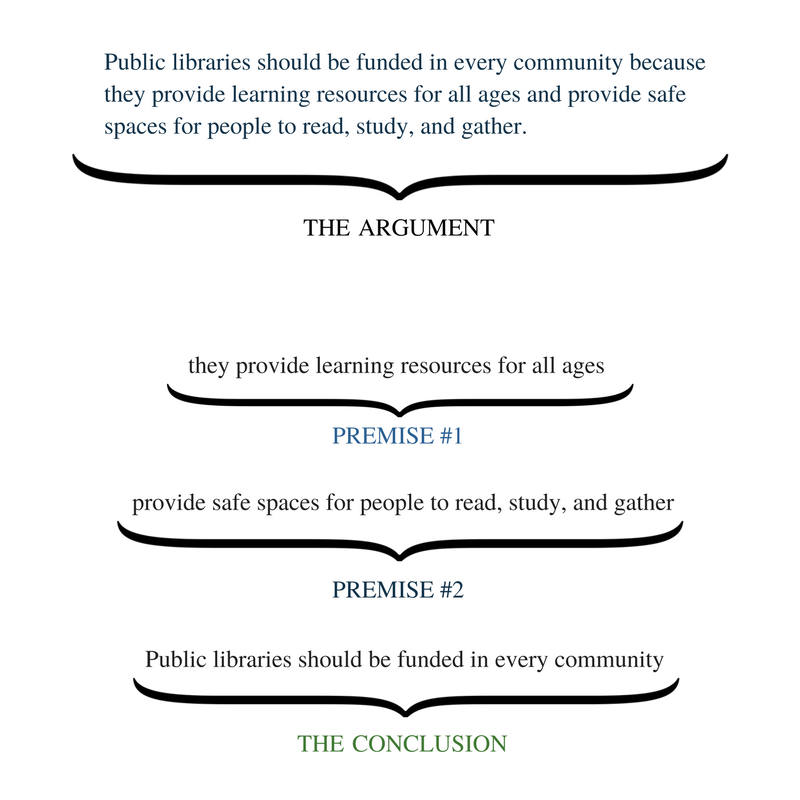
The library diagram also shows an important habit: state the conclusion in a short, complete form. Do not answer merely “libraries” or “funding.” Say: “Public libraries should be funded in every community.”
Signposts help—but do not replace thinking
Speakers and writers often use words that signal how their statements fit together. These are useful clues, particularly when you are trying to follow speech in real time.
Common conclusion indicators include:
- therefore
- so
- thus
- hence
- consequently
- as a result
- we conclude that
- the point is that
Common reason indicators include:
- because
- since
- given that
- for the reason that
- seeing that
The placement of the word matters. Compare:
“It is flu season, so you should consider vaccination.”
Here, so introduces the conclusion: you should consider vaccination.
“You should consider vaccination because it is flu season.”
Here, because introduces the reason, while the conclusion comes before it.
Thus, do not adopt the rule “the sentence after because is the conclusion.” It is usually the opposite. Ask what the statement after because is doing: it gives a reason for the statement before it.
5.3 Arguments - Introduction to Philosophy
Read the opening of OpenStax’s “5.3 Arguments” to reinforce the vocabulary of conclusion and premises, then use its practical method for locating the main point.
In Section 5.3, begin with the definition and example. Then read the subsection “Getting to the Premises,” beginning at the identification method. Pay particular attention to the question about what a person is trying to make you accept, and to the difference between conclusion and premise indicator words.
Indicators are clues, not guarantees. In ordinary speech, someone may say “so” as a filler (“So, anyway…”), or omit signposts completely. The underlying question remains the same: Which statement is the overall point, and which statements are offered to make that point more believable?
When the claim is implied
Sometimes a person never says their conclusion in a polished, explicit sentence. This is common in tense conversations: people can list complaints and assume that everyone knows the requested outcome.
Imagine someone says:
“We have discussed this for an hour. We still have not agreed on the facts, and everyone is getting frustrated. Let’s return to it tomorrow after we have checked the information.”
The main claim is explicit but informal:
We should pause this discussion and return to it tomorrow after checking the information.
Now consider a more implied version:
“We have been here an hour. No one has checked the information, and everyone is getting frustrated.”
There may be no complete argument yet. The speaker could be suggesting a pause, demanding that someone check facts, expressing frustration, or merely reporting the situation. Do not force a definite conclusion where the person has not made one. A constructive response would be a clarifying question, such as: “Are you suggesting that we pause and check the information before continuing?”
That restraint is philosophically valuable. Identifying an argument accurately is different from guessing a person’s motives or supplying a stronger position for them.
A practical spoken-listening routine
When someone is talking quickly or emotionally, use this short internal routine:
- Set aside tone for a moment. A raised voice, sarcasm, or a moving story may matter to the relationship, but it does not by itself tell you the conclusion.
- Listen for a position. Is the person claiming that something is true, false, good, unfair, possible, or necessary? Are they proposing an action?
- Ask the acceptance question. “What do they want me to accept?”
- Check the direction. Are the other statements meant to support this candidate claim?
- State it briefly in your own words. If you need a paragraph to name the main point, you may be mixing the conclusion with its reasons.
For example:
“We should not decide on the new rule tonight. Half the group has not read it, and we have only heard one interpretation of it.”
A focused identification is:
The group should postpone the decision on the new rule.
It would be less accurate to say, “The main claim is that half the group has not read the rule.” That is a reason supporting the proposal, not the proposal itself.
One claim, not every claim
Short arguments often contain several claims. The goal is to identify the main one: the claim with the largest job in the argument.
Take this example:
“The library is open only during standard work hours. Many residents cannot visit then. Extending its evening hours would make the service available to more people, so the library should stay open two evenings each week.”
There are several claims here:
- The library is open only during standard work hours.
- Many residents cannot visit then.
- Longer hours would increase access.
- The library should stay open two evenings each week.
The final claim is the main conclusion because the others function as a case for it.
Arguments can also contain smaller arguments inside larger ones. For now, work with short exchanges and ask only: What is the overall point of this speaker’s turn? Later, you will learn to separate and assess the individual reasons.
A related caution: not every “because” sentence is an argument. Compare:
“The meeting was canceled because the organizer is ill.”
This may simply explain an accepted fact: the meeting was canceled. But if a person says:
“We should postpone the meeting because the organizer is ill,”
they are asking you to accept a recommendation. That is clearly an argument. Context tells you whether the speaker is trying to establish a claim or merely explain one.
A brief aloud practice method
Because speaking can make it harder to hold a thread, practice this skill out loud in a deliberately short format. Choose a short opinion from a conversation, article, or video and say only:
“The main claim is that ___.”
Then add one separate sentence:
“The speaker supports it by saying ___.”
Keeping these statements separate trains you not to blur the point with the supporting detail. If you record yourself, listen for whether your first sentence names one definite claim rather than retelling the entire exchange.
You can also use this as a calming tool in a live disagreement. Before replying, silently translate a long or emotionally charged statement into one neutral sentence. This does not mean you agree with it. It means you know what you would be disagreeing with.
Key takeaways
A philosophical argument is a set of reasons offered in support of a conclusion. The main claim or conclusion is what the speaker wants you to accept; the other statements typically function as support.
To find it:
- ask, “What am I being asked to believe, agree to, or do?”
- use words such as therefore, so, and because as clues, while checking their direction;
- distinguish the topic, the supporting details, and the overall position;
- state the result in one short, neutral sentence;
- do not invent a conclusion when the speaker has only implied one unclearly.
Next, you will build on this map by identifying the reasons offered in support of a claim.
Can't find a good explanation? Sign up and we'll make it for you
Sign up