
In our previous lessons, we've thoroughly analyzed the Engineering Change Order (ECO) for our BIW bracket. We uncovered significant risks, first from a Design for Assembly (DFA) perspective regarding weld gun access, and then from a Design for Manufacturability (DFM) viewpoint concerning the stamping die and springback. These reviews are essential, but their findings are just conversations and notes until they are formally documented.
Today, we will take that critical next step. Our objective is to update the Design Failure Mode and Effects Analysis (DFMEA) to reflect the design changes from the ECO. The DFMEA is the official record of design risk in automotive engineering. By updating it, we convert our analysis into a documented, trackable action plan that holds us accountable for mitigating the risks we've identified before they become costly problems in production.
1. The DFMEA: From Academic Exercise to a Living Document
You're familiar with DFMEA from your university studies, but in industry, it's not a static document you create once. It is a "living document" that must evolve with the design. An ECO is a primary trigger for reviewing and updating the DFMEA.
The modern automotive industry, guided by the AIAG & VDA, has standardized this process into a 7-step methodology.
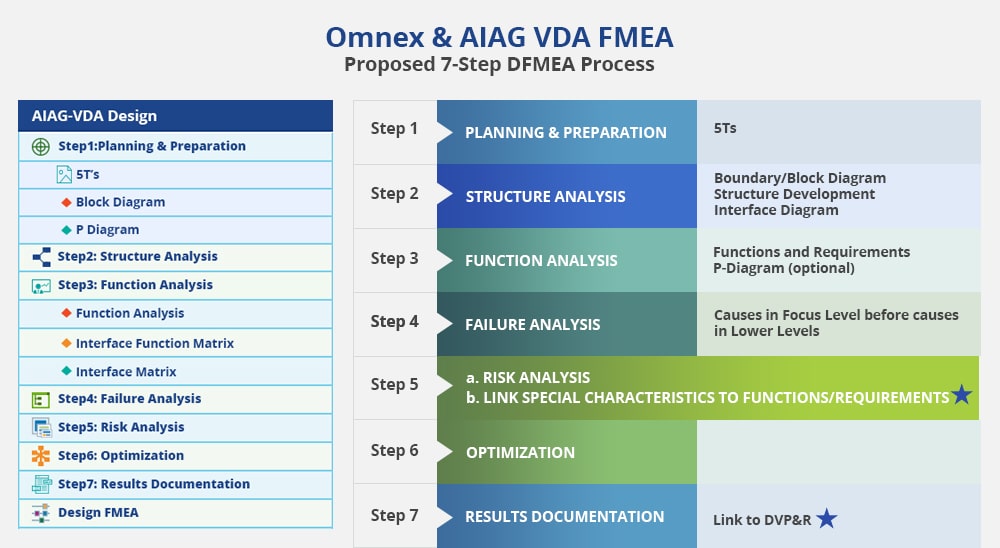
When we update an FMEA, we are essentially re-executing this loop:
- Failure Analysis: Have we introduced new potential failure modes? (Yes, we have.)
- Risk Analysis: What is the new level of risk for Severity (S), Occurrence (O), and Detection (D)?
- Optimization: What actions must we take to reduce this new risk to an acceptable level?
Let's do a quick refresher on the core concepts.
FMEA, the 10 Step Process to do an FMEA (PFMEA or DFMEA)
The video "FMEA, the 10 Step Process to do an FMEA" from CQE Academy provides a solid overview of the FMEA workflow. While it describes a 10-step process, the core concepts are identical to the 7-step model.
Focus on these key definitions as a refresher: DFMEA vs. PFMEA: A clear distinction. We are focused on design failures. Failure Mode: What might go wrong? Effects: What is the impact on the end-user or downstream process? This drives Severity. Causes: The root cause of the failure. This is what our corrective actions will target. Controls, Detection, and RPN: How we currently prevent or find failures, and how we score the overall risk.
2. Translating ECO Risks into DFMEA Line Items
Now, let's apply this to the bracket ECO. We will take the risks we identified in the previous lessons and translate them into formal DFMEA entries. A typical DFMEA form looks like this:
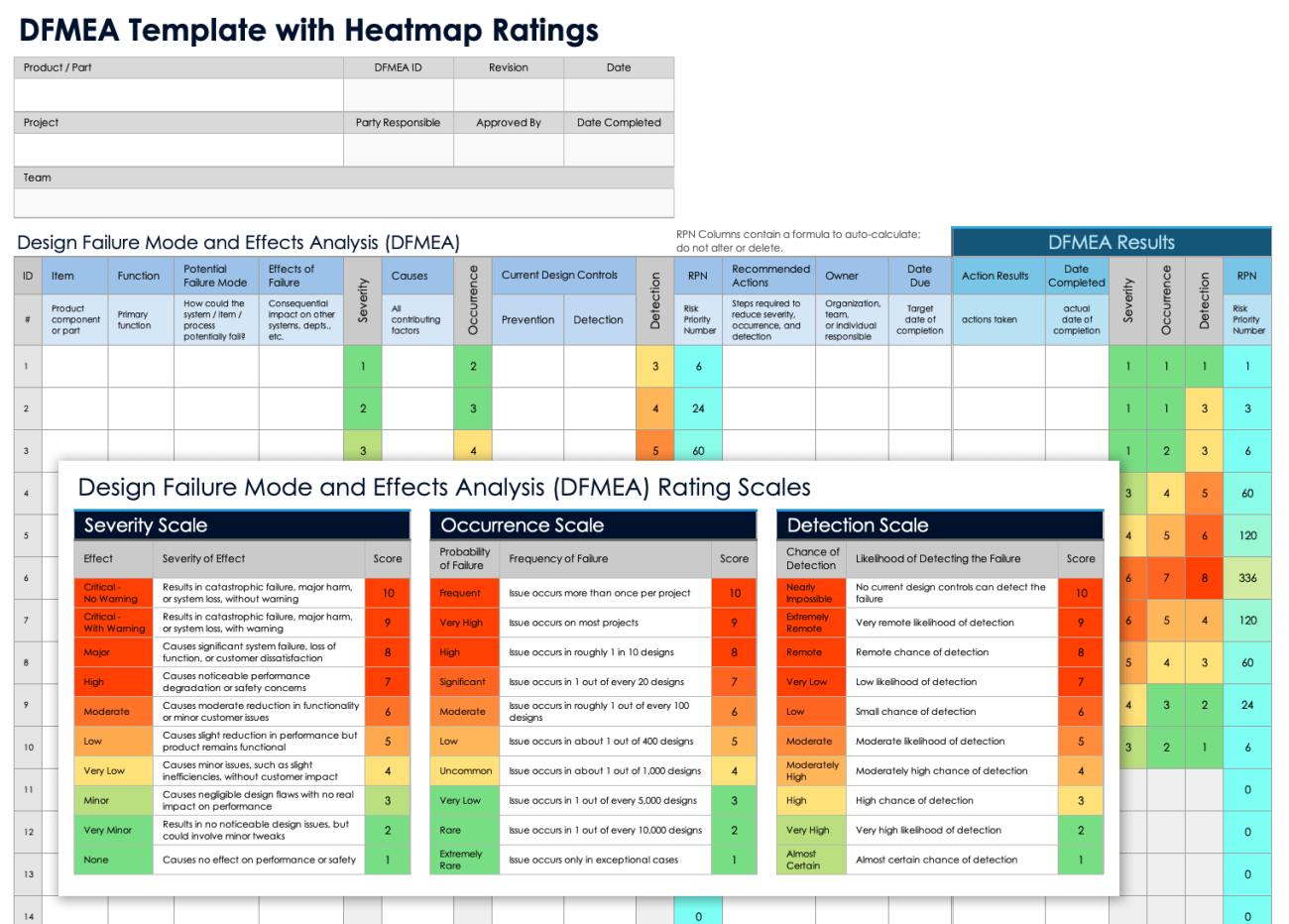
Example 1: Stamping Springback Risk
In the last lesson, we determined that adding a gusset to the DP600 steel bracket would fundamentally change its springback characteristics.
- Item/Function: Bracket Body / Provide a mounting interface at 90° ± 0.5° to the A-pillar inner.
- Potential Failure Mode: Bracket flange angle is out of specification (e.g., measures 93° after forming).
- Potential Effect of Failure: Poor fit-up to mating panel in BIW, creating a gap. Leads to dimensional instability in the body shell and requires shimming or rework. Potential for inconsistent weld quality.
- Severity (S): This affects a key vehicle dimension and assembly quality. Let's rate it as S=8.
- Potential Cause of Failure: Unpredicted springback behavior due to the added stiffness of the ECO gusset. The original die's springback compensation is no longer valid.
- Current Prevention Controls: Original FEA forming simulation and die compensation for the simple L-bracket. These are now ineffective for the new design.
- Occurrence (O): Given the material (DP600) and the significant change in geometry, a change in springback is almost certain. Let's rate it as O=7.
- Current Detection Controls: CMM layout of first-off parts from the modified tool.
- Detection (D): The CMM will catch the defect, but only after the expensive tool has been machined incorrectly. This is detection, not prevention. Let's rate it as D=5.
Risk Prioritization: From RPN to Action Priority (AP)
Traditionally, we would calculate the Risk Priority Number (RPN): . This high number signals a need for action.
However, the new AIAG-VDA standard emphasizes Action Priority (AP) over RPN. AP uses a logic table that prioritizes high severity above all else. You don't need to memorize the table, but you must understand the logic: a high-severity item (like S=8, 9, or 10) will almost always result in a "High" or "Medium" AP, demanding action, even if Occurrence or Detection is low.
For our S=8, O=7, D=5 example, the AP would be High (H).
- Recommended Action:
- Perform new forming simulation with ECO geometry to establish a new springback prediction.
- Assign responsibility to the Simulation Engineer.
- Set a target completion date.
- Follow-up Action:
- Update forming die compensation based on simulation results.
- Assign to Tooling Engineer.
3. Your Task: Update the Bracket DFMEA
Below is a simplified version of the original DFMEA for the simple L-bracket, before the ECO.
| Item | Function | Failure Mode | Effect(s) of Failure | S | Cause(s) | O | Prevention Controls | D | Detection Controls | AP |
|---|---|---|---|---|---|---|---|---|---|---|
| L-Bracket | Resist in-service loads | Bracket cracks at bend radius | Loss of structural integrity, potential rattle | 7 | Bend radius too small for DP600 material, creating stress concentration | 3 | Follow corporate design guide for HSS bend radii | 2 | Physical durability testing on prototype parts | M |
| L-Bracket | Provide stable mounting | Hole pattern position out of spec | Misalignment with mating parts, cannot install fasteners | 6 | Incorrect flat pattern development | 4 | CATIA sheet metal workbench calculation | 4 | CMM Layout on first-off parts | M |
Now, it's your turn. Your task is to update this DFMEA by adding a new line item to address the weld gun access risk we identified in our DFA review two lessons ago.
Use the following information to fill in a new row in the DFMEA:
- Function: Provide clearance for weld gun access to all specified weld locations.
- Failure Scenario: The new gusset physically blocks the throat of the standard robotic weld gun, making it impossible to reach a critical spot weld on the main flange.
- Consequence: The automated BIW line will fault. This requires either a costly manual welding operation or an emergency redesign of the part or process.
- Likelihood: This depends on the specific weld gun model and access path, but it's a known risk with this type of geometry change.
- Controls: The primary control is a robotic simulation (e.g., in CATIA/DELMIA or Process Simulate), which should happen before tooling is finalized.
Challenge: Fill in the values for Failure Mode, Effect(s) of Failure, S, Cause(s), O, Prevention Controls, D, and determine if the AP should be High, Medium, or Low. Finally, propose a "Recommended Action."
Click here to see my proposed DFMEA update.
Here is how I would add the new line item to the DFMEA. Your ratings might differ slightly, which is normal, but the logic should be similar.
| Item | Function | Failure Mode | Effect(s) of Failure | S | Cause(s) | O | Prevention Controls | D | Detection Controls | AP |
|---|---|---|---|---|---|---|---|---|---|---|
| L-Bracket (ECO) | Provide clearance for weld gun access | Weld gun interference (no access to weld spot) | Inability to complete assembly sequence in automated station. BIW line stoppage. Requires manual rework or process deviation. | 9 | ECO gusset geometry interferes with weld gun throat/shanks. | 5 | Initial weld study on baseline design (no longer valid). | 3 | Robotic weld simulation (Process Simulate). | H |
- Failure Mode: Weld gun interference (no access to weld spot). This is a concise, technical description of the failure.
- Effect(s) of Failure: BIW line stoppage and need for manual rework. This is a severe impact on production.
- Severity (S): 9. A line stoppage is one of the most severe manufacturing consequences short of a safety issue.
- Cause(s): ECO gusset geometry interferes with the weld gun. The root cause is the design change.
- Occurrence (O): 5. This is a reasonable estimate. It's a significant risk, but not guaranteed to happen; it depends on the specifics.
- Prevention Controls: The old weld study is no longer valid, so there is effectively no prevention for this new design.
- Detection (D): 3. Robotic simulation is a very effective detection method. If performed correctly, it has a high chance of catching this issue.
- Action Priority (AP): High. With a Severity of 9, the AP will be High regardless of the O and D scores. This is a non-negotiable risk that must be addressed.
Recommended Action:
- Action: Conduct new robotic weld access simulation study using the specified plant weld gun model against the ECO bracket geometry.
- Responsibility: Manufacturing Engineer / Robotics Simulation Team.
- Target Date: [Date before tooling steel is cut]
Conclusion
In this lesson, you have translated abstract risks into the formal, structured language of an FMEA. This is a fundamental skill for a design engineer, turning you from a problem-spotter into a problem-solver. You have seen how the DFMEA serves as the definitive log of design risk and the engine that drives corrective actions.
Key Takeaways:
- The DFMEA is a living document that must be updated whenever a design change, like an ECO, is introduced.
- The AIAG-VDA 7-step process provides the framework for this update, focusing on analyzing new failure modes and optimizing the design.
- Risks identified in DFM and DFA reviews must be formally captured in the DFMEA with clear failure modes, effects, causes, and S-O-D ratings.
- Action Priority (AP) is the modern standard for prioritizing risk, emphasizing high-severity issues to ensure that the most critical potential failures are always addressed.
The "Recommended Actions" we just defined are the starting point for our final validation activity. In our next lesson, we will learn how to use these actions to create a Design Verification Plan & Report (DVP&R), which is the master plan for all the testing required to prove our design is robust and ready for production.
Can't find a good explanation? Sign up and we'll make it for you
Sign up