
Hello! Welcome to your next lesson in "Leveraging Predictive Analytics for Performance."
In our last lesson, we focused on developing the critical judgment needed to assess a model's reliability, deciding when to trust its outputs and when to rely on human expertise. This is vital for managing existing analytics systems. But what happens when you identify a new business opportunity where a predictive model could be the solution? How do you get that idea off the ground and ensure it delivers real value?
This lesson will equip you to answer that question. Today, you will learn how to formulate a business case and project brief for commissioning a predictive analytics project. This is a cornerstone skill for any marketing leader transitioning into a more strategic role. It's the formal process for translating a business challenge into a well-defined project that your technical team or an external vendor can successfully execute.
1. The "Why": Building a Compelling Business Case
Before any technical work begins, you need to justify the investment. A business case is a formal document or presentation that argues for a specific course of action by weighing its costs and benefits. It's your tool for convincing stakeholders (like the CFO or CEO) that this project is a sound investment.
To start, let's get a clear, concise definition of what a business case entails.
What is a Business Case? Project Management in Under 5
This short video, 'What is a Business Case?', provides a great high-level overview of the core concept. Think of it as weighing the pros and cons on a scale.
Please watch the video from the beginning to 1:45 and then from 2:37 to 4:04. Focus on the idea of a cost-benefit analysis and the two types of business cases: one for advocacy and one for impartial decision-making.
For a predictive analytics project, the business case is particularly important because the benefits can seem abstract and the risks are unique. A great business case for an AI project moves beyond "this would be cool to have" and builds a rigorous argument for its value.
The AI solutions provider SAS has an excellent guide on this. We'll use its structure to walk through the essential components.
We will use 'THE AI BUSINESS CASE GUIDE' by SAS to structure our thinking. This guide provides a professional, step-by-step framework for justifying an AI investment.
Please read pages 4 through 7. This covers 'Know your stakeholders,' 'Frame the challenge,' 'Describe the risk of doing nothing,' and 'Show the positive impact.' Focus on how you would translate these concepts into your marketing context.
Drawing from that guide, here are the key pillars of a strong business case for a predictive marketing project:
-
Frame the Business Challenge: Start with a problem that stakeholders care about, using business language, not technical jargon.
- Bad: "We need a neural network to predict user LTV."
- Good: "We are currently investing the same amount to acquire every customer. We believe a significant portion of our budget is wasted on acquiring low-value customers who churn quickly, driving up our overall CAC-to-LTV ratio."
-
Define the Objective and Positive Impact: Clearly state what you want to achieve and how it will benefit the business.
- Objective: "To develop a predictive model that estimates the 12-month LTV for new users at the point of acquisition."
- Impact: "This will allow us to focus acquisition spend on channels and campaigns that deliver high-potential customers, aiming to improve our LTV/CAC ratio by 20% within six months of implementation."
-
Describe the Risk of Inaction: What happens if you do nothing? This creates urgency. This leverages the "fear of missing out" (FOMO) that the SAS guide mentions.
- Example: "If we continue with our current uniform acquisition strategy, our paid media efficiency will likely continue to decline. Meanwhile, competitors who are leveraging predictive acquisition are likely gaining a durable cost advantage, allowing them to capture more market share."
-
Estimate the ROI and Required Investment: This is where you talk numbers. You don't need to be perfect, but you need a defensible estimate.
- Investment: Costs for data scientists, engineering time, potential software/platform costs.
- Return: Calculate the potential financial upside. For example: "If we shift $500k in annual ad spend from low-LTV-prospecting campaigns to high-LTV-prospecting campaigns, and our model is even moderately successful, the incremental LTV gained could be $1.5M, representing a 3x ROI on the initial investment."
2. The "What": Identifying Opportunities for Predictive Analytics
Now that you know how to frame the business case, how do you spot the right opportunities in your day-to-day marketing operations? Given your computer science background, you'll find the underlying logic here straightforward. Most predictive analytics use cases in marketing can be boiled down to two simple questions.
This next resource offers a brilliant way to think about this using "first principles."
Building a Business Case for AI/ML: 5 Key Principles
The article 'Building a Business Case for AI/ML: 5 Key Principles' deconstructs complex AI concepts into simple, actionable ideas. It provides a powerful mental model for identifying prediction problems.
Please read the section 'First Principle', starting from 'Step 1: Deconstructing AI' and ending at 'Step 2: Reconstructing AI with business problems'. Focus on the distinction between predicting an event (classification) and predicting a value (regression).
As the article explains, you can deconstruct machine learning into two primary types of prediction tasks:
-
Classification (Predicting an event): The model predicts a probability or a binary outcome (Yes/No).
- Will this user convert in the next 7 days?
- Is this new sign-up likely to churn next month?
- Will this customer respond to a promotional offer?
-
Regression (Predicting a value): The model predicts a continuous number.
- What will be the total spend of this customer over the next year (LTV)?
- How many days until this customer makes their next purchase?
- What is the optimal discount percentage to offer to maximize profit?
As a marketing leader, your role is to look at your business challenges and see if they can be reframed as one of these prediction problems.

Test your understanding!
Your company is struggling with rising Customer Acquisition Cost (CAC) on Meta ads. The team suspects they are spending too much on acquiring users who make one small purchase and never return.
- How would you frame this as a predictive analytics project?
- Is it a classification or a regression problem?
- What is the primary business objective?
Show answer
- Framing: You could frame this as a project to predict the value of a user before you spend significant money to acquire them.
- Problem Type: This would primarily be a regression problem. The goal is to predict a continuous value: the estimated 6-month or 12-month spend (or LTV) of a user based on the very early signals available (e.g., which ad they clicked, their device type, their landing page behavior).
- Business Objective: The objective is to build a "look-alike" audience or a value-based bidding model based on predicted LTV, enabling the ad platform's algorithm to target users who look like future high-value customers, thereby improving long-term ROAS.
3. The "How": Crafting a Clear and Actionable Project Brief
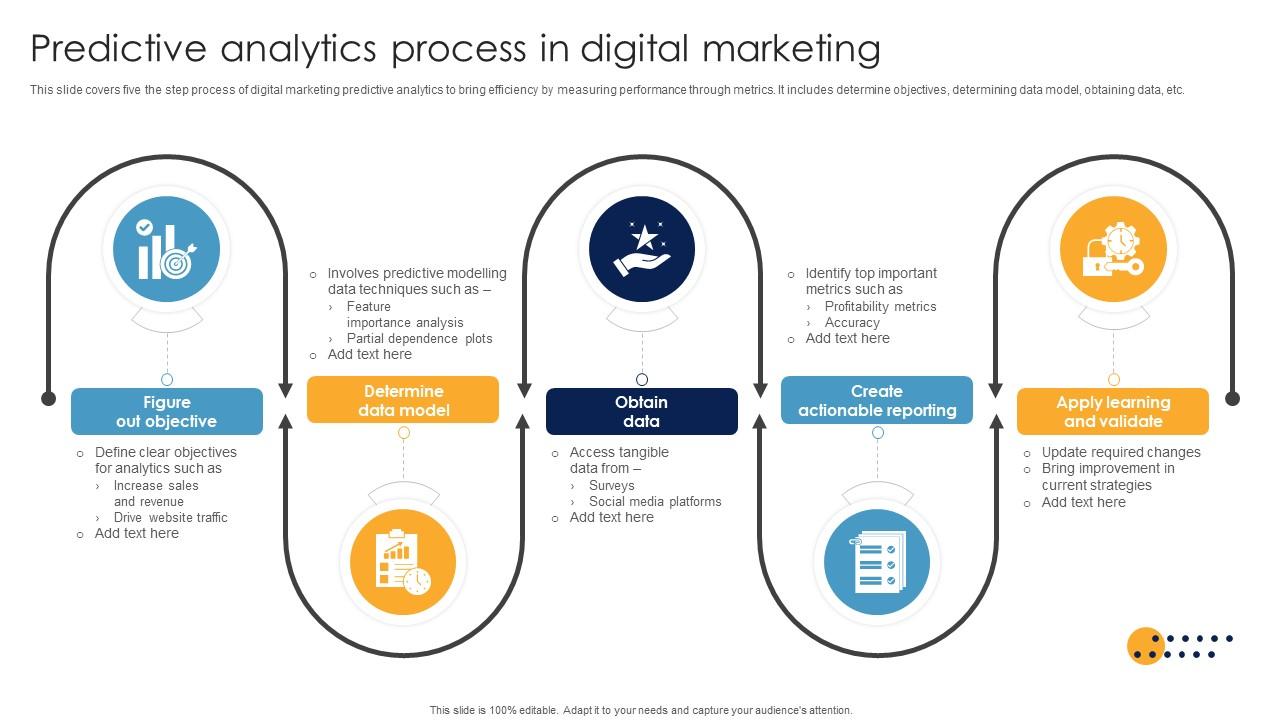
Once your business case is approved, you need to translate it into a project brief. This is the document you hand over to your data science team or an external vendor. Its purpose is to provide all the necessary context and requirements so they can design and build the right solution. A great brief prevents misunderstandings and scope creep down the line.
In her talk at Columbia Business School, data scientist Shawndra Hill touches on the many non-technical factors that make a project successful—things that need to be captured in a brief.
In this 'Data Science in Marketing' video, Shawndra Hill discusses the realities of managing data science projects in industry. Her insights highlight why a clear brief is so important.
Please watch from 5:56 to 12:03. Notice how many of her points are about managing expectations, stakeholder alignment, navigating constraints (legal, privacy), and proving business impact—all critical elements to capture upfront in a brief.
A comprehensive project brief should include the following sections:
- Business Problem & Background (1-2 paragraphs): Succinctly state the "why" from your business case. What is the pain point we're trying to solve?
- Project Goal & Success Criteria:
- Goal: A one-sentence summary. (e.g., "Predict which active subscribers are at high risk of churning in the next 30 days.")
- Business Success Metric: How will you know if this project was a success from a business perspective? (e.g., "Reduce monthly subscriber churn by 15%.")
- Model Success Metric: A technical metric for the data scientists, if you know what to suggest. (e.g., "The model should achieve a precision of at least 70% on the 'high-risk' class.") You can often leave this to the technical team to propose.
- Key Questions to Answer: Frame the goal as specific questions. (e.g., "What are the top 5 drivers of churn? Which segments of customers are most at risk?")
- Scope (In-Scope & Out-of-Scope): Be explicit about the boundaries.
- In-Scope: "This project will deliver a ranked list of at-risk customers with their churn probability scores, refreshed weekly."
- Out-of-Scope: "This project will not include the development of the retention campaigns or the email/in-app messages sent to these users."
- Available Data Sources: You don't need technical details, just the business context. (e.g., "We have access to our CRM (HubSpot), transaction database (Shopify), and web analytics (Google Analytics).")
- Stakeholders: Who are the key people involved? (e.g., Project Lead, Marketing Analyst, Data Scientist, Engineering contact).
- Ethical & Privacy Considerations: As Shawndra Hill mentioned, this is crucial. Are there any data privacy concerns? Is there a risk the model could be unfairly biased against certain user groups? Acknowledging this upfront is a sign of mature leadership.
Conclusion
You have now learned how to take a business problem and systematically transform it into a fundable, actionable predictive analytics project. This process is the critical link between marketing strategy and data science execution. Mastering it will allow you to direct technical resources toward solving your most important business challenges.
Key Takeaways:
- A business case justifies the "why" of a project by focusing on the business challenge, potential impact (ROI), and the risk of doing nothing.
- You can identify predictive analytics opportunities by asking if your problem can be framed as predicting an event (classification) or a value (regression).
- A project brief defines the "what" and "how" for the technical team, outlining the goals, scope, success criteria, and available data to ensure everyone is aligned.
Preview of the Next Lesson:
You've successfully commissioned a project, and the data science team has come back with a model and some results. What now? In our next lesson, "Critique the deliverables of a data science project, focusing on the business implications of the findings," we will cover how to evaluate what your team has built, interpret their findings, and decide on the next steps for implementation.