
Hi again. Last lesson, you built a five-day schedule from small, specific actions and included recovery time and a buffer. That plan reduces uncertainty—but even a well-made plan can feel impossible when you sit down and your brain starts shouting, “There is too much to do.”
This lesson is for that exact moment. You will use a five-minute starting routine: a short script that helps you settle the stress enough to begin one tiny piece of the task. Its purpose is not to make schoolwork magically easy or to finish everything in five minutes. Its purpose is to replace “I have to fix my grades” with one real action you can do now.
Overwhelm is a signal to shrink the next step
When an assignment feels huge, avoiding it can bring a few minutes of relief: checking messages, watching videos, cleaning your room, or telling yourself you will start later. That relief is real—but the assignment remains, often with more stress attached to it.
This does not mean you are lazy or incapable of improving your grades. It means the task currently feels too big, unclear, or emotionally loaded to start all at once. The solution is not to wait until you “feel motivated.” It is to make the first promise extremely small and specific.
The key idea is:
You do not need to complete the assignment right now. You need to begin the next visible action.
For example:
| When your brain says… | Your five-minute action can be… |
|---|---|
| “I have so much math.” | Put the worksheet on the desk and solve problem 1. |
| “I need to catch up in History.” | Open the class portal and find the missing assignment directions. |
| “This essay is impossible.” | Write a messy first sentence or list two possible ideas. |
| “I do not understand Biology.” | Read the first paragraph and circle the exact word or step that confuses you. |
| “I cannot even start.” | Sit in your work spot, open the needed tab, and set a five-minute timer. |
The action needs to be so small that it is hard to argue with. “Finish my homework” is not a starting action. “Open the document and type the title” is.
watch this if you're avoiding homework
Watch the short excerpts from “watch this if you're avoiding homework” by Gohar Khan. They show two useful tools: choosing the smallest possible action and using a brief countdown to stop negotiating with yourself.
Watch the smallest action. Notice that even sitting at the desk can count as the first move when you are frozen. Then watch the countdown cue, which gives you a simple moment to begin rather than waiting for motivation.
A countdown is not supposed to force you to feel calm. It is just a cue: when you reach zero, your body moves toward the first action you already chose.
Your five-minute starting routine
Use this routine at the beginning of a planned 30-minute study block, especially on days when you want to avoid it. Keep the wording almost the same each time. Repetition makes it easier to use when your thoughts are loud.
Minute 0: Name the moment and choose one task
Look at your five-day plan. Choose one action—not a whole subject and not every overdue assignment.
Say quietly, aloud or in your head:
“I feel overwhelmed, and I only need to start [specific action] for five minutes.”
For instance:
“I feel overwhelmed, and I only need to open Algebra and solve question 1 for five minutes.”
Naming the feeling matters because it separates the feeling from the decision. You can feel stressed and take a small step.
Minute 1: Set up only what you need
Put the materials for that one action in front of you:
- one notebook or worksheet;
- one textbook page;
- one school-portal tab;
- a pencil, calculator, or document.
Put your phone out of reach if it pulls you away—across the room, in a bag, or face down with notifications silenced. You are not trying to create a perfect study space. You are removing one or two barriers between you and the first action.
Minute 2: Notice three natural breaths
Overwhelm can make your thoughts race ahead to deadlines, grades, and everything that might go wrong. Before working, spend about a minute noticing your breathing. You do not have to breathe in a special way or empty your mind.
How to Use Meditation for Teen Stress and Anxiety
Read the brief guidance from Cleveland Clinic on a simple two-to-five-minute mindfulness practice. Use it here as a reset before work, not as another task you need to do perfectly.
In the answer to “Q: How do you start a meditation program?”, read the simple practice. Focus on noticing the breath and body without trying to force the stress away. Then read the following answer to “Q: Is the goal of meditation to ‘stop thinking?’”, especially the reminder about thoughts: when a worry appears, notice it and bring your attention back rather than arguing with it.
Try this:
- Rest your feet on the floor or sit comfortably.
- Notice one breath coming in and one breath going out.
- If a thought appears—“I am behind,” “I will fail,” or “this is too much”—silently label it: thought.
- Bring attention back to the next breath.
The goal is not to become perfectly relaxed. The goal is to create just enough space to choose your next action.
Minute 3: Count down and move
Say:
“Five, four, three, two, one.”
At “one,” physically begin. Put pencil to paper, open the assignment, read the first instruction, or type the first words. Avoid adding a new decision at this point. You chose the action before the countdown.
Minutes 4–5: Do the smallest real piece
Set a five-minute timer and work only on the action you named.
These minutes count as actual schoolwork. Do not spend all five minutes organizing folders, finding the perfect playlist, or making a better schedule. Start with something that creates evidence of progress:
- solve one problem;
- read one paragraph and annotate it;
- write one sentence;
- make one flashcard;
- find and copy the assignment directions;
- write down one exact question to ask.
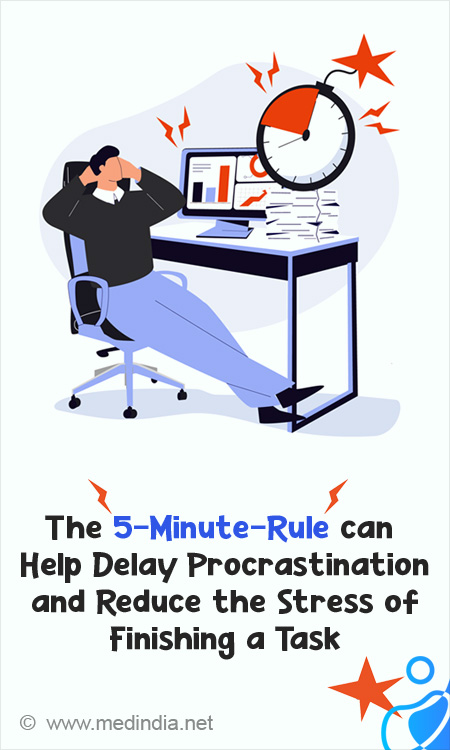
At the end of the timer, pause briefly and choose honestly:
- Continue into the rest of your planned work block if you have momentum.
- Take the planned five-minute break, then return for another short start.
- Stop and record the next action if five minutes was all you could manage today.
Even the third choice is better than avoiding the work entirely. You have identified where you are and left yourself a clear re-entry point.
Make the routine easy to find when you need it
Write this short version at the top of your planner, on a sticky note, or in a note on your device:
1. One task: What is my smallest next action?
2. Set up: Put out only what I need.
3. Three breaths: Notice, do not judge.
4. Countdown: 5–4–3–2–1.
5. Five minutes: Begin the smallest real piece.
Here is how it could look with an actual scheduled block:
Thursday, 4:30 p.m. — History
Smallest action: Open Source 1 and write down one fact about the cause of the event.
At 4:30: three breaths, countdown, five-minute timer.
At 4:35: decide whether to continue reading or take a short reset.
The routine works best when the action is prepared ahead of time. Before you stop work today, make tomorrow’s start easier: place the worksheet in your bag, write the next problem number, or leave yourself a note such as, “Open the portal and click Assignments.”
What to do when the start still feels difficult
Some days will be harder than others. That does not mean the routine failed; it tells you what barrier is still in the way.
| Barrier | Adjust the five-minute action |
|---|---|
| You cannot find the materials. | “Find the worksheet” or “download the assignment” becomes the action. |
| The assignment feels confusing. | Read one example, circle the confusing step, and write a specific question. |
| You want the work to be perfect. | Make a deliberately rough first attempt: one messy sentence or one problem attempt. |
| You were interrupted. | Restart with a fresh five-minute timer; do not treat the interruption as proof you cannot work. |
| You are exhausted. | Do a very small school step, then follow your schedule’s recovery plan rather than forcing hours of low-focus work. |
| You begin scrolling instead. | Move the phone away, return to the chair, and make “open the assignment” the new smallest action. |
There is an important boundary here: use the routine to begin, not to punish yourself. Five focused minutes are useful. Demanding that you keep going for hours when you are distressed, hungry, sick, or severely exhausted usually makes tomorrow’s start harder.
For the next few planned study blocks, use the routine exactly as written. You are testing a method, not testing your worth. A record like “Started History at 4:30; worked five minutes; continued for ten more” gives you more useful information than “I am bad at school.”
Key takeaways
A five-minute starting routine helps you act before overwhelm turns into avoidance.
- Choose one specific, visible action, not an entire assignment or subject.
- Set up the minimum materials, notice a few natural breaths, and use a countdown as a cue to move.
- Spend the five minutes doing a real piece of the school task.
- After five minutes, decide whether to continue, take a short planned break, or record the next action for later.
- Starting small is not lowering your goals. It is a practical way to build progress toward them.
Next, you will use a submit-and-verify checklist so that completed work does not get lost, left as a draft, or accidentally fail to reach your teacher.
Can't find a good explanation? Sign up and we'll make it for you
Sign up