
Hi again. You now have an important planning tool: instead of writing “finish everything,” you can name small actions such as “solve problems 1–4” or “draft the cause paragraph.” This lesson gives those actions a home in your actual week.
A schedule is not proof that you must be productive every minute, and it is not a test of whether you are “good enough.” It is a way to make the next few days less mysterious. By choosing a small number of realistic 30-minute work blocks, protecting recovery time, and leaving room for surprises, you can make progress without turning every evening into punishment.
A useful schedule includes life, not just schoolwork
When grades are stressful, it is tempting to plan an enormous catch-up session every day. Usually that plan collapses because it leaves out the things that make focused work possible: food, sleep, movement, relaxation, family responsibilities, and time with people you care about. The goal is steady progress, not a week that looks perfect on paper.
Guidelines for Creating a Study Schedule – Learning Strategies Center
Read Cornell Learning Strategies Center’s “Guidelines for Creating a Study Schedule.” It explains why breaks and basic needs belong in a study plan, then offers a short timed-work method for getting started.
In the “Creating a Study Schedule” section, read the balanced-schedule guidance. Then, farther down the page, find the paragraph beginning “If you are having trouble getting started” and read the Pomodoro suggestion. Notice that breaks are planned parts of effective work, not rewards you have to earn.
A 30-minute work block can be structured in either of two ways:
- 25 minutes focused work + 5 minutes recovery. This is a useful default when starting feels hard.
- Up to 30 minutes focused work, followed by a longer break you have already scheduled.
For now, use the first option. During the five-minute break, stand up, get water, use the restroom, stretch, look out a window, or get a snack. Try not to start a video game or social-media scroll that will make returning harder.
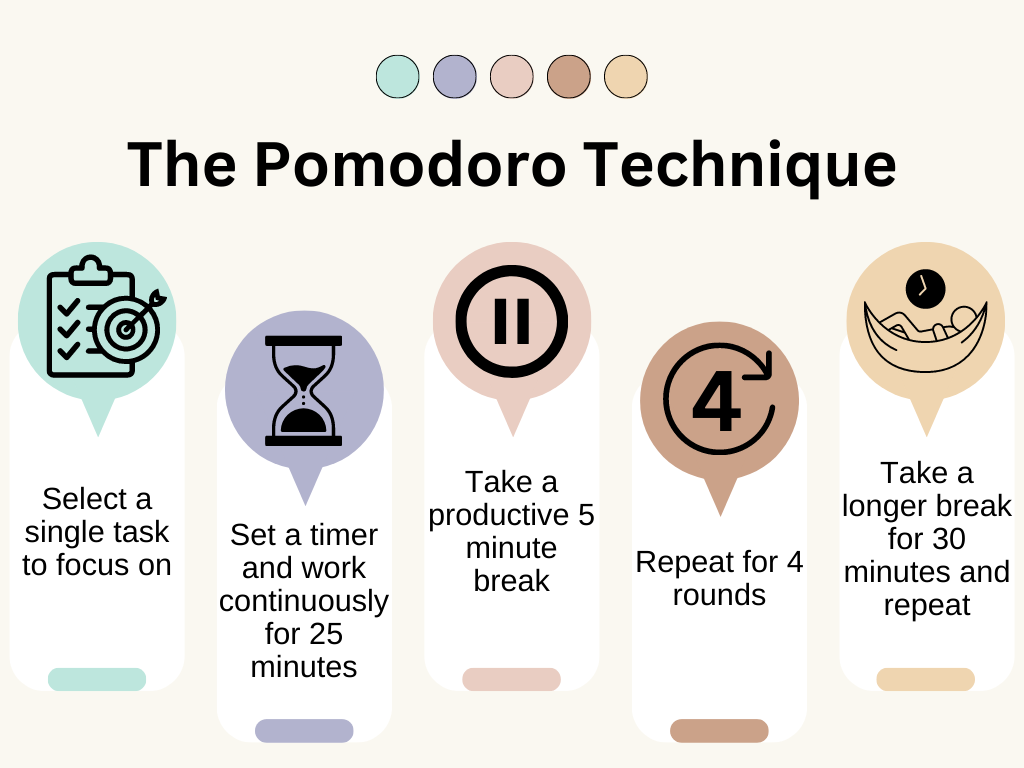
The timer is there to shrink the promise you are making to yourself. You are not promising, “I will fix all my grades tonight.” You are promising, “For one block, I will do this one clearly named action.”
POMODORO TECHNIQUE - My Favorite Tool to Improve Studying and Productivity
Watch “POMODORO TECHNIQUE - My Favorite Tool to Improve Studying and Productivity” by Med School Insiders for a clear demonstration of timed focus blocks and the idea that the timing can be adjusted to fit the task.
Watch the basic routine for the 25-minute focus and five-minute break structure. Then watch using it flexibly. The key point is that a timer is a framework: begin with a manageable block, protect breaks on longer study days, and adapt only after you learn what actually works for you.
Find your real available time first
Do not begin by writing school tasks into every empty space. First, identify the parts of the next five days that are already occupied.
These may include:
- school and travel;
- meals and sleep;
- sports, clubs, work, appointments, or family responsibilities;
- time you want to protect for friends, hobbies, or simply resting.
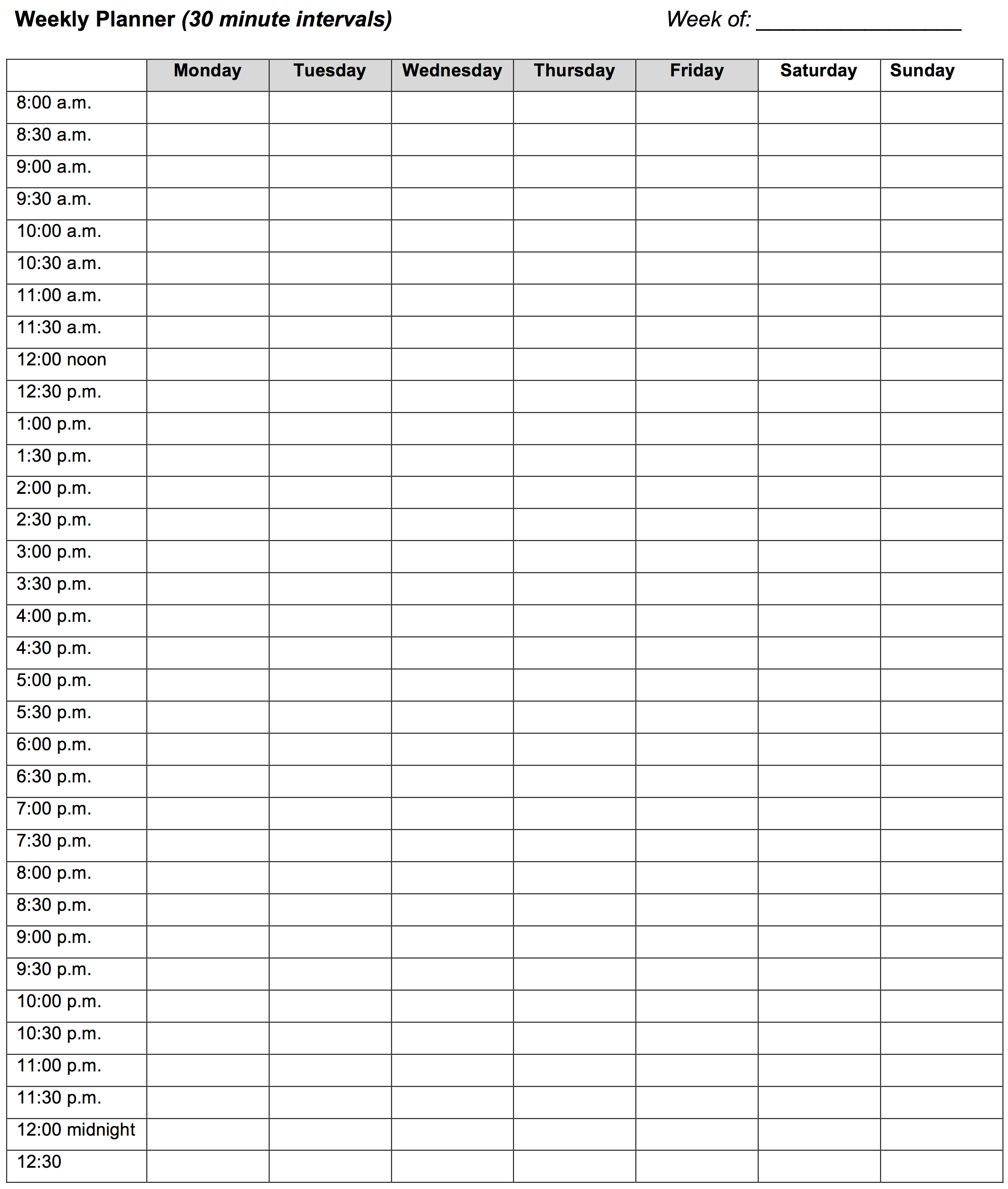
You can use a paper planner, a notes app, a calendar, or a copy of the Weekly Planner. The format matters less than being able to see five days at once.
Use this order:
- Write the dates for the next five days.
- Block off fixed commitments first. Write “school,” “practice,” “dinner,” “family,” or “bedtime,” rather than leaving those spaces blank.
- Circle realistic open times. An open slot is only useful if you are likely to have the materials, energy, and a place to work.
- Choose your starting capacity. If you have been overwhelmed or have not been studying regularly, start with one 30-minute block on most days. Add a second block only on days where you genuinely have room.
- Reserve at least one buffer block. A buffer is intentionally left without a required task. It can catch up a missed block, handle a surprise assignment, or become free time.
The UNC Learning Center’s weekly-planning handout uses the same basic logic: put regular commitments on the planner, estimate work, place tasks in open slots, and include buffer time.
[PDF] Semester & Weekly Planners | The Learning Center
Read the University of North Carolina Learning Center’s one-page planner handout for a practical order of operations: commitments first, tasks second, and buffer time built in.
In the “The Weekly Planner” part of the handout, read the numbered planning process from the four planning steps. Then continue into “WEEKLY PLANNING THAT WORKS,” especially the advice to reduce work into segments, plan demanding work when you are most alert, maintain balance, adjust as needed, and set a stopping time at night. Keep the main principle: a schedule has to fit your real life to be usable.
A blank square on a planner is not automatically study time. You may need that time to eat, recover after school, talk with family, or sleep. Keeping those needs visible is part of making the plan realistic.
Put specific actions into the open blocks
Bring out the 30-minutes-or-less action list you made last lesson. You are scheduling actions, not just subjects.
Compare:
| Too vague for a calendar | Ready to schedule |
|---|---|
| Biology | Read pages 54–57 and write three notes about cell division. |
| Math homework | Solve questions 1–4 and show each step. |
| History essay | Choose two pieces of evidence for the cause paragraph. |
| Spanish study | Make flashcards for vocabulary words 1–8. |
| Catch up | Find the missing assignment directions in the class portal. |
A specific block tells you what to do when the time arrives. “Study History, 5:00–5:30” still forces you to make decisions when you may already be tired. “Read Source 1 and record two facts about the cause, 5:00–5:30” lets you begin.
Choose the order
When deciding what goes first, use the priority information from earlier lessons:
- Put urgent, high-impact work into the earliest reliable slots.
- Place the hardest task at a time when you tend to have the most energy.
- Mix subjects when you have more than one block. For example, follow a difficult Algebra block with a shorter Spanish vocabulary block rather than scheduling several difficult tasks in a row.
- Schedule a final block for a task that is easy to restart, check, upload, or verify. This makes the end of the week less stressful.
Do not fill every available block. A plan with six completed blocks is more valuable than a plan with twenty blocks that makes you feel behind before Wednesday.
An example five-day plan
Here is an example only. Replace the times and actions with your own real commitments and assignments.
| Day | Planned 30-minute work block(s) | Recovery and protected time |
|---|---|---|
| Monday | 4:30: Algebra, solve questions 1–4. | Five-minute break after the block; dinner and no more required schoolwork that evening. |
| Tuesday | 5:00: History, read Source 1 and record two useful facts. | Five-minute break; time to relax or connect with friends afterward. |
| Wednesday | 4:30: Spanish, make flashcards for words 1–8. | Five-minute break; evening activity or rest. |
| Thursday | 4:30: History, choose evidence and write a three-part outline. 5:30: Algebra, solve questions 5–8. | A full 30-minute meal, movement, or reset between the two blocks. |
| Friday | 4:30: Buffer block for a missed task, a new urgent task, or submission checking. | If the buffer is not needed, it is free time. Keep the evening mostly open. |
This plan has six possible work blocks across five days, but only five are required actions. Friday’s buffer is not “wasted” if you do not use it. It has protected you from needing to cram everything into Thursday night.
Build your five-day schedule now
Set aside about 15 minutes to create your own first version. Keep it small enough that you can honestly imagine doing it.
1. Decide how many blocks you can handle
Start with a floor, not your best-case guess.
For example:
- If school days are exhausting right now, plan one block on Monday, Tuesday, Wednesday, and Thursday, plus one Friday buffer.
- If one or two days are especially busy, make those recovery-only days and schedule the work on lighter days instead.
- If you have more energy on a weekend day, you can use two blocks separated by at least a 30-minute recovery period.
The right number is the number you can return to tomorrow. You can always add a block later; you cannot recover energy by pretending it is unlimited.
2. Assign exact actions
Copy actions from your list into the open spaces. Include the class and the finish line:
Tuesday, 5:00–5:30 — Biology: Read pages 54–57; write three notes.
Thursday, 4:30–5:00 — Biology: Answer questions 1–3 using the notes.
If you are unsure how long something will take, schedule the first manageable part. “Work on the essay” may take hours; “draft the introduction” or “find two quotes” fits a block.
3. Write recovery time on the schedule too
Every work block includes a five-minute break. Also protect larger recovery periods:
- a meal after school;
- a longer break between two work blocks;
- a time to shower, move, talk with someone, or do something enjoyable;
- a stopping time at night that protects sleep.
Resting does not mean you are giving up on grades. It is part of keeping your attention working over several days. Time for friends and family also belongs on the planner; you do not need to earn care or connection by finishing every assignment first.
4. Add one buffer and one stopping rule
Write “BUFFER” in at least one 30-minute slot. Avoid assigning a specific task until you need it.
Then write a simple stopping rule, such as:
“After 8:30 p.m., I only pack materials, check tomorrow’s plan, or rest.”
A stopping rule prevents the schedule from quietly turning into late-night panic. Sleep supports attention, memory, and the ability to begin again the next day.
When the schedule does not go perfectly
A missed block is information, not a reason to throw away the entire plan. Perhaps practice ran late, you were more tired than expected, the task took longer, or you did not have the right materials. Notice what happened and make one adjustment.
Use this short reset:
- Mark the unfinished action clearly. Do not leave it floating in your head.
- Use your buffer block if one is available.
- If there is no buffer, move one lower-priority task, rather than stacking every missed task onto tomorrow.
- If the task was too big, split it again before rescheduling.
- If you are stuck because you do not understand the work, schedule the next action as getting clarification, not as “trying harder.”
A schedule should be revised when real life changes. Revising is part of planning; it is not failure.
Key takeaways
A five-day study schedule works best when it is built from your real life rather than from pressure.
- Mark fixed commitments, meals, sleep, and recovery time before adding schoolwork.
- Schedule small, specific actions that fit in 30 minutes or less.
- Use a 25-minute focus period plus a five-minute break as a simple starting structure.
- Start with a small number of blocks, place urgent work in reliable time slots, and mix difficult and lighter tasks.
- Protect a buffer block, a nighttime stopping time, and time to rest or connect with people.
- If you miss a block, adjust the plan instead of judging yourself or cramming everything into the next day.
Next, you will learn a five-minute routine for starting one of these planned blocks when overwhelm, avoidance, or stress makes it difficult to begin.
Can't find a good explanation? Sign up and we'll make it for you
Sign up