
Hi again. In the last lesson, you sorted your missing and current work by real deadline, possible grade impact, and time needed. You also marked assignments with an unclear late-work policy as “Needs confirmation.” This lesson gives you a practical way to get that confirmation.
Sending this message can feel scary, especially when school has already been stressful. But an overdue assignment is a school problem to handle, not proof that you are incapable or “not good enough.” A short, respectful email can replace guessing with a clear answer: Can you still submit the work, how much credit is possible, and when is it due?
By the end of this lesson, you will have a ready-to-send draft about one specific overdue assignment.
The purpose: ask clearly, do not demand
A teacher may say yes, no, or yes with a late penalty. Their answer may depend on the class policy, how late the work is, and the assignment itself. Your goal is not to pressure them or explain every difficult thing that has happened. Your goal is to make it easy for them to understand exactly what you are asking and to respond.
A useful message does five things:
- Identifies you, the class, and the assignment.
- Briefly acknowledges that it is late.
- Takes responsibility without putting yourself down.
- Politely asks whether it can still receive credit.
- Asks for the current submission deadline if it is accepted.
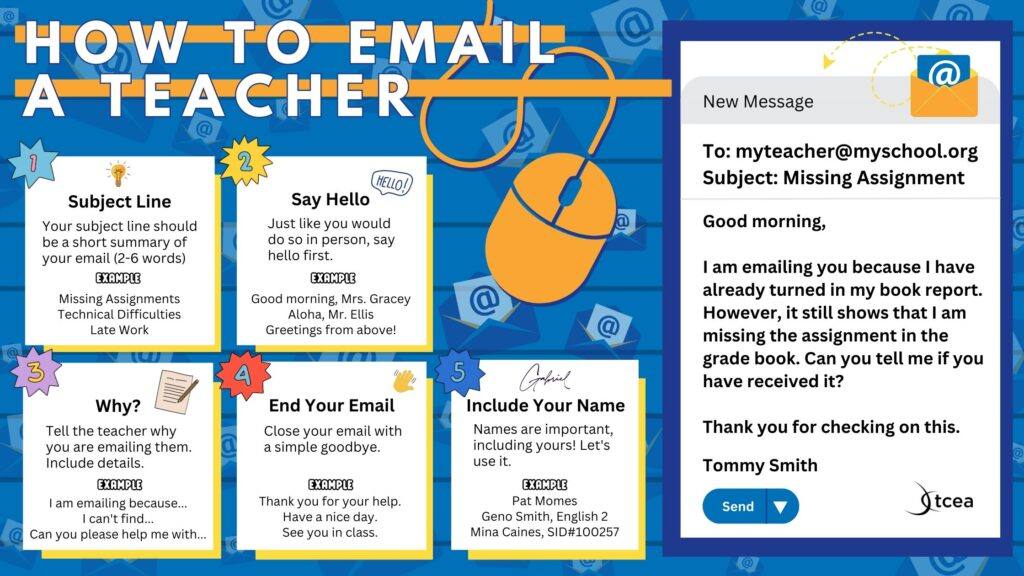
Before writing, open your assignment inventory from the previous lesson and choose one overdue assignment. Find its exact title, class name or period, and original due date if you know it. Do not send a vague email that says, “What can I do to fix my grade?” A teacher can answer a specific question about “Spanish 1, Period 3, Chapter 4 Vocabulary Practice” much more easily.
Build the email from five small parts
The image’s structure is a strong starting point, and the details matter most when the message is about late work.
Email Etiquette for Students: A Crash Course | Learning Essentials
Read “Email Etiquette for Students: A Crash Course” from Learning Essentials for a simple teacher-email checklist. Its advice is especially useful for keeping your request respectful, specific, and easy to answer.
Read the five numbered guidelines, from the full checklist. Focus especially on identifying the class or period, briefly owning the missed work, and signing your full name.
1. Write a useful subject line
The subject line is a label, not the whole email. Include the assignment name and, if helpful, your class period.
Good subject lines
Late Work Question: Cell Model, Biology Period 2Question About Credit for Chapter 3 ReviewSpanish 1 Period 4: Missing Vocabulary Practice
Avoid
HELPQuestionMissing work- putting your entire message in the subject line
A teacher may teach many students and classes. Specific information lets them quickly find the right assignment.
2. Start with a respectful greeting
Use the name and title your teacher uses at school:
Dear Ms. Rivera,Dear Mr. Chen,Dear Dr. Patel,
If your school culture is more casual and your teacher has told students to use their first name, follow their preference. Otherwise, a title and last name is the safest choice.
3. Name the assignment and take responsibility briefly
This is the middle of the email. Keep it honest and short. You do not need to write a long apology or share personal details you do not want to share.
Compare these:
| Less effective | More effective |
|---|---|
| “I have had so much going on and I am really stressed and did not mean to miss everything.” | “I apologize for not submitting the Chapter 3 Review by its deadline.” |
| “The portal is confusing and I did not know it was due.” | “I missed the deadline and should have checked the portal sooner.” |
| “I am terrible at school and really need you to help me.” | “I am working on catching up and want to complete the assignment if it is still possible.” |
Taking responsibility means naming what you did or did not do. It does not mean calling yourself lazy, irresponsible, or bad at school.
If there was an important reason—such as an illness or family emergency—you may give one brief sentence of context. For example: “I was absent due to illness and am now catching up on the work.” You do not have to provide a detailed personal story in an email.
4. Ask one answerable question
Your request should be polite and direct:
“Would it still be possible for me to submit it for credit?”
Then ask for the information you need to act:
“If so, could you please let me know the deadline and where you would like me to submit it?”
This is better than asking the teacher to “fix” your grade. You are asking about a specific action you can take.
5. Thank them, sign your name, and identify your class
Close simply:
Thank you for your time.Sincerely,- Your full name
- Class and period
Your full name matters, especially if your email address is a username a teacher may not recognize.
Watch how clarity changes the tone
How to Write & Send Email to Teacher | Step by Step Guide for Students in GMAIL
Watch the selected parts of “How to Write & Send Email to Teacher” by Mister Messinger. The video demonstrates how a specific subject line, respectful wording, short body, and careful proofreading make an email easier for a teacher to answer.
First watch subject lines for the difference between a vague topic and one that names the assignment. Then watch greeting and tone, paying attention to why a courteous opening matters in writing. Finish with concise messages and the final check. Notice that being brief does not mean sounding cold.
A teacher should be able to scan your email and answer these questions:
- Which student is writing?
- Which class is this about?
- Which assignment is overdue?
- What is the student asking for?
- What response or deadline does the student need?
If any answer is missing, add it. If the email is more than a short paragraph or two, see what can be removed.
A ready-to-use template
Copy this into your school email and replace everything in brackets. Keep the wording that feels natural to you, but do not remove the key details.
Subject: Late Work Question: [Assignment Name], [Class/Period]
Dear [Teacher’s Title and Last Name],
I am [Your Full Name] from your [Class Name/Period] class. I apologize for not submitting the [Assignment Name] by the deadline.
I am working on catching up on my missing work. Would it still be possible for me to submit this assignment for credit? If so, could you please let me know the deadline and how you would like me to submit it?
Thank you for your time.
Sincerely,
[Your Full Name]
[Class Name/Period]
Here is a completed example:
Subject: Late Work Question: Chapter 2 Practice, Algebra 1 Period 5
Dear Mr. Lewis,
I am Jordan Kim from your Algebra 1 Period 5 class. I apologize for not submitting the Chapter 2 Practice by the deadline.
I am working on catching up on my missing work. Would it still be possible for me to submit this assignment for credit? If so, could you please let me know the deadline and where I should submit it?
Thank you for your time.
Sincerely,
Jordan Kim
Algebra 1, Period 5
Notice what the example does not say:
- It does not promise, “This will never happen again,” unless Jordan has a real plan to support that promise.
- It does not demand full credit.
- It does not blame the teacher, portal, classmates, or circumstances.
- It does not include several unrelated requests in one email.
When the work is already finished or partly finished
Adjust the request to match the truth. Being accurate helps your teacher decide what to do.
If the assignment is complete but not submitted:
I have completed the [Assignment Name] but did not submit it by the deadline. Would it still be possible to submit it for credit? If so, could you please let me know the best way to turn it in?
If it is partly complete:
I have started the [Assignment Name] and can finish it by [realistic day]. Would it still be possible to submit it for partial or full credit? Please let me know the deadline you would like me to follow.
Only name a completion day you can realistically meet. It is better to say nothing about a date than to offer a deadline you cannot keep.
If you do not know whether the portal label is correct:
The grade portal lists [Assignment Name] as missing, but I believe I submitted it on [day, if known]. Could you please let me know whether you received it?
In all cases, continue working on the assignment if it is possible. Do not wait several days for a reply before starting. Teachers may be busy, and some late-work policies set firm limits.
Do a 90-second check before sending
Read the email once from the teacher’s point of view. Use this checklist:
- The subject line names the assignment or topic.
- I greeted the teacher respectfully and spelled their name correctly.
- I included my full name and class or period.
- I named one specific overdue assignment.
- I briefly acknowledged the late work without making excuses or insulting myself.
- I clearly asked whether it can still receive credit.
- I asked for a submission deadline or method.
- I said thank you.
- The tone is calm, even if I feel worried.
- I checked spelling and attached the work only if it is ready and the teacher’s system allows it.
If you feel upset while writing, save the draft, take a few slow breaths, and reread it later. You do not need to sound perfect; you need to sound clear and respectful.
After sending, write this in your assignment inventory: “Emailed [teacher] on [date]; waiting for late-work instructions.” When the teacher replies, update the assignment’s real deadline and priority. If they say no, that can be disappointing, but it is still useful information: you can put your energy into assignments that can still improve your grade.
Key takeaways
A respectful late-work email is short, specific, and honest. Include your class, the exact assignment, a brief acknowledgment that it is late, and a direct question about whether it can still receive credit and by when.
One overdue assignment does not define your ability. Sending the email is a concrete step toward replacing uncertainty with a plan.
Next, you will take one overwhelming assignment and break it into small actions that each take 30 minutes or less. That will help you follow through if a teacher gives you a new late-work deadline.
Can't find a good explanation? Sign up and we'll make it for you
Sign up