
Welcome back. In the previous lesson, you created one inventory of current, missing, submitted, and unclear assignments instead of trying to hold everything in your head. That list is your starting data, not a judgment of you.
Now you will turn that list into an order of action. The goal is not to finish every assignment immediately. It is to identify which assignment deserves your attention first, which ones need an early start, and which ones need more information before you spend time on them. Low grades and a long list can feel personal, but priorities are practical decisions based on evidence: deadlines, possible grade impact, and the time work will take.
Set aside about 35–40 minutes with your assignment inventory, your school portal, and a pencil or notes app.
Prioritizing is not the same as doing the easiest thing
When several tasks are waiting, your brain may push you toward one of two extremes:
- doing only quick, easy tasks because finishing something feels good;
- avoiding the list entirely because every task feels equally huge.
Neither gives you a real plan. A short worksheet due tomorrow may genuinely need to come first. But a large project due Friday might need an early start even if it is not technically due first. And an overdue task that can no longer receive credit may need a quick teacher check before it gets hours of your time.
This is why you will use three lenses for every assignment:
- Deadline: When is it actually due, including any revised late-work deadline?
- Possible grade impact: How much could it affect your grade or preparation for an upcoming quiz or test?
- Time required: How long will it realistically take?
The order matters. A deadline creates a limit; grade impact tells you what is worth protecting; time required tells you whether you need to begin early.
Prioritize and Execute | University College
Read “Prioritize and Execute” from Arizona State University’s University College. It gives a clear overview of listing work, judging urgency and importance, and estimating the time needed before making a plan.
In the section “How to Prioritize and Execute for Academic Success?”, read numbered steps 1 through 3. Begin at the first three steps. Focus on the difference between urgent work and important work, and notice that the advice asks you to estimate time rather than assume every task is equally large.
The Priority Quadrant is a useful starting picture: urgent and important tasks are handled now, while important but less urgent tasks are scheduled before they become emergencies.
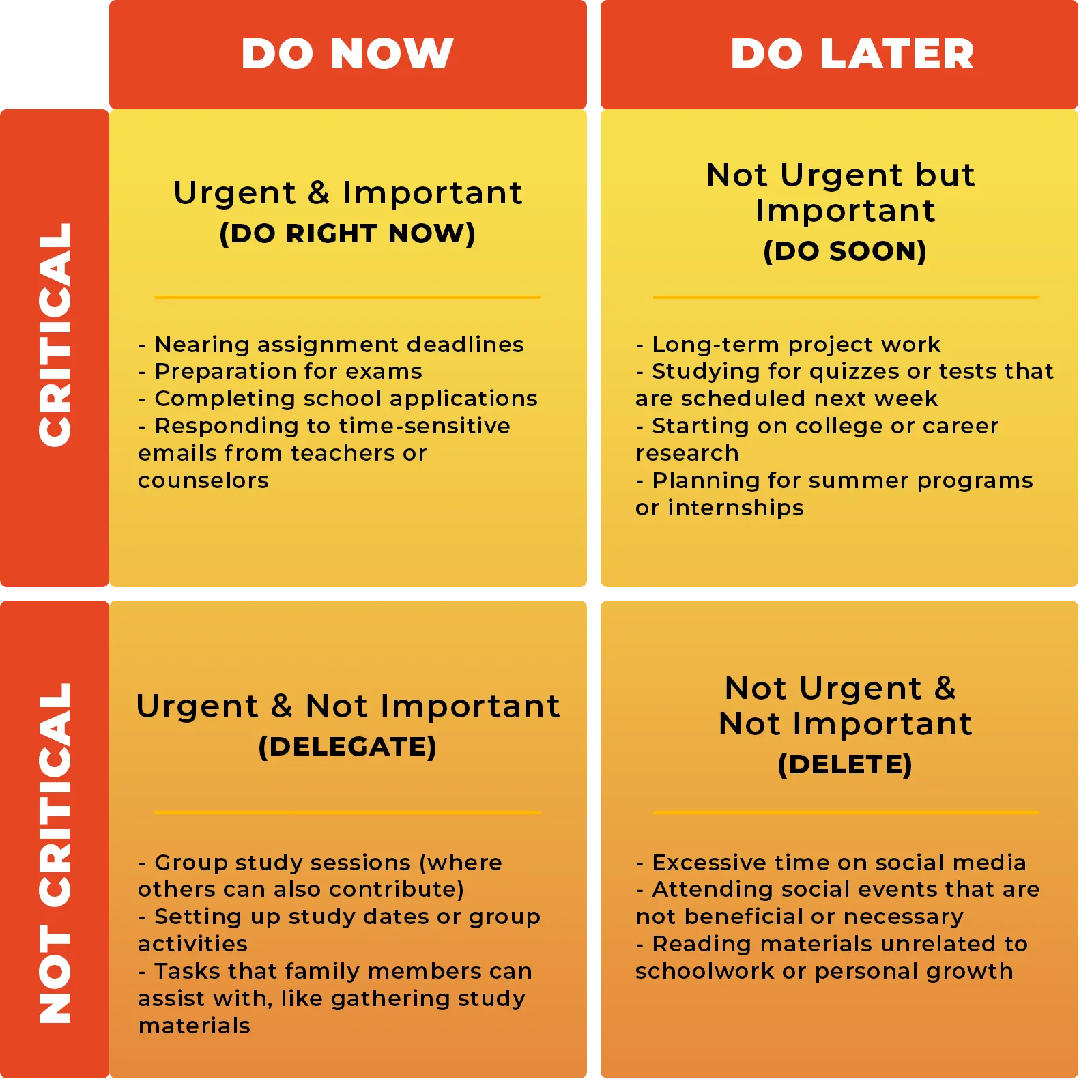
There is one important adjustment for your situation: the quadrant does not show time required. A three-hour project due in four days may belong in “do later” by urgency, but it still needs an early start because waiting until the night before would make it urgent.
Lens 1: Find the real deadline
Write a deadline category beside each current or missing assignment in your inventory.
| Deadline category | Meaning | What to do |
|---|---|---|
| Now | Due today, tomorrow, or on the next school day | Put near the top of your list. |
| Soon | Due within the next few school days | Check its time estimate; long work may need an early start. |
| Later | Due after the next few school days | Keep it visible and protect time for high-impact work. |
| Needs confirmation | Overdue, no date posted, or late-work policy is unclear | Do not guess. Record what you need to ask the teacher. |
For overdue assignments, the original due date is useful information, but it is not always the deadline that should control your decision. What matters now is whether the teacher still accepts it and, if so, when they want it submitted.
For example:
- “Essay was due October 3” tells you it is overdue.
- “Teacher will accept it for partial credit until Friday” gives you a real current deadline.
- “Portal says missing; I do not know whether it can still be submitted” belongs in Needs confirmation.
Do not assume an overdue assignment is automatically your highest priority. First find out whether completing it can still help your grade. The next lesson will help you write a respectful message to ask that question.
Lens 2: Estimate possible grade impact
“Possible” matters here. You may not know exactly how many points an assignment is worth or whether late work receives full credit. Use the best information you have from the portal, grading categories, directions, a syllabus, or a teacher.
An assignment usually has high possible impact when one or more of these are true:
- it is a test, project, essay, lab, or other major assessment;
- it is worth many points or belongs to a heavily weighted grade category;
- it can replace a current zero or recover a large amount of credit;
- it prepares you directly for a quiz or test that is coming soon;
- it is required before you can complete the next assignment.
An assignment may have medium possible impact when it is regular homework, a smaller quiz, or a practice task that still counts. It has low possible impact when it is worth very little, is optional, or is unlikely to earn credit. If you do not know, mark it with a question mark instead of pretending you do.
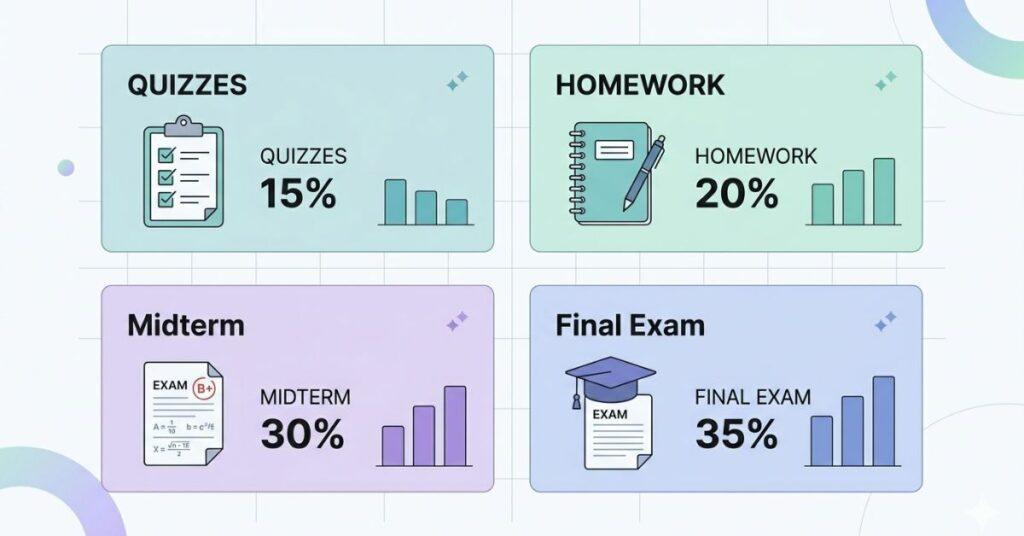
A task’s point value is not the whole story. Suppose an Algebra review sheet is worth only a few points but will help you prepare for tomorrow’s quiz. Completing it may protect both the homework points and your quiz performance. In that situation, give it high possible impact.
Use simple labels in your inventory:
| Impact label | Evidence you might write |
|---|---|
| High | “Major project,” “replaces zero,” “quiz tomorrow,” or “large grade category” |
| Medium | “Regular homework grade” or “small assignment that still counts” |
| Low | “Optional,” “few points,” or “credit unlikely” |
| ? | “Need to ask if late work is accepted” or “weight not shown” |
A low score right now does not mean every task must be treated as equally urgent. Looking for impact helps you spend limited energy where it can do the most good.
Lens 3: Estimate the true size of the work
Before choosing an order, open the directions for each assignment briefly. Look for the number of questions, required pages, materials, research, reading, or online steps. Then make a realistic estimate.
watch this if you're avoiding homework
Watch the short segment “watch this if you’re avoiding homework” by Gohar Khan. It explains why looking at the actual size of a task and estimating its duration can make a pile of work feel more manageable.
Watch the workload estimate. As you watch, notice the difference between a vague thought such as “I have tons of homework” and checking what each assignment actually requires.
Use these rough time labels:
| Time label | Estimate | Example |
|---|---|---|
| Short | 30 minutes or less | A brief vocabulary practice, five math problems, or uploading finished work |
| Medium | About 30–90 minutes | A reading with questions or a full worksheet |
| Long | More than 90 minutes | A project, essay, lab report, or major test review |
| Unclear | You cannot estimate yet | Directions or materials are missing |
Estimate honestly and add some buffer. A worksheet may look like “20 minutes,” but if you need to find notes, understand new material, or troubleshoot an upload, it may take longer.
A key rule:
Time required does not make a high-impact task less important. It tells you how early you need to begin it.
For a long, high-impact task due soon, “priority” may mean start it today, not necessarily finish it today. In a later lesson, you will turn overwhelming assignments into small work periods. For now, simply make sure long tasks are not invisible until the night before they are due.
Turn the three lenses into a priority order
Add five columns to your assignment inventory:
| Assignment | Real deadline | Impact | Time | Priority / next action |
|---|
Then sort with this decision process:
- Put real deadlines first. Assignments due today or tomorrow, or with a confirmed late-work deadline, move near the top.
- Within the same deadline group, protect higher-impact work. A major assignment, a recoverable zero, or work tied to an upcoming test usually comes before a low-value task.
- Use time estimates to choose when to start. A long project due Friday may need a start before several small tasks due later in the week.
- Separate unclear work. If you do not know whether an overdue task earns credit or what it requires, write “Confirm with teacher” rather than letting it quietly take over your plan.
Here is an example. Imagine it is Monday afternoon:
| Assignment | Real deadline | Possible impact | Time | Priority / next action |
|---|---|---|---|---|
| Algebra review sheet; quiz Tuesday | Tuesday | High: prepares for quiz | Short | 1 — Do first |
| English paragraph response | Tuesday | Medium to high: graded | Medium | 2 — Do after Algebra |
| Biology project | Friday | High: major project | Long | 3 — Begin early after urgent work |
| Spanish worksheet, already missing | Unknown late deadline | ?: credit unclear | Short | Confirm with teacher |
| History reading notes | Next Monday | Medium | Medium | 4 — Plan after Friday work is started |
Notice what this example does not do:
- It does not automatically put the oldest missing assignment first.
- It does not put every short task first just because it is easier.
- It does not ignore the Biology project simply because Friday is several days away.
- It does not spend an hour on the Spanish worksheet before finding out whether it will count.
Your first priority should be a task that is both worth doing and possible to act on now.
Your 15-minute sorting pass
Use your real inventory now. You are making a first draft, not a permanent perfect plan.
- Go through every current or missing/overdue assignment.
- Write its real deadline category: Now, Soon, Later, or Needs confirmation.
- Mark its possible impact: High, Medium, Low, or ?.
- Write a time label: Short, Medium, Long, or Unclear.
- Give actionable tasks a number: 1, 2, 3, and so on.
- Circle only your first one or two tasks. Seeing ten “top priorities” at once recreates the overwhelm you are trying to reduce.
If you get stuck deciding between two assignments, use this tie-breaker:
- Choose the one with the nearer confirmed deadline.
- If the deadlines are equally near, choose the one with greater possible grade or test impact.
- If both are similar, choose the one that needs an earlier start because it is longer.
- If one is unclear, choose the task you can actually begin while you prepare to get clarification.
Keep this list flexible. A teacher may update a deadline, a missing assignment may turn out not to be accepted, or a task may take longer than expected. Revising a priority is not failing the plan; it is using new information.
Key takeaways
Prioritizing does not mean trying to do everything or choosing work based only on what feels easiest. For each assignment, check:
- the real deadline, including revised late-work deadlines;
- its possible grade and learning impact;
- the time it will realistically require.
Handle urgent, high-impact, actionable tasks first. Start long, important tasks early enough that they do not become emergencies. Mark unclear overdue work for confirmation rather than guessing about whether it is worth your time.
Next, you will draft a respectful message to a teacher to ask whether an overdue assignment can still receive credit. That information will make your priority list more accurate and give you a clearer path forward.
Can't find a good explanation? Sign up and we'll make it for you
Sign up