
Hi again. You have already made your missing work more visible, decided what matters most, and learned how to ask a teacher for a clear late-work answer. Now comes the practical part: turning one assignment from a stressful label on a list into a set of small, doable actions.
An assignment can feel impossible when it is written as “finish Biology project” or “do the essay.” Those are outcomes, not actions. This lesson will help you create steps that are clear enough to start and short enough to finish in 30 minutes or less. The goal is not to do the whole assignment today. It is to know exactly what “work on it” means.
Make the assignment smaller than the worry
Feeling overwhelmed often means the task is still too big or too unclear—not that you cannot do it. A large assignment can require many different kinds of thinking: understanding directions, locating materials, deciding what to say, writing, checking requirements, and fixing mistakes. Trying to hold all of that in your head at once is exhausting.
The solution is to replace a big label with a next physical action.
Compare these:
| Too big to start | Small enough to start |
|---|---|
| “Do my history essay” | “Read the prompt and highlight what it asks for.” |
| “Study for the Spanish test” | “Make flashcards for ten vocabulary words.” |
| “Finish math homework” | “Complete problems 1–4 and check them with the example.” |
| “Work on my presentation” | “Choose three main ideas for Slides 2–4.” |
A useful task has four features:
- It starts with a verb. Read, list, find, solve, write, check, or upload.
- It names the object. Not “research,” but “find two sources about the causes of the event.”
- It has a clear finish line. You can tell when it is done.
- It fits into 30 minutes or less.
The 30-minute limit is a ceiling, not a requirement. A five-minute action still counts. In fact, short actions are often the best way to restart when you have been avoiding work.
Helping Kids With Poor Working Memory: Tips & Tools
Read the “Break it down” section from Child Mind Institute for an example of separating a writing assignment into manageable parts rather than trying to think about every part at once.
In the subsection “Break it down,” read the full explanation and essay example. Notice that “write an essay” is separated into idea generation, making a thesis, outlining, drafting, and editing. Those stages can be split even further when needed.
The example in the reading lists stages such as drafting and editing. For your plan, some stages may still be too large. “Write rough draft” could take hours, so you would split it again: draft the first body paragraph, draft the second body paragraph, and so on.
Use three levels: assignment, stages, actions
Start with the assignment’s exact name. Then identify a few broad stages. Finally, turn each stage into actions that take 30 minutes or less.
For example, imagine the assignment is:
History: Write a two-page response explaining one cause and one consequence of an event, using two class sources.
The stages might be:
- Understand the directions and collect evidence.
- Plan and draft the response.
- Revise and prepare the final version.
Those are helpful organizing labels, but they are not yet work blocks. Here is what the smaller actions could look like:
| Stage | Action | Estimated time |
|---|---|---|
| Understand and collect | Read the prompt; highlight the required event, cause, consequence, and sources. | 10 min |
| Understand and collect | Read Source 1; write down two facts that could support the cause. | 20 min |
| Understand and collect | Read Source 2; write down two facts that could support the consequence. | 20 min |
| Plan and draft | Write one possible main claim using the evidence notes. | 15 min |
| Plan and draft | Make a three-part outline: introduction, cause paragraph, consequence paragraph. | 15 min |
| Plan and draft | Draft the cause paragraph using the outline and evidence. | 25 min |
| Plan and draft | Draft the consequence paragraph using the outline and evidence. | 25 min |
| Plan and draft | Draft a short introduction and conclusion. | 25 min |
| Revise | Check whether every part of the prompt is answered. Add missing information. | 20 min |
| Revise | Check spelling, citations, and formatting. | 20 min |
Notice the difference between “write the response” and “draft the cause paragraph using the outline and evidence.” The second one has a clear place to begin, a limit, and a visible finish line.
Also notice that estimates are allowed to be imperfect. You are making your best guess, not taking a test. If “read Source 1 and take notes” actually takes 35 minutes, split it next time: read the first half and take notes; then read the second half and take notes.
Split tasks that are still too large
Sometimes a step sounds small but still hides several jobs. Use one of these ways to split it.
Split by amount
Choose a limited number of items, pages, questions, slides, or vocabulary words.
- Instead of “read Chapter 5,” write “read pages 112–116 and write three notes.”
- Instead of “do the problem set,” write “solve problems 1–4.”
- Instead of “make flashcards,” write “make cards for terms 1–8.”
Split by part of the product
Give each paragraph, slide, section, or question its own action.
- “Make a presentation” becomes “draft Slide 1 title,” “choose an image for Slide 2,” and “write speaker notes for Slide 3.”
- “Write a lab report” becomes “write the purpose,” “make the data table,” and “write the conclusion.”
Split by thinking type
Do not ask yourself to research, decide, write, and edit all at the same time.
For a writing assignment, separate:
- gathering facts or quotes,
- choosing your main point,
- outlining,
- drafting,
- checking requirements,
- editing.
This matters because a rough draft does not need to be perfect. When the task says “draft paragraph one,” your only job is to get the ideas into sentences. Editing can have its own block later.
Split by time
If you cannot see a natural smaller part, give the task a time boundary.
- “Look for a source for 20 minutes.”
- “Brainstorm possible topics for 15 minutes.”
- “Work through the first example problem for 25 minutes.”
At the end of the timer, record where you stopped. You have still made progress, and you now know more accurately what the next action should be.
How To Master Time Management – ADHD Skills Part 1
Watch “How To Master Time Management – ADHD Skills Part 1” by Dr. Tracey Marks for a concrete explanation of why estimating each part of a large task matters more than treating it as one giant job.
Watch time estimation first. Focus on the idea that a task that takes longer than one available work period needs separate parts. Then watch the laundry example as an everyday example of breaking a long task into timed phases. You do not need to copy the example; use its method for your assignment.
A timer is not a punishment. It gives your brain a smaller promise: I only have to do this one defined action for this one block. When the timer ends, stop, take a short break if you need one, and decide whether to do the next action later.
Build your own 30-minute action list
Choose one real assignment from your priority list. Ideally, choose the assignment you emailed about if the teacher has said you may still submit it, or another assignment that has a real deadline.
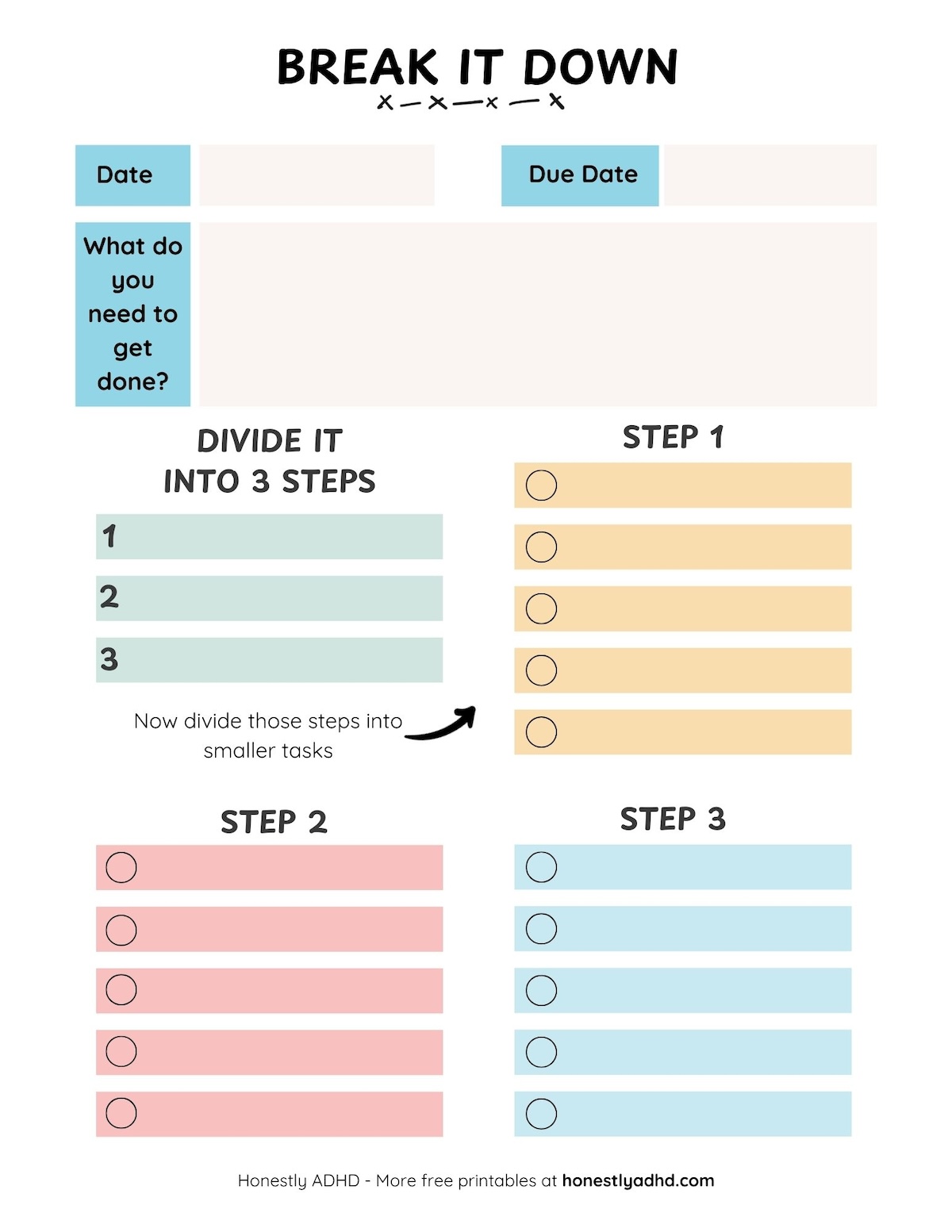
Use the worksheet image, paper, a notes app, or your planner. Take about 10–15 minutes to make the list.
1. Write the assignment exactly
Include the class and assignment name.
Algebra 1: Complete “Solving Two-Step Equations” practice, questions 1–20.
2. Read the directions before planning
Do not rely only on the assignment title. Look for:
- how many questions, pages, slides, or paragraphs are required;
- which materials you need;
- whether there is a rubric, example, or required format;
- the submission method and deadline.
This step may itself be your first action:
Read the directions and circle the required questions and showing-work rules. 10 minutes
3. Name two to four broad stages
For the algebra example, the stages could be:
- Understand the directions and review an example.
- Complete the problems.
- Check the work.
For a reading assignment, the stages might be read, take notes, and answer questions. For a project, they might be gather information, create the product, and revise it.
The worksheet has room for three stages, but you do not have to force every assignment into exactly three. It is just a way to organize your list.
4. Write actions beneath each stage
For the algebra example:
- Read the directions and look at one completed example. 10 min
- Solve questions 1–4, showing every step. 25 min
- Check questions 1–4 with the example or answer key if one is provided. 15 min
- Solve questions 5–8, showing every step. 25 min
- Check questions 5–8. 15 min
Keep breaking the assignment down until each item passes this check:
- Could I begin this without making another big decision?
- Can I tell exactly when I have finished it?
- Is it likely to take 30 minutes or less?
- Do I have the materials needed to start?
If the answer to any of these is “no,” make the action smaller or more specific.
When you get stuck while breaking it down
There are three common reasons a task will not split easily.
You do not understand what the assignment asks for.
Make the next action about getting clarity: “Underline the words in the directions I do not understand,” or “Write one question to ask my teacher.” You do not have to pretend you understand before you make a plan.
You do not have the materials.
Your action might be “Find the class handout in the portal for 15 minutes” or “Ask a classmate which pages were assigned.” Do not write “complete the worksheet” if you cannot access it yet.
You keep writing vague words.
Watch for phrases like “work on,” “get caught up,” “study,” or “finish.” Add a verb, a specific amount, and a finish line.
| Vague plan | Clearer action |
|---|---|
| “Study Biology” | “Read the cell-division notes and write five recall questions.” |
| “Work on Spanish” | “Write and say aloud sentences using vocabulary words 1–6.” |
| “Get caught up in History” | “Find the missing assignment directions and write its required parts.” |
| “Finish my project” | “Choose the three facts that belong in the first section.” |
Put a checkbox next to each action. Checking off a real action is evidence that you are moving forward. It is more useful than staring at an unfinished assignment and judging yourself for it.
Key takeaways
An overwhelming assignment is usually not one task. It is a bundle of smaller tasks that need to be named.
To break it down:
- Start with the exact assignment and read its directions.
- Organize it into a few broad stages.
- Turn each stage into actions with a verb, a specific object, and a visible finish line.
- Keep every action at 30 minutes or less.
- If an action still feels intimidating, reduce the amount or separate the kinds of thinking involved.
Your list does not have to be perfect before you begin. It only needs to give you one honest, manageable next action.
In the next lesson, you will place these small actions into a realistic five-day plan with 30-minute work blocks and recovery time.
Can't find a good explanation? Sign up and we'll make it for you
Sign up