
Introduction
Welcome back. In our previous lessons, we followed Descartes' ambitious project through five of his six Meditations. We began with the radical method of doubt, stripping away all beliefs that could be questioned. We then arrived at the first bedrock of certainty, the cogito: "I think, therefore I am." From this internal anchor, Descartes argued for the existence of a non-deceiving God, first via the cosmological argument in Meditation III and then the ontological argument in Meditation V.
The proof of a benevolent God is the crucial turning point. It allows Descartes to trust the validity of his "clear and distinct perceptions." With this divine guarantee in place, he is finally ready to reclaim the world he had previously cast into doubt.
In this lesson, we arrive at the culmination of his journey in Meditation VI. Here, Descartes not only argues for the existence of the external, material world but also presents his famous and highly influential thesis of mind-body dualism. Our goal is to analyze Descartes' arguments for mind-body dualism in Meditation VI. We will reconstruct his arguments for why the mind and the body are two fundamentally different kinds of things and explore the profound philosophical problem this distinction creates.
1. What is Substance Dualism?
Before we dive into the arguments, we need to understand exactly what Descartes is claiming. His position is not just that the mind and body are different, but that they are different substances.
To get a clear initial grasp of this concept, let's start with a short video.
The video 'Descartes Mind-Body Dualism' from Attic Philosophy provides a concise introduction to the core concepts. It defines 'substance' and 'dualism' in the Cartesian context.
Please watch the first part of the video (00:24 - 03:47). Focus on how it explains: The meaning of 'dualism' (two fundamental, irreducible things). The philosophical definition of a 'substance' as something that can exist on its own. The two substances Descartes identifies: mind (the thinking substance) and body (the physical substance).
As the video explains, Descartes posits two fundamentally different categories of being. This view, known as Cartesian Dualism, stands in contrast to Monism, the view that there is only one fundamental type of substance.

To be more precise, Descartes argues for a real distinction between mind and body. This is a technical term with a specific meaning in his philosophy.
René Descartes: The Mind-Body Distinction
The Internet Encyclopedia of Philosophy article 'René Descartes: The Mind-Body Distinction' explains what Descartes means by a 'real distinction'. This concept is the cornerstone of his argument.
Please read section 1, 'The Real Distinction of Mind and Body'. Focus on the definition of a 'substance' versus a 'mode', and what it means for two substances to be 'really distinct'. The key idea is that they could exist independently of each other.
So, to prove that the mind and body are "really distinct," Descartes needs to show that it is possible for the mind to exist without the body, and the body without the mind. This is precisely what his arguments aim to do.
2. The Main Arguments for Dualism
In Meditation VI, Descartes provides two primary arguments for the real distinction between mind and body.
The Argument from Conceivability (The "Real Distinction" Argument)
This is Descartes' central and most famous argument. It leverages the guarantee of a non-deceiving God to move from what is conceivable to what is possible. The argument is subtle, so we'll use a resource that breaks it down into its constituent parts.
The 'Sixth Meditation - Notebook' resource provides an excellent, step-by-step reconstruction of the argument as it appears at paragraph 7:78 of the Meditations. This text-focused breakdown will allow us to analyze its structure carefully.
Please read the following sections: 'Three Kind of Distinction', 'Essence as Primary Attribute', 'The Real Distinction Argument (7:78)', 'God’s Power', 'Knowing One’s Essence', and 'The Real Distinctness of Mind and Body'. This will guide you through the necessary background and the three main parts of the argument. Pay close attention to: The definitions of essence: extension for body, thought for mind. The role of God's power in linking clear and distinct understanding to real possibility. How Descartes argues from knowing his essence solely as a thinking thing to the conclusion that he is distinct from his body.
To summarize the argument's core logic:
- I have a clear and distinct idea of myself (my mind) as a thinking, non-extended thing.
- I have a clear and distinct idea of body as an extended, non-thinking thing.
- Whatever I can clearly and distinctly understand as separate can be created by God as separate.
- Therefore, it is certain that my mind is really distinct from my body and can exist without it.
This argument was immediately challenged. The philosopher Antoine Arnauld raised a powerful objection: How do you know that your perception of the mind's essence isn't just due to ignorance? Perhaps mind and body are really the same thing, and your idea of the mind as "non-extended" is incomplete, not a positive feature.
Let's examine this classic objection and Descartes' response, using the same resource.
Read the section 'An Objection: Excluding Ignorance'. Note how Arnauld uses the analogy of a person who doesn't know the Pythagorean theorem. Then, analyze Descartes' defense, which falls back on the power and completeness of a truly 'clear and distinct' idea.
The Argument from Divisibility
Descartes offers a second, more straightforward argument based on a property he believes the mind has and the body lacks.
René Descartes: The Mind-Body Distinction
Let's return to the IEP article, which presents this second argument very clearly.
Please read the section 'The Second Version' under section 3, 'The Real Distinction Argument'. This section lays out the divisibility argument and explains its logic.
This argument can be stated simply:
- Any body, being extended, is by its very nature divisible into parts.
- The mind, or the "I" that thinks, is by its very nature indivisible. I cannot perceive myself as having parts; I am a single, complete self.
- Therefore, since one is essentially divisible and the other is essentially indivisible, the mind is completely different from the body.
This argument is elegant, but critics point out that it may assume what it's trying to prove. If the mind is a function of the brain (a physicalist view), then it is spatially located and divisible, even if it doesn't seem that way from introspection. Descartes' premise that the mind is indivisible seems to already presuppose that it is not a physical thing.
3. The Mind-Body Problem: The Price of Dualism
While Descartes' dualism provides a powerful basis for the immortality of the soul and a non-materialist view of the person, it comes at a very high philosophical price: the problem of interaction.
If the mind is non-extended, non-physical stuff, and the body is extended, physical stuff, how can they possibly interact? It is a fundamental part of our experience that our thoughts and decisions (mental events) cause our bodies to move (physical events), and that physical events (like stubbing a toe) cause mental events (the feeling of pain).
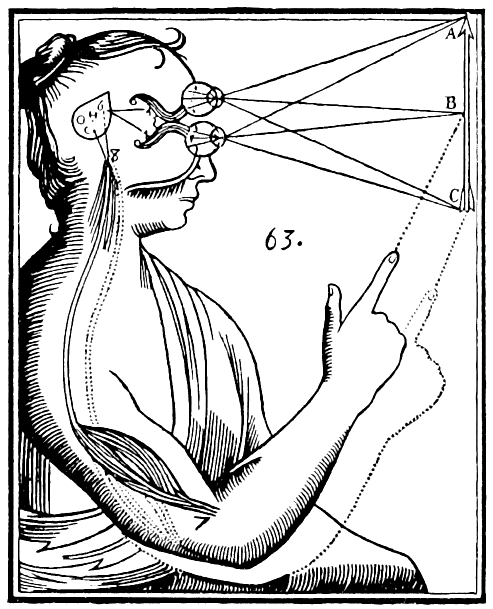
This challenge was put to Descartes forcefully by his contemporaries, most notably Princess Elisabeth of Bohemia.
René Descartes: The Mind-Body Distinction
The IEP article provides a fantastic, in-depth discussion of this problem and Descartes' own response, which is more complex than often assumed.
Please read section 4, 'The Mind-Body Problem', and section 5, 'Descartes’ Response to the Mind-Body Problem'. This is a rigorous, university-level analysis that fits your goal of a deeper study. As you read, focus on: How Princess Elizabeth and Gassendi frame the problem in terms of physical contact. Descartes' two-pronged reply: that the problem assumes a false premise (that different substances can't interact) and that we misunderstand the nature of the mind-body union. The concept of the human being as a 'substantial union'—a third kind of thing that is more than just a 'ghost in a machine.'
Descartes' response suggests that while mind and body are distinct substances, the human being is a unique and intimate union of the two. Modes like sensation and emotion are not properties of the mind alone or the body alone, but of the composite being. However, for many philosophers, this response only re-describes the mystery of interaction without truly solving it, and the mind-body problem remains one of the most significant and enduring legacies of Cartesian philosophy.
Conclusion
In this lesson, we have reached the climax of Descartes' Meditations and analyzed one of his most lasting contributions to philosophy. By separating the world into two distinct substances—mind and matter—he carved out a space for both the new mechanistic science and a non-material human soul.
Key Takeaways:
- Substance Dualism: Descartes argues for a "real distinction" between mind and body, meaning they are two different types of substance, defined by mutually exclusive essences: thought (for mind) and extension (for body).
- The Conceivability Argument: Because he can clearly and distinctly conceive of his mind as a non-extended thinking thing, separate from his body as an extended, non-thinking thing, he concludes that God could separate them, meaning they are distinct.
- The Divisibility Argument: The mind is perceived as an indivisible whole, whereas the body is by its nature divisible. This essential difference proves they are distinct substances.
- The Problem of Interaction: The most severe challenge to Cartesian dualism. If mind and body are fundamentally different, explaining how they causally interact (how thoughts move limbs, how injuries cause pain) becomes deeply problematic.
Descartes' dualism set the terms for centuries of debate in the philosophy of mind. His sharp distinction created a problem so profound that the next philosopher we will study, Baruch Spinoza, felt compelled to reject it entirely.
Preview of the Next Lesson:
In our next lesson, we will examine Spinoza's radical solution to the mind-body problem. Instead of two substances, Spinoza argues there is only one substance—which he calls "God, or Nature." We will explore his monistic system, where mind and body are not separate things but merely two different "attributes" or ways of understanding the very same underlying reality.
Can't find a good explanation? Sign up and we'll make it for you
Sign up