
Introduction
Welcome back. In our last lesson, we explored Descartes' mind-body dualism, concluding with the formidable problem of interaction: if the mind (a non-physical substance) and the body (a physical substance) are fundamentally different, how can they possibly influence one another? This question became a central challenge for philosophers in the 17th century.
Today, we turn to Baruch Spinoza, a fellow rationalist who took Descartes' foundational principles of reason and clarity to their most radical and logical conclusions. Spinoza found the idea of two distinct substances interacting to be an incoherent fudge. His solution was to dismantle the dualistic framework entirely. He argued that reality does not consist of two substances, but only one, which he controversially identified as "God, or Nature" (Deus sive Natura).
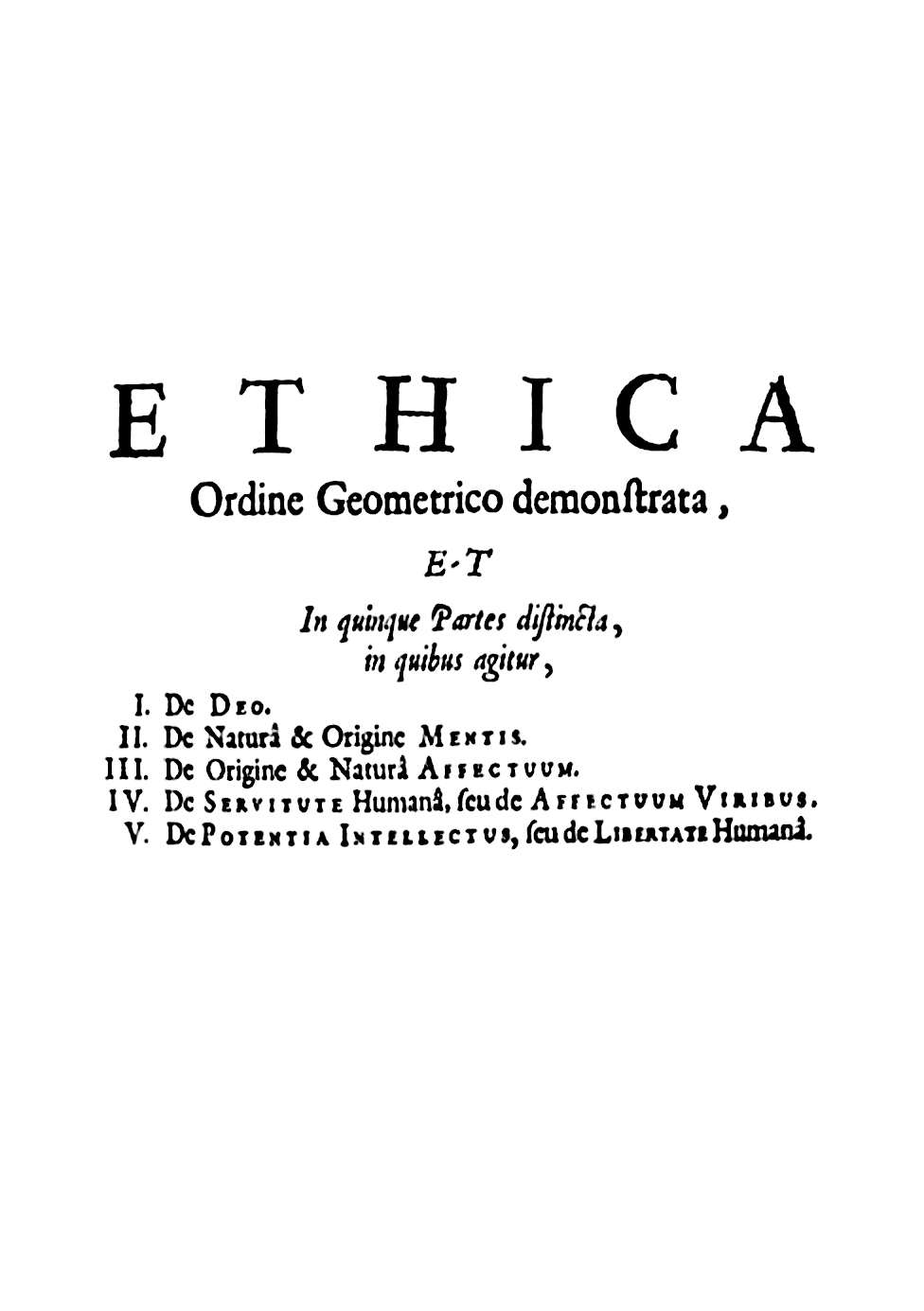
Our goal in this lesson is to explain Spinoza's monism and the identification of God with Nature in Part I of his masterpiece, the Ethics. Your preference for a rigorous, text-driven approach is perfectly suited to Spinoza's work. He constructed his philosophy using a "geometrical method," building an intricate system of definitions, axioms, and propositions, much like a mathematical proof. We will follow this logical path to understand how he arrives at his revolutionary conclusion.
1. The Building Blocks of Reality
To understand Spinoza's argument, we must first master his vocabulary. He begins Part I, "Concerning God," by defining his key terms. These definitions may seem abstract at first, but they are the precise tools he uses to construct his entire metaphysical system. You'll notice that he uses familiar terms like 'substance' and 'God' but gives them a specific, technical meaning that differs sharply from the common-sense or even the Cartesian view.
Spinoza's Ethics - An Edinburgh Philosophical Guide
To begin, let's study Spinoza's foundational definitions as explained in the 'Spinoza's Ethics - An Edinburgh Philosophical Guide'. This guide does an excellent job of clarifying these concepts and contrasting them with the views we saw in Descartes.
Please read the section titled 'Definitions' (from page 18 to the end of page 21). As you read, focus on understanding the precise meaning of these four crucial terms: Substance (D3): 'what is in itself and is conceived through itself.' Note how this implies both ontological and epistemological independence. Mode (D5): 'the affections of a substance, or that which is in another through which it is also conceived.' This is what depends on substance. Individual people, objects, and ideas are modes. Attribute (D4): 'what the intellect perceives of a substance, as constituting its essence.' For Spinoza, these are not properties of a substance, but the very essence of substance as it is expressed and perceived. We are familiar with two: Thought and Extension. God (D6): 'a substance consisting of infinite attributes.' This is a purely philosophical definition, not a religious one.
With these definitions in hand, Spinoza has all the necessary pieces to begin his deductive argument. His goal is to demonstrate that, contrary to Descartes' view of a world with one divine substance and many created mental and physical substances, there can logically be only one substance in total.
2. The Argument for Monism: A Step-by-Step Reconstruction
Spinoza's argument in the first fifteen propositions of the Ethics unfolds in three major stages. We will trace this path using the same guide, which lays out the argument with exceptional clarity.
Step 1: There Cannot Be Two Substances with the Same Attribute (Propositions 1-5)
Spinoza’s first major move is to attack the foundation of any pluralistic view of substance. He argues that it is logically impossible for two or more distinct substances to share the same fundamental essence or attribute. This directly challenges the Cartesian idea that there could be many distinct minds (all sharing the attribute of thought) or many distinct bodies.
Spinoza's Ethics - An Edinburgh Philosophical Guide
Let's analyze this first crucial step in the argument.
Read the section 'Propositions 1–5' (pages 23-26). Focus on the demonstration for Proposition 5 (P5). The core question is: how can you distinguish two substances that have the same essential nature (attribute)? Spinoza argues that you can't, and therefore they must be one and the same.
The conclusion of P5—that there can be at most one substance for any given attribute—is a critical blow to the common-sense view of reality. If Spinoza is right, there is only one substance of Thought and only one substance of Extension. The question then becomes: are these two different substances?
Step 2: The Necessary Existence of God (Propositions 6-11)
Next, Spinoza establishes that substance, by its very nature, must exist. It cannot be created or caused by anything else, so it must be its own cause (causa sui). He then introduces his definition of God—a substance with infinite attributes—and argues that such a being cannot possibly not exist.
Spinoza's Ethics - An Edinburgh Philosophical Guide
This is Spinoza's version of a proof for God's existence, but it is deeply intertwined with his definition of substance.
Please read the sections 'Propositions 6–10' and 'P11: The Necessary Existence of God' (pages 27-32). As you read, pay attention to: Proposition 7 (P7): 'it pertains to the nature of a substance to exist.' Why must a substance be self-caused and therefore necessarily exist? Proposition 11 (P11): How Spinoza argues that a substance with infinite attributes (God) must exist. Note how the guide explains this is not a simple ontological argument like Descartes'; it's an argument about the nature of being itself.
At this point, Spinoza has established that there is only one substance per attribute, and that a substance with infinite attributes (God) necessarily exists. He is now ready for his final, decisive conclusion.
Step 3: God is the Only Substance (Propositions 12-15)
The final step ties everything together. If God necessarily exists and possesses all possible attributes, and we already know there can only be one substance for each attribute, then there is no room left for any other substance to exist.
Spinoza's Ethics - An Edinburgh Philosophical Guide
Let's examine the culmination of Spinoza's argument.
Read the section 'Propositions 12–14' (pages 32-33). Focus on the logic of Proposition 14 (P14): 'except God, no substance can be or be conceived.' The reasoning is: God has all the attributes, so any other supposed substance would have to share an attribute with God, which P5 already showed is impossible.
With Proposition 14, the argument is complete. Spinoza has moved from a set of seemingly innocuous definitions to a radical conclusion: there is only one substance, it is infinite, and we call it God. Proposition 15 makes this explicit: "Whatsoever is, is in God, and without God nothing can be, or be conceived."
3. Deus Sive Natura (God or Nature)
Spinoza's conclusion is a form of substance monism: the view that all of reality is a single, unified being. But what is this one substance? Spinoza famously equates it with Nature.
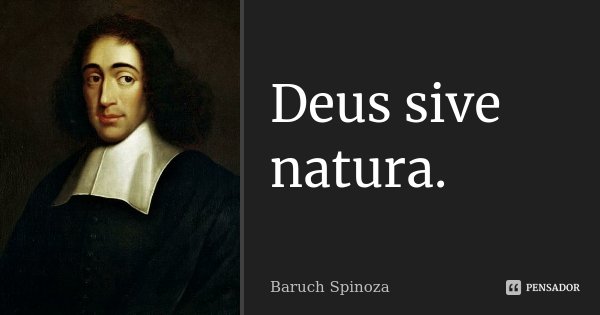
When Spinoza says "God or Nature," he does not mean the God of traditional religion—a personal, transcendent creator who stands apart from the world and acts upon it. Spinoza's God is the world. More precisely, God/Nature is the single, all-encompassing, and eternal system of reality, governed by necessary laws. It is an immanent cause, meaning it is the inner cause of all things, not an external, transient one.
This view is a form of pantheism, the belief that God and the universe are identical.
How does this solve the mind-body problem? For Spinoza, mind (Thought) and body (Extension) are not two different substances that need to interact. They are two of the infinite attributes of the one and only substance, God/Nature. Every event in the universe is simultaneously an event in the attribute of Extension (a physical process) and an event in the attribute of Thought (a mental/ideational process). They are two sides of the same coin, parallel expressions of the same underlying reality. There is no problem of interaction because there is no interaction—only a perfect, parallel correspondence.
Conclusion
In this lesson, we have traced the rigorous logical path that led Spinoza from a critique of Cartesian dualism to a radical monistic and pantheistic vision of reality. By redefining the fundamental terms of metaphysics, he argued that the universe is not a collection of separate things but a single, unified, and self-caused substance that he identified as God or Nature.
Key Takeaways:
- Spinoza's Method: Spinoza uses a "geometrical method," deducing his conclusions from a strict set of definitions and axioms.
- Core Concepts: Reality is composed of one Substance (God/Nature), which is expressed through infinite Attributes (like Thought and Extension), and all individual things are Modes (modifications) of that substance.
- The Argument for Monism: The argument proceeds in steps: (1) There can be only one substance per attribute (P5); (2) A substance with infinite attributes (God) necessarily exists (P11); (3) Therefore, God is the only substance there is (P14).
- God or Nature (Deus Sive Natura): Spinoza's God is not a personal creator but the immanent, necessary, and all-encompassing system of Nature itself.
- Solution to the Mind-Body Problem: Mind and body are not two substances but two attributes of the one substance, expressing the same reality in parallel ways.
Preview of the Next Lesson:
Spinoza's system has profound implications. If everything that happens is just a modification of the one substance, and if that substance acts from the necessity of its own nature, what does that mean for human freedom? In our next lesson, we will analyze Spinoza's determinism and his critique of free will as a human illusion, exploring what it means to live within this necessary and unified system of Nature.
Can't find a good explanation? Sign up and we'll make it for you
Sign up