
Introduction
Welcome back. In our last lesson, we worked through the dense and intricate cosmological argument in Meditation III. We saw Descartes reason from an effect—the idea of an infinitely perfect being in his mind—to its necessary cause, God. This argument hinged on the complex scholastic machinery of formal and objective reality and the causal adequacy principle. Having secured this first proof, Descartes is not yet finished.
In this lesson, we will explore his second, and perhaps more famous, argument for God's existence, found in Meditation V. This is an ontological argument. Unlike the cosmological argument, which starts from an observation about the world (or the mind), an ontological argument is purely a priori. It attempts to prove God's existence from the very concept, essence, or definition of God alone.
Our goal is to analyze Descartes' ontological argument for God's existence in Meditation V. We will reconstruct its logical structure, understand its reliance on the concept of "essence," and examine some of the classic objections it has faced for centuries.
1. From Triangles to God: Essence and Existence
Before presenting his argument for God, Descartes asks us to consider the nature of our ideas about things, even things that may not exist in the world. He uses the example of a triangle. We can understand the essence of a triangle—what it is to be a triangle—without knowing if any perfect triangles actually exist.
To begin, let's clarify what an ontological argument is and how Descartes sets the stage for his.
Rene Descartes Meditation 5 | An Ontological Argument for God's Existence | Philosophy Core Concepts
This video by Dr. Gregory B. Sadler provides an excellent introduction. It defines what makes an argument 'ontological' and explains Descartes' starting point: the idea of 'true and immutable natures' like the triangle.
Please watch the segment from 01:35 to 04:50. Focus on: The definition of an ontological argument: how it argues from the idea of God to the necessary existence of God. Descartes' concept of 'true and immutable natures,' using the triangle example. Notice how certain properties (like its angles summing to 180 degrees) belong to the triangle's nature, whether one exists or not.
Now that you have a sense of the general approach, let's turn to Descartes' own words in Meditation V. Here, he makes the crucial move from the essence of a triangle to the essence of God.
Fifth Meditation: The essence of material things, and the existence of God considered a second time
Reading the primary text is essential to see how Descartes builds his case. Pay close attention to the analogies he uses.
Please read the section of the text from the paragraph beginning 'The most important point is that I find in myself countless ideas...' down to '...namely the perfection of existence.' As you read, identify: How Descartes argues that the nature of a triangle is 'eternal, unchanging, and independent of my mind.' The point where he pivots from the idea of shapes and numbers to the idea of God. The analogy of the 'highlands' and 'lowlands' (or mountain and valley). What is this analogy meant to show about the relationship between God's essence and existence?
Descartes' core insight is this: just as you cannot coherently think of a triangle without its essential properties, or a mountain without a valley, he argues you cannot coherently think of a supremely perfect being that lacks the perfection of existence.
2. Reconstructing the Argument
The argument can seem almost like a verbal sleight of hand. To analyze it properly, it's helpful to reconstruct it in a clear, step-by-step format. The structure of the argument closely parallels a simple geometric proof, a style of reasoning Descartes found to be the epitome of certainty.
René Descartes - Meditation #5 - The Ontological Proof of God's Existence
The following video by Jeffrey Kaplan provides an exceptionally clear, step-by-step reconstruction of the ontological argument, placing it side-by-side with a proof about triangles to reveal its logical form.
Please watch from 01:55 to 05:04 to review the concept of 'essence', then watch from 06:57 to 12:26 for the argument itself. Take careful notes on the four-step proof about God's existence. Pay attention to how each premise is justified: Premise 1: Justified by the stipulated definition of God. Premise 2: Presented as a supposedly straightforward fact about what counts as a 'perfection.' Conclusion 3: Follows logically from the first two premises. Final Conclusion 4: Follows from premise 3 and the meaning of 'essence.'
Here is the argument, presented formally:
- I have an idea of a supremely perfect being, i.e., a being having all perfections. (This is taken as the definition of "God".)
- Existence is a perfection. (To exist is better, or more perfect, than not to exist.)
- Therefore, existence is part of God's essence. (This follows from 1 and 2.)
- Therefore, God necessarily exists. (This follows from 3, because a being whose essence includes existence must exist.)
Descartes believes this argument is as certain as a mathematical truth. For him, denying God's existence is as self-contradictory as affirming the existence of a triangle whose angles do not sum to 180 degrees. The claim "God does not exist" becomes equivalent to "A being that must exist does not exist," which is a plain contradiction.
3. Classic Objections
This argument has been controversial since its inception. While it has had its defenders, many philosophers believe it contains a fatal flaw. Two major lines of objection have been particularly influential.
Objection 1: You Can't Define Things into Existence
This objection was raised in Descartes' own time. If this argument form is valid, it seems we could invent all sorts of "perfect" things and prove they exist simply by defining them as existing. The classic parody of the argument, first formulated by a monk named Gaunilo against an earlier version by St. Anselm, involves the idea of a "perfect island."
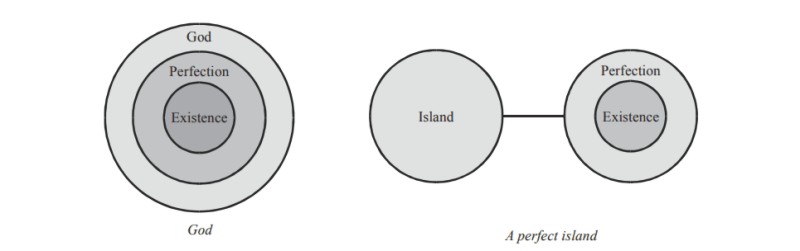
The objection runs as follows:
- I can conceive of the most perfect island imaginable.
- Existence is a perfection.
- Therefore, the most perfect island must exist, otherwise it would lack a perfection and wouldn't be the most perfect.
This conclusion seems obviously false; we can't simply prove islands exist by defining them. So, the critic argues, there must be something wrong with the original argument about God.
Descartes' response is to claim that this parallel doesn't work. The idea of a "perfect island" is a confused concept, a fiction we've cobbled together. The idea of God, however, is a clear and distinct, innate idea of a being with all perfections, a unified and unique essence. Only in the case of a supremely perfect being is existence necessarily tied to the essence.
Objection 2: Existence is Not a Predicate
Perhaps the most famous objection comes from the later philosopher Immanuel Kant. Kant argued that the mistake in the ontological argument lies in Premise 2: "Existence is a perfection."
Kant's point is that existence is not a "predicate" or a "property" that a thing can have or lack, in the way a triangle can have the property of "having three sides" or a car can have the property of "being red." When you say a thing exists, you are not adding a new feature to its concept; you are positing that the concept is instantiated in reality.
René Descartes - Meditation #5 - The Ontological Proof of God's Existence
Let's return to Jeffrey Kaplan's video, where he explains Kant's objection with a clear and intuitive example.
Watch from 15:02 to 17:42. Focus on the distinction between these two sentences: 'Kim smokes.' 'Kim exists.' Understand why Kant argues that the 'exists' in the second sentence functions differently from the 'smokes' in the first. It doesn't add a property to the concept of Kim; it asserts that the concept of Kim applies to something in the world.
If Kant is right, then "existence" isn't on the list of perfections that a supreme being could possess. It's a precondition for possessing any perfections at all. The ontological argument would therefore fail because it treats existence as just another property, which it is not.
While Descartes never faced Kant directly, we can see from his broader philosophical system how he might have responded. For a deeper analysis of these objections and Descartes' potential replies, the Stanford Encyclopedia of Philosophy is an excellent resource.
Descartes' Ontological Argument
For a more advanced analysis, this article explores how Descartes' system, particularly his theory of innate ideas and clear and distinct perception, provides him with resources to counter these objections. It's a challenging read that will reward careful attention.
Read the section '3. Objections and Replies.' This is a dense, university-level analysis. Don't worry about grasping every detail. Instead, focus on the general strategy of Descartes' defense against: The charge of an 'illicit logical leap' from concepts to reality (what Caterus objected). The 'perfect island' or 'existing lion' objection. The Kantian-style objection that 'existence is not a perfection' (raised by Gassendi). Notice how Descartes' distinction between different grades of existence (contingent vs. necessary) is crucial to his defense.
Conclusion
In this lesson, we have dissected one of the most elegant and debated arguments in the history of philosophy. Unlike the laborious cosmological proof of Meditation III, the ontological argument is compact, powerful, and purely conceptual.
Key Takeaways:
- Ontological arguments are a priori proofs that attempt to demonstrate God's existence from the definition or essence of God alone.
- Descartes' Argument: The idea of God is that of a supremely perfect being. Since existence is a perfection, existence must be part of God's essence. Therefore, God cannot be conceived of as not existing, meaning God necessarily exists.
- Analogy to Geometry: Descartes presents this conclusion as being as certain as a mathematical truth. Denying God's existence is presented as a logical contradiction, akin to describing a mountain that has no valley.
- Major Objections: The argument faces powerful critiques, notably that it illegitimately tries to define something into existence (the "Perfect Island" objection) and that it mistakenly treats existence as a property or perfection (Kant's objection).
With God's existence now seemingly proven in two different ways, Descartes has what he needs to complete his project. He has established an anchor of certainty outside his own mind—a perfect God who is not a deceiver. This will be the key to vanquishing the evil demon and rebuilding the edifice of knowledge.
Preview of the Next Lesson:
Now that the threat of a malicious deceiver is neutralized, Descartes can finally trust his clear and distinct perceptions. In our next lesson, we will analyze his arguments for mind-body dualism in Meditation VI, where he attempts to prove the existence of the external, material world and argues that the mind and body are two fundamentally distinct substances.
Can't find a good explanation? Sign up and we'll make it for you
Sign up