
Introduction
Welcome back. In our previous lesson, we explored Spinoza's revolutionary monism, culminating in his famous identification of "God, or Nature" (Deus sive Natura). We saw how, through a rigorous geometrical method, he argued that everything in existence is not a separate entity but a "mode" or modification of a single, infinite, and self-caused substance. Everything that is, is in God and follows from the necessity of the divine nature.
This powerful metaphysical vision has profound consequences. If everything is a determined expression of a single, unified system, what does this imply about human choice and freedom? This is the central question for today's lesson.
Our goal is to analyze Spinoza's determinism and his critique of free will as a human illusion. We will investigate why Spinoza believed that the notion of a 'free will' is not only philosophically incoherent but also a fundamental misunderstanding of our place in nature. We will break down his arguments for universal determinism and then explore his psychological explanation for why we persistently feel free despite being fully determined.
1. From Monism to Determinism: The Necessity of All Things
Spinoza's determinism is a direct and logical consequence of the monistic metaphysics we studied previously. If there is only one substance (God/Nature) that acts solely according to the laws of its own being, then everything that follows from it—which is to say, everything—must also be necessitated.
For Spinoza, there are no "brute facts" or contingent events. Everything has a cause and an explanation, a position rooted in the Principle of Sufficient Reason. The universe unfolds with the same logical necessity that the properties of a triangle follow from its definition.
Let's start with a foundational reading that connects the metaphysics of Part I of the Ethics to this deterministic conclusion.
Baruch Spinoza - Stanford Encyclopedia of Philosophy
The following text from the Stanford Encyclopedia of Philosophy explains how Spinoza's view of God/Nature leads directly to a deterministic worldview, where there is no room for contingency or alternative possibilities. It highlights the key propositions that establish this necessity.
Please read the section titled '2.1 God or Nature'. Focus on the latter half of the section, starting from the paragraph that begins: 'According to the traditional Judeo-Christian conception of divinity...'. Pay close attention to how Spinoza's God differs from a transcendent creator and why this leads to the conclusions in Propositions 29 and 33.
As the reading makes clear, Spinoza argues:
- (Ip29): "In nature there is nothing contingent, but all things have been determined from the necessity of the divine nature to exist and produce an effect in a certain way."
- (Ip33): "Things could have been produced by God in no other way, and in no other order than they have been produced."
This position is known as causal determinism (or nomological determinism): the idea that every event is necessitated by antecedent events and conditions together with the laws of nature.
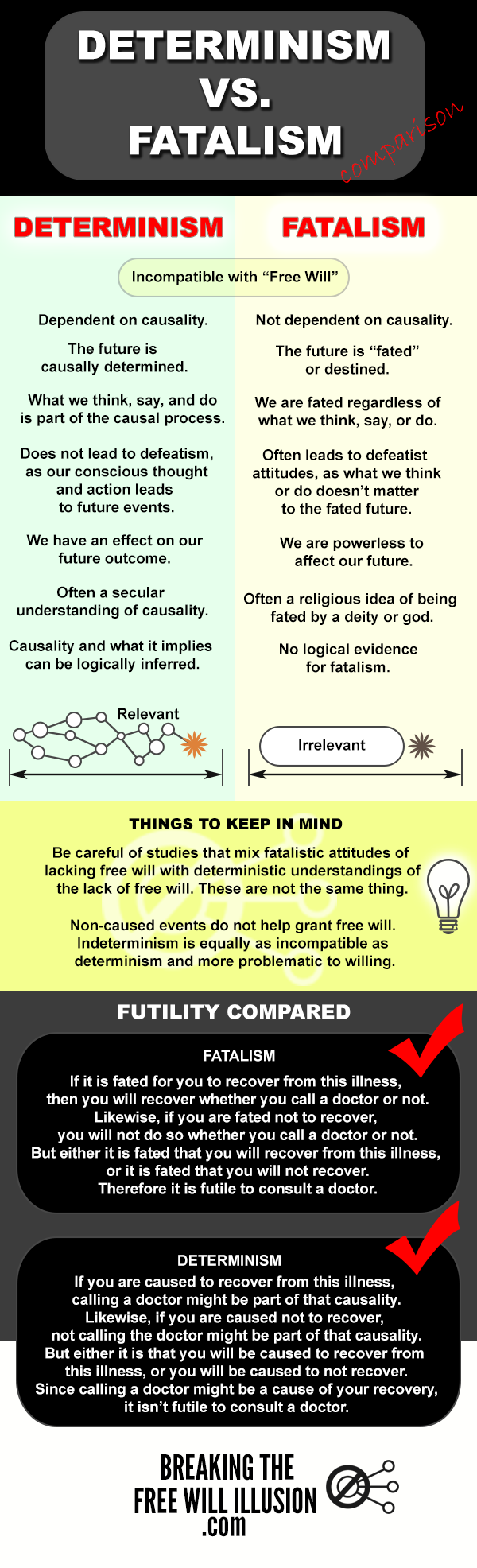
It is crucial, however, to distinguish Spinoza's determinism from fatalism. Fatalism is the belief that certain outcomes are destined to happen regardless of what you do. Determinism, in contrast, asserts that your actions are part of the causal web. Your choices and actions are themselves determined effects of prior causes, and they are, in turn, causes of future effects. What you do matters immensely; it's just that what you do is not an uncaused, spontaneous event.
This infographic provides a helpful summary of the distinction:
2. The Will Is Not Free
Having established that all of nature is determined, Spinoza turns his attention to the human mind. He argues that the human will, far from being an exception to this universal rule, is as determined as any other natural phenomenon.
The following video provides an excellent, energetic overview of Spinoza's core argument against the conventional notion of free will.
Dr. Darren Staloff, Spinoza's Ethics
Dr. Darren Staloff explains Spinoza's argument that free will is a 'pathetic joke'. He connects Spinoza's determinism to the predictability of human behavior and introduces the core reason why we mistakenly believe we are free.
Please watch the segment from 17:59 to 23:28. Focus on how Spinoza argues that if our choices have a cause, they are determined, and if they are random, they are irrational. Notice the examples he uses (like shaking hands) to show that we implicitly believe in determinism in our daily lives.
Dr. Staloff brings Spinoza's argument to life. Now, let's analyze the philosophical mechanics behind it in more detail, as this is where Spinoza directly confronts his predecessor, Descartes.
For Descartes, you'll recall, the intellect was finite, but the will was an infinite faculty capable of affirming or denying any proposition, even those the intellect did not clearly understand. This mismatch was the source of error. Spinoza rejects this picture entirely.
The core of Spinoza's argument is found in Part II of the Ethics:
(IIp48): "In the mind there is no absolute, or free, will, but the mind is determined to will this or that by a cause which is also determined by another, and this again by another, and so to infinity."
To understand this, we need to delve into Spinoza's text-based argument, which dismantles the very idea of the "will" as a distinct faculty.
Spinoza on Free Will and Freedom
This article from the Internet Encyclopedia of Philosophy provides a rigorous analysis of Spinoza's position. It explains his technical arguments for why the will is not a separate faculty and why it is identical to the intellect.
Please read the entire section titled '2. Spinoza on Free Will'. This is a detailed section, so take your time. As you read, focus on: Rejection of the Will as a Faculty: Why does Spinoza believe the 'will' is a fiction, a mere 'universal notion' abstracted from individual volitions? Will = Intellect: What does Spinoza mean by claiming 'the will and the intellect are one and the same' (IIP49C)? Understand his view that ideas themselves intrinsically involve affirmation or negation. Critique of Descartes: How does this view undermine Descartes' explanation for error and his defense of free will? The Four Objections: Pay attention to how Spinoza refutes common objections, such as our 'experience' of suspending judgment or the Buridan's ass paradox.
3. The Enduring Illusion of Freedom
If we are completely determined, why is the feeling of freedom so powerful and universal? Spinoza offers a simple and profound explanation: we are conscious of our desires, but ignorant of their causes.
He famously writes in the Appendix to Part I:
"...men think themselves free, because they are conscious of their volitions and their appetites, and do not even think in their dreams, of the causes by which they are disposed to wanting and willing because they are ignorant of those causes."
Think of a stone thrown through the air. Spinoza suggests in a letter that if this stone were conscious, it would believe it was moving of its own free will, simply because it would be aware of its motion but entirely unaware of the force that propelled it. We are in the same position.
- An infant believes it freely desires milk.
- An angry child believes they freely want revenge.
- A drunkard believes they freely choose to say things they later regret.
In each case, the individual is aware of the what (the desire) but ignorant of the why (the complex chain of physiological and psychological causes that necessitated it). For Spinoza, those who believe they speak or act from a "free decision of the mind, dream with open eyes."
This illusion is not a simple error we can easily correct. Spinoza compares it to our perception of the sun. Even when we know through reason that the sun is immense and distant, we cannot help but see it as a small, close object in the sky. Similarly, even if we rationally understand that we are determined, the immediate experience of choosing can feel free, because the intricate causes determining that choice are not present in our consciousness.
Conclusion
In this lesson, we have followed the logical chain from Spinoza's monism to his unyielding determinism. We have seen that for Spinoza, freedom of the will is an impossibility in a universe that operates with the necessity of a mathematical proof.
Key Takeaways:
- Universal Determinism: Spinoza's metaphysics implies that nothing in nature is contingent. Every event, including every human thought and action, is determined to exist and act by an infinite chain of causes.
- The Will Is Not a Faculty: Spinoza rejects the Cartesian idea of the will as an independent faculty. For him, the will is simply the sum of individual volitions, and these volitions are the ideas themselves, which inherently contain affirmation or negation.
- The Illusion of Freedom: We believe we are free because we are conscious of our desires and actions, but profoundly ignorant of the complex web of causes that determine them.
- Determinism vs. Fatalism: Spinoza's determinism is not fatalism. Our choices are meaningful and effective parts of the causal chain; they are simply not uncaused.
It is important to note that while Spinoza denies free will (libera voluntas), he does not deny freedom (libertas). For Spinoza, true freedom is not the ability to make uncaused choices, but the ability to act from the necessity of one's own nature, guided by reason. This is a state of being active rather than passive, a topic central to his ethics that we will encounter later.
Preview of the Next Lesson:
Having explored the radical systems of Descartes and Spinoza, we will next turn to the third great rationalist of the early modern period: Gottfried Wilhelm Leibniz. We will begin by examining his famous Principle of Sufficient Reason, a concept we've seen at play in Spinoza's thought, and analyze how Leibniz uses it to construct a completely different, and equally astonishing, metaphysical system based on indivisible, soul-like substances he called "monads."
Can't find a good explanation? Sign up and we'll make it for you
Sign up