
Hello! Welcome to the next lesson in your journey into audio AI.
In our previous lesson, we established how speaker embeddings can condition a Text-to-Speech (TTS) model to produce speech in different voices. We made a key distinction: using a lookup table for a fixed set of seen speakers versus using a pre-trained speaker encoder to generalize to unseen speakers.
Today, we will dive deep into that second, more powerful paradigm. Our learning outcome is to describe the methodology behind zero-shot voice cloning using a separately trained speaker encoder network. We'll unpack this by examining the architecture, training strategy, and inference process that allows a model to mimic a voice from just a few seconds of audio, without any retraining.
1. The Core Idea: Decoupling Speaker and Synthesis
The foundational principle of modern zero-shot voice cloning is the decoupling of speaker modeling from speech synthesis. Instead of training one monolithic model to understand both what to say (text) and how to say it (voice), we separate the two problems.
This is a classic transfer learning strategy with significant advantages:
- Data Efficiency: The speaker encoder can be trained on a massive, easily obtainable dataset of untranscribed speech from thousands of speakers (e.g., audiobooks, voice search data). This dataset just needs speaker labels.
- High-Quality Synthesis: The TTS synthesizer can be trained on a smaller, high-quality, and carefully transcribed dataset. This is much more expensive to create, so using less of it is a major benefit.
- Generalization: By training the speaker encoder on a vast and diverse set of voices, it learns a rich and robust representation of human vocal characteristics. This "knowledge" is then transferred to the TTS model, enabling it to generalize to voices it has never been trained on.
Let's begin by reading the introduction of a seminal paper from Google that pioneered this approach.
Transfer Learning from Speaker Verification to Multispeaker TTS
This paper, 'Transfer Learning from Speaker Verification to Multispeaker Text-To-Speech Synthesis', perfectly outlines the motivation for a decoupled system.
Please read Section 1, 'Introduction'. Focus on how the authors frame the problem and their proposed solution of decoupling speaker modeling (using a speaker-discriminative embedding network) from speech synthesis.
As the paper states, this decoupling allows the system to support "zero-shot learning," where a few seconds of untranscribed reference audio are sufficient to synthesize new speech in that voice.
2. The System Architecture: A Tale of Three Components
A typical zero-shot voice cloning system consists of three independently trained components that work in concert.
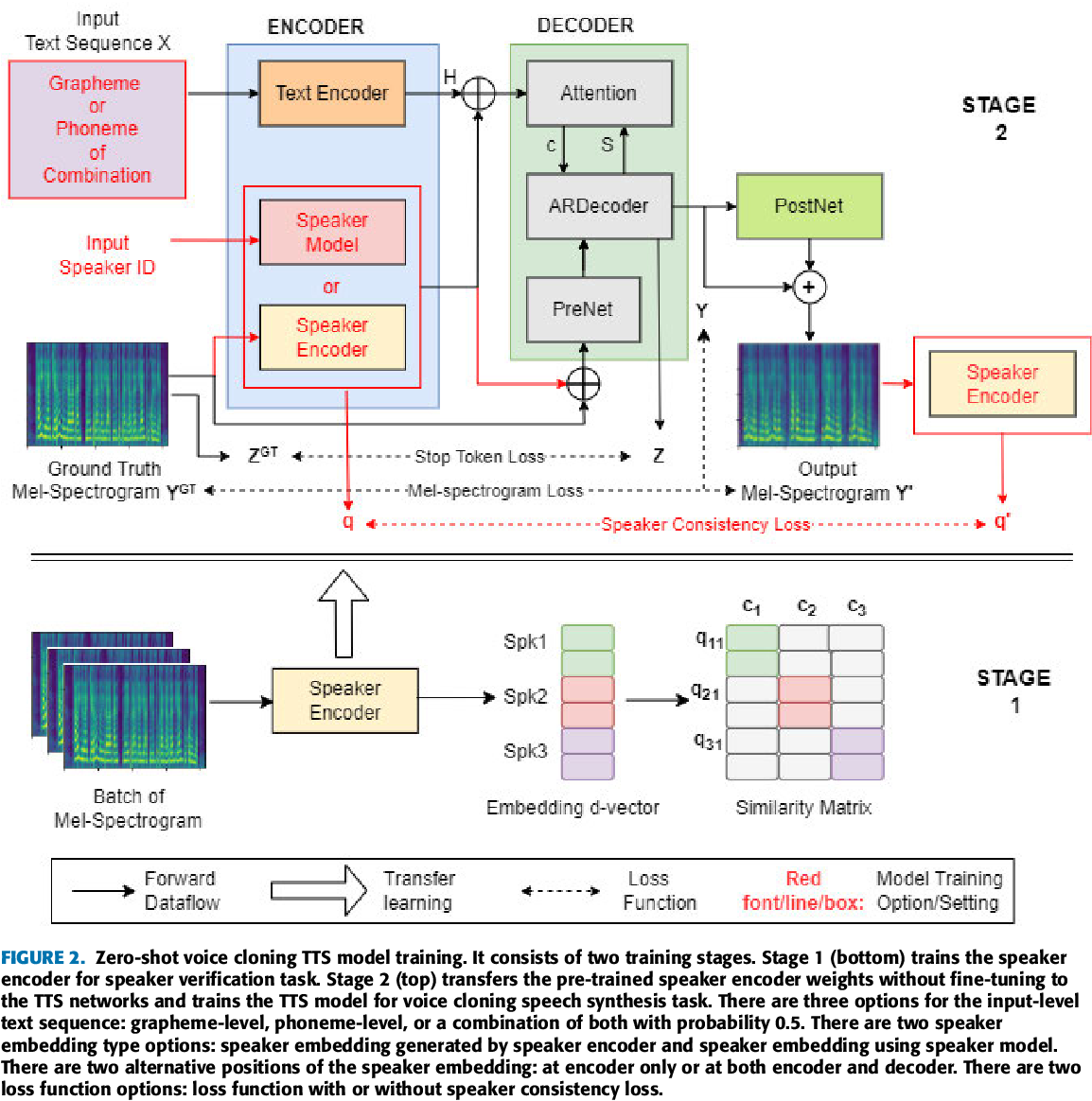
Let's break down each part.
Component 1: The Speaker Encoder Network
The speaker encoder is the heart of the voice cloning capability. Its sole purpose is to take a variable-length audio clip and produce a fixed-dimensional vector—the speaker embedding or d-vector—that acts as a numerical "fingerprint" for the speaker's voice.
Crucially, this network is not trained as part of the TTS system. It is pre-trained on a completely different task: text-independent speaker verification.
- The Task: The model is trained to determine if two different utterances were spoken by the same person.
- The Objective: The training process uses a loss function designed to maximize the similarity of embeddings from the same speaker while minimizing the similarity of embeddings from different speakers. A common objective is the Generalized End-to-End (GE2E) loss, which encourages high cosine similarity for same-speaker pairs and low similarity for different-speaker pairs.
Transfer Learning from Speaker Verification to Multispeaker TTS
Let's examine the details of the speaker encoder as described in the Google paper.
Please read Section 2.1, 'Speaker encoder'. Pay attention to: The task it's trained on ('text-independent speaker verification'). The goal of the training ('embeddings of utterances from the same speaker have high cosine similarity'). The general network architecture (a stack of LSTM layers).
The result is a powerful encoder that can distill the unique vocal characteristics of any speaker into a compact vector, independent of what they are saying.
How Voice Cloning Works: Explained EASILY
For a more conceptual explanation, this video provides a great analogy of speaker embeddings as the 'soul of a voice'.
Watch from 19:19 to 22:15. The speaker explains how voice cloning models separate 'what is said' from 'who says it' using speaker embeddings, which he likens to a voice fingerprint.
Component 2: The Multi-Speaker Synthesis Network
This component is a standard sequence-to-sequence TTS model (like Tacotron 2 or VITS). Its job is to generate a mel-spectrogram from input text. However, it's modified to be conditioned on a speaker embedding.
The training process for the synthesizer leverages the pre-trained speaker encoder:
- Freeze the Speaker Encoder: The weights of the pre-trained speaker encoder are loaded and frozen. They will not be updated during synthesizer training.
- Training Loop: For each (text, audio) pair in the multi-speaker training set:
- The audio is passed through the frozen speaker encoder to generate its corresponding speaker embedding on-the-fly.
- The synthesizer model takes the text and this speaker embedding as input.
- It predicts a mel-spectrogram.
- A reconstruction loss (e.g., L1 or L2 loss) is calculated between the predicted spectrogram and the ground-truth spectrogram.
- The synthesizer's weights are updated via backpropagation.
This way, the synthesizer learns to associate different speaker embeddings with different acoustic characteristics in the output spectrograms, effectively learning to generate speech in various voices.
Transfer Learning from Speaker Verification to Multispeaker TTS
The Google paper details this transfer learning setup for the synthesizer.
Read Section 2.2, 'Synthesizer'. Note the key phrase: 'The synthesizer is trained in a transfer learning configuration, using a pretrained speaker encoder (whose parameters are frozen) to extract a speaker embedding from the target audio'.
Component 3: The Neural Vocoder
The final component is a vocoder (e.g., HiFi-GAN, WaveNet) that converts the mel-spectrogram generated by the synthesizer into a high-fidelity audio waveform. This component is also trained independently, often on ground-truth spectrogram-audio pairs, or on spectrograms predicted by the synthesizer to better adapt to its specific outputs.
3. The Zero-Shot Inference Workflow
With all three components trained, performing zero-shot voice cloning at inference time is a straightforward pipeline:
- Provide Reference Audio: Take a short audio clip (3-10 seconds) of the target speaker. This person can be completely new to the model.
- Extract Speaker Embedding: Feed this reference audio through the speaker encoder to compute the target speaker's embedding vector.
- Provide Text: Define the text you want the cloned voice to speak.
- Synthesize Spectrogram: Pass the text and the extracted speaker embedding into the synthesis network. It generates a mel-spectrogram containing the linguistic content of the text, rendered in the acoustic style of the target speaker.
- Generate Waveform: Pass the generated mel-spectrogram through the vocoder to produce the final audio file.
This process requires no fine-tuning or model updates, hence the term "zero-shot."
YourTTS - Towards Zero-Shot Multi-Speaker TTS for everyone
Let's watch two short clips that clearly illustrate this inference workflow.
First, watch from 02:20 to 02:35. This part explains exactly how the speaker verification model is used to get a vector representation. Then, watch from 05:10 to 06:03. This visualizes the entire inference pipeline, showing how the speaker embedding from the reference audio is used to condition the model.
4. Practical Implementation and Evaluation
This methodology isn't just theoretical; it's implemented in popular open-source frameworks like Coqui TTS, particularly in models like YourTTS and XTTS.
Coqui TTS: Deep Dive Into an Open-Source Text-to-Speech ...
This article provides a brief overview of the Coqui TTS framework and shows a concrete code example of zero-shot voice cloning.
First, read the sections 'High-Level Architecture' and 'ML Components'. Notice that 'Speaker Encoders' are listed as a key, separate component. Then, look at the Python code block under the 'Voice Cloning' heading. You can see the API directly reflects the methodology: you provide text, a speaker_wav file, and a language to generate the output.
The simple API tts.tts_to_file(text=..., speaker_wav=...) elegantly hides the complex pipeline we just discussed.
How do we know if it works?
Evaluation is critical. We need to measure both the naturalness of the speech and its similarity to the target speaker.
- Naturalness (MOS): Human raters score the audio quality on a 1-5 scale (Mean Opinion Score).
- Speaker Similarity (MOS): Raters listen to the synthesized audio and a ground-truth clip from the target speaker and rate their similarity.
- Speaker Verification EER (Objective Metric): A separate, automated speaker verification system is used to see if it can be "fooled." The Equal Error Rate (EER) measures how often the system incorrectly accepts a synthesized voice as real or rejects a real voice. A lower EER for synthesized audio indicates higher similarity to the target.
The Google paper provides extensive analysis using these metrics to prove their model's effectiveness on unseen speakers.
Conclusion
In this lesson, we've dissected the methodology behind zero-shot voice cloning. We've seen it's not a single magical model but a well-engineered system of three decoupled components, built upon the principles of transfer learning.
Key Takeaways:
- Decoupled Architecture: The system is composed of an independently trained speaker encoder, a synthesis network, and a vocoder.
- Transfer Learning is Key: The speaker encoder is pre-trained on a speaker verification task using a massive, unlabeled dataset. Its learned knowledge of vocal characteristics is then transferred to the synthesizer.
- The Workflow: At inference, the speaker encoder extracts a "voice fingerprint" from a reference clip. This embedding, along with text, is fed to the synthesizer to generate a spectrogram in the target voice, which the vocoder then converts to audio.
- Zero-Shot Capability: This entire process happens without any model fine-tuning, allowing for the cloning of voices the system has never encountered during its training.
Preview of the Next Lesson:
Now that we understand the methodology, the next logical step is to consider the data. To get the best results, especially if you want to fine-tune a model for a specific voice, data quality is paramount. In our next lesson, we will cover how to prepare a custom dataset for voice cloning, including audio segmentation, cleaning, and transcription.