
Hello! Welcome back.
In our last lesson, we took a deep dive into the VITS architecture, understanding how it masterfully combines a VAE, normalizing flows, and a GAN to create a high-fidelity, end-to-end text-to-speech system. However, the model we examined was designed to synthesize speech in a single voice. To build truly flexible and personalized TTS systems, we need the ability to generate speech in many different voices.
This brings us to today's topic. Our learning outcome is to explain how speaker embeddings are used to condition a TTS model for multi-speaker speech synthesis. We will explore how to capture the essence of a speaker's voice in a simple vector and then "inject" that information into a model like VITS to control the vocal identity of the synthesized speech. This is the foundational concept behind both multi-speaker models and the exciting field of voice cloning.
1. Representing Speaker Identity: What is a Speaker Embedding?
Before a model can synthesize a particular speaker's voice, it first needs a mathematical representation of that voice's unique characteristics—its timbre, pitch range, and other acoustic qualities. This representation is called a speaker embedding.
A speaker embedding is a fixed-dimensional vector (e.g., a 256-element vector) that numerically represents a speaker's vocal identity, ideally disentangled from the content of what is being said.
The process of generating such an embedding is a form of representation learning. A specialized neural network, often called a speaker encoder, is trained to map a variable-length audio clip to a single, compact vector.
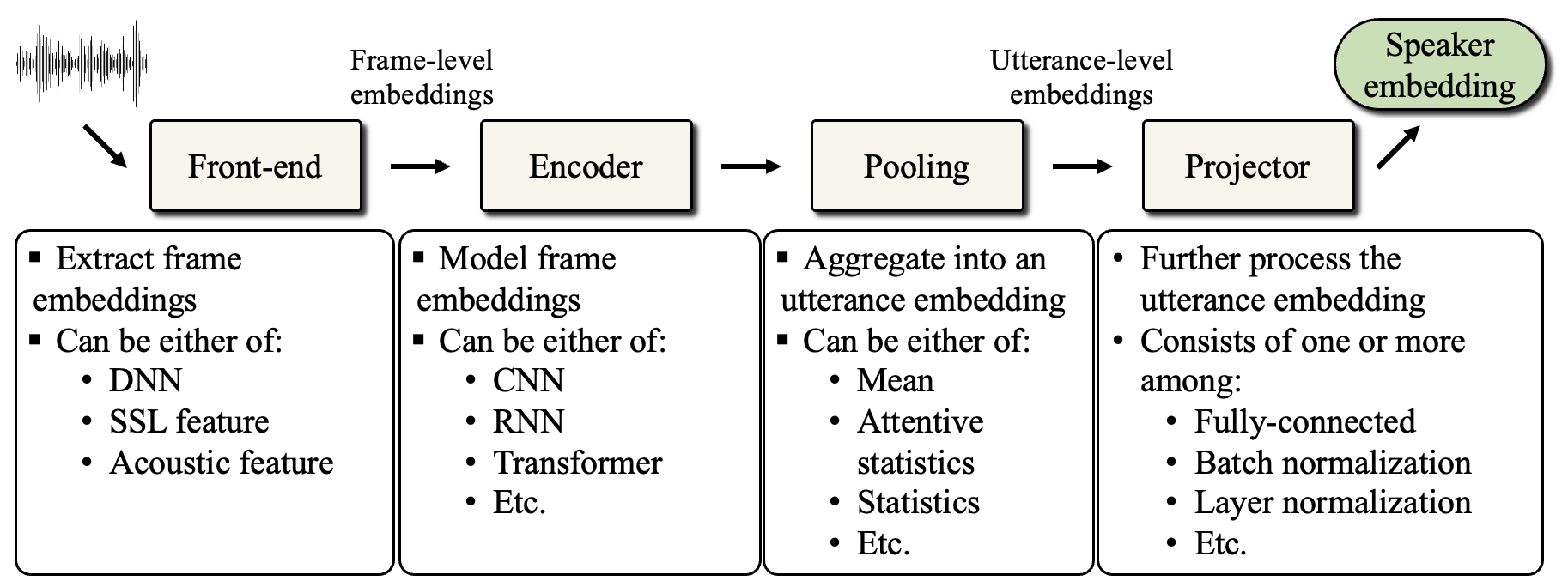
As the diagram illustrates, this typically involves:
- Front-end: Extracting frame-level acoustic features (like MFCCs or learned features) from the raw audio.
- Encoder: Using a network like a CNN, RNN, or Transformer to process the sequence of feature frames.
- Pooling: Aggregating the frame-level information into a single, utterance-level vector. This could be simple mean pooling or a more complex attention-based mechanism.
- Projector: A few final layers that map the utterance-level vector to the final speaker embedding.
The key idea is that audio clips from the same speaker will result in embedding vectors that are close to each other in the vector space, while clips from different speakers will be far apart.
2. Methods for Generating Speaker Embeddings
There are two primary strategies for obtaining speaker embeddings to use in a multi-speaker TTS model. The choice between them determines whether the model can only replicate voices it was trained on or generalize to entirely new voices.
a) Trainable Lookup Table (for Seen Speakers)
The simplest approach is used when you have a dataset with a known, fixed set of speakers (e.g., the VCTK dataset with its 109 native English speakers).
- How it works: Each of the speakers in the training set is assigned a unique integer ID from 0 to . The model contains an "embedding table," which is essentially a matrix of size , where is the dimension of the speaker embedding. During training, the model looks up the corresponding -dimensional vector for the speaker of the current audio sample. This vector is then fed into the TTS model.
- Analogy: This is identical to how embedding layers are used for words in NLP.
- Limitation: This method can only generate voices for the speakers it has seen during training. It cannot generalize to a new, unseen speaker because there is no entry for them in the lookup table.
b) Pre-trained Speaker Encoder (for Unseen Speakers)
To generate speech for any speaker, including those not in the training set (a task known as zero-shot voice cloning), we need a more powerful approach.
- How it works: A separate speaker encoder model is pre-trained on a large dataset of speakers, often for a speaker verification or identification task. This model learns a general mapping from any audio clip to a robust speaker embedding.
- During TTS Training: For each training sample, you pass the audio through this pre-trained speaker encoder to get its embedding on the fly. This embedding is then used to condition the TTS model.
- During Inference (Voice Cloning): To clone a new voice, you simply provide a short audio clip (e.g., 3-5 seconds) of the target speaker. This clip is fed through the same speaker encoder to generate an embedding, which then conditions the TTS model to synthesize speech in that target voice.
This second approach is far more flexible and is the key enabler for modern voice cloning systems.
YourTTS - Towards Zero-Shot Multi-Speaker TTS for everyone
The following video from Coqui introduces their YourTTS model, which is a multi-speaker version of VITS. It clearly explains the distinction between using speaker IDs for seen speakers and using a speaker encoder for zero-shot synthesis of unseen speakers.
Please watch from 00:42 to 03:05. Focus on how the narrator explains: Multi-speaker TTS using speaker IDs for voices seen during training. Zero-shot TTS, where a 'speaker verification model' (a speaker encoder) provides a vector representation for an unseen voice.
3. Conditioning: Injecting the Embedding into the TTS Model
Once we have a speaker embedding vector, how do we use it to influence the speech synthesis process? This is known as conditioning. The goal is to make the model's output dependent on the speaker embedding.
Let's look at a high-level architectural diagram.
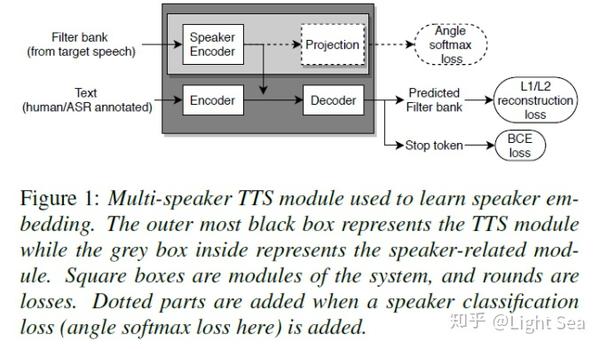
There are several techniques for injecting the speaker embedding into the TTS model's architecture. Let's explore the most common ones.
Multi-Speaker Speech Generation
The resource 'Multi-Speaker Speech Generation' provides a concise and structured overview of standard conditioning approaches. The table in this section is particularly useful.
Please read the section '1. Architectural Foundations and Speaker Conditioning'. Pay close attention to the table summarizing the different conditioning approaches, embedding types, and injection sites.
As the reading explains, the main methods are:
-
Concatenation/Addition: This is the most straightforward method. The speaker embedding vector is simply concatenated or added to the text embeddings before they are fed into the text encoder. It can also be added to the hidden states at various points in the model.
- Advantage: Simple to implement.
- Disadvantage: Can be a crude way of merging information, potentially "confusing" the model as it tries to process both phonetic and speaker information mixed together.
-
Style-Adaptive Layer Normalization (SALN): This is a more sophisticated and effective technique. Instead of just adding the speaker information, you use it to control the internal statistics of the network. In a Transformer block, for example, a Layer Normalization step standardizes the activations. In SALN, a small network takes the speaker embedding and predicts the affine transformation parameters (scale and bias ) for the LayerNorm layer.
This allows the speaker style to modulate the entire feature space throughout the network in a very granular way.
-
Gating Mechanisms and Advanced Modulation: State-of-the-art models often use even more advanced mechanisms. For example, a recent paper proposes a Style Gating-Film (SGF) mechanism.
DS-TTS: Zero-Shot Speaker Style Adaptation...
Let's look at a concrete example of an advanced conditioning mechanism from the recent DS-TTS paper. You don't need to memorize the formulas, but focus on the intuition behind the design.
Read the subsection that begins 'Phoneme Encoder is capable...'. Notice how it first criticizes simpler methods like concatenation and then introduces the Style Gating-Film (SGF) mechanism. Try to grasp the high-level idea: the speaker embedding is used to compute parameters that scale, shift, and gate the phoneme representations, providing finer control over style injection.
The key idea behind these advanced methods is to give the model a more expressive way to integrate speaker identity without corrupting the phonetic content being processed.
4. Case Study: YourTTS and Multi-speaker Training
Let's bring this all together with the YourTTS model, which is a multi-speaker, zero-shot version of VITS.
YourTTS - Towards Zero-Shot Multi-Speaker TTS for everyone
Let's return to the YourTTS video to see how the speaker embedding is integrated into the VITS architecture.
Watch the section from 04:48 to 06:03. The diagram shows the VITS inference pipeline. Observe where the 'speaker embedding' (computed by the speaker encoder) is fed into the model. It's used to condition the flow decoder and the vocoder, influencing the final waveform generation.
As you saw, the speaker embedding is a crucial input, conditioning the generative process. During training, this setup allows for an additional, powerful loss function: the speaker consistency loss.
YourTTS - Towards Zero-Shot Multi-Speaker TTS for everyone
The same video briefly mentions this clever training technique.
Watch the short segment from 06:57 to 07:11. The narrator explains how the speaker encoder is used during training to ensure the generated voice is similar to the reference voice.
This loss works by using the speaker encoder to extract an embedding from the synthesized audio and comparing it to the embedding of the ground-truth audio. The loss encourages the model to minimize the distance (e.g., maximize cosine similarity) between these two embeddings, explicitly training the model to preserve speaker identity.
L_{\text{scl}} = 1 - \text{cos_sim}(SE(y_{\text{ref}}), SE(G(z, e_{\text{spk}})))where is the speaker encoder and is the TTS generator.
Finally, when training on a dataset with an imbalanced number of samples per speaker, it's common practice to use a speaker-weighted sampler to ensure the model sees examples from all speakers more evenly, preventing it from being biased towards speakers with more data.
Conclusion
In this lesson, we demystified the process of creating multi-speaker TTS models. We've seen that the core idea is to represent a speaker's voice as a vector—a speaker embedding—and then condition the TTS architecture on this vector.
Key Takeaways:
- Speaker Embeddings: A speaker embedding is a fixed-size vector representation of a speaker's vocal identity, generated by a speaker encoder network.
- Seen vs. Unseen Speakers: For a fixed set of seen speakers, a simple trainable lookup table can be used. For generalizing to unseen speakers (zero-shot TTS), a pre-trained, universal speaker encoder is required.
- Conditioning Mechanisms: The speaker embedding is injected into the TTS model to influence synthesis. Methods range from simple concatenation to more effective techniques like Style-Adaptive Layer Normalization (SALN) that modulate the network's internal activations.
- Training for Consistency: A speaker consistency loss can be used during training to explicitly force the synthesized voice to match the target speaker's embedding, improving voice similarity.
Preview of the Next Lesson:
We have introduced the concept of zero-shot voice cloning today. In our next lesson, we will perform a deep dive into this topic, specifically covering the methodology behind zero-shot voice cloning using a separately trained speaker encoder network. We will move from the "what" to the "how," preparing you to build your own voice cloning systems.