
Welcome back. In the previous lesson, you practised using context to paraphrase difficult or figurative language without losing the writer’s meaning. Before you can decide which details to explain, however, you need to know exactly what the question requires.
This lesson gives you a quick, repeatable way to unpack an unseen-text question before writing. You will identify the command word, isolate the idea you must address, notice the limits of the task, and use the mark value to plan an answer of the right depth. This works especially well after your first read of a text: a glance at the questions makes your second pass more purposeful.
Treat the question as a set of instructions
An unseen-text question is not merely a topic. It is a set of directions telling you:
- What intellectual action to perform
- What idea to discuss
- Which parts of the text or texts you must use
- How fully you need to develop your response
Use the four-part check:
Directive – Focus – Scope – Marks
You can annotate the question very quickly:
- Circle the directive verb.
- Box the conceptual focus.
- Bracket words that limit or extend the scope.
- Write the mark value beside your plan.
For example:
Explain how the writer uses imagery in lines 8–15 to convey an uneasy atmosphere. (3 marks)
| Part | What it is here | What it tells you |
|---|---|---|
| Directive | Explain | Show how the imagery creates the atmosphere. Make the connection clear. |
| Conceptual focus | uneasy atmosphere | Your answer must be about tension, discomfort, uncertainty, or apprehension—not just imagery generally. |
| Scope | imagery, lines 8–15, the writer | Use imagery from this specified section. Do not rely on an example elsewhere in the passage. |
| Mark value | 3 marks | Develop more than one relevant point or detail, with explanation rather than a list. |
Your mental translation might be:
“I need to explain how images in this particular section make the atmosphere feel uneasy.”
That translation stops a common mistake: spotting a technique but answering a different question.
1. Directive verbs tell you what kind of answer to build
The directive verb is the command word. It determines the kind of thinking a marker expects to see.
The official NSW glossary is a useful reference for distinguishing closely related verbs. Its definitions are brief, so read related entries together rather than memorising one word in isolation.
Glossary of key words | NSW Government
Read the NSW Government glossary as a reference for the wording of common exam commands. It is particularly useful for separating verbs that sound similar, such as describe, compare, and contrast.
On the single alphabetical glossary page, read the nearby entries under A through D. Start at Apply through Assess, then locate the entries Compare, Contrast, Describe, and Identify. Next, scan the entries from E through S for Explain, Interpret, Justify, and Summarise. Focus on the different actions each word requires, rather than trying to memorise the whole list.
Here are the directives most likely to appear in a Year 11 unseen-text paper.
| Directive | What it asks you to do | What a suitable response usually includes |
|---|---|---|
| Identify | Recognise and name something. | A precise feature, idea, attitude, or detail. |
| Describe | State characteristics or features. | What is presented and its main qualities. |
| Explain | Make a relationship clear: show how or why. | A point, evidence, and a clear link between the evidence and the idea. |
| Analyse | Break a text into meaningful parts and show how they work together. | Language or structural choices, their effects, and their connection to the question’s idea. |
| Interpret | Draw a supported meaning from the text. | Your reading of an image, action, attitude, or idea, supported by details. |
| Compare | Show relevant similarities and/or differences. | Explicit connections between two texts, characters, moments, or representations. |
| Assess / evaluate | Make and support a judgement. | A clear judgement, criteria implied by the question, and evidence that justifies it. |
| Discuss | Explore relevant points or aspects of an issue. | A sustained response that considers more than one relevant point while staying focused. |
A crucial distinction: identify, explain, analyse, evaluate
These four are often confused because they can all involve quotations. The difference is what you do with the evidence.
Suppose a narrator says:
“I folded the invitation into a square so small it disappeared in my fist.”
If asked to identify a detail showing the narrator’s reluctance, you could write:
The narrator folds the invitation until it “disappeared in my fist.”
If asked to explain how reluctance is conveyed, you need the link:
The narrator’s action of folding the invitation until it “disappeared in my fist” suggests a desire to hide or reject it, conveying reluctance to attend.
If asked to analyse how the writer conveys reluctance, you would go further into the method and effect:
The hyperbolic image of the invitation “disappearing” in the narrator’s fist makes the physical action seem forceful and secretive. It reveals that the narrator tries to suppress the invitation, suggesting a stronger emotional resistance than simple hesitation.
If asked to evaluate the effectiveness of this representation, make a judgement as well:
The image is effective because the exaggerated disappearance of the invitation makes the narrator’s reluctance immediate and physical, allowing the reader to sense their desire to reject the event.
The quotation may be identical. The depth and purpose of the response change.
2. Find the conceptual focus: the idea you must keep returning to
The conceptual focus is usually the key noun, noun phrase, or relationship in the question. It is the central idea your answer must prove or explore.
Common conceptual focuses in unseen texts include:
- belonging or isolation
- memory
- change
- family relationships
- identity
- resilience
- fear
- hope
- the impact of place
- contrasting perspectives
- the value of ordinary experiences.
Consider this question:
Analyse how Text 2 represents the challenges of belonging in a new community. (4 marks)
The directive is analyse, but the conceptual focus is the challenges of belonging in a new community.
A weak response might discuss every technique it notices: similes, punctuation, dialogue, listing, and imagery. A stronger response chooses details that show the difficulty of trying to belong: perhaps exclusion, uncertainty, altered behaviour, or eventual connection.
A useful self-check is:
“Could I put the question’s key idea into every main sentence of my answer?”
For this example, your points might begin:
- “The text presents belonging as difficult because…”
- “The writer also shows the challenge of entering an unfamiliar community through…”
- “This reinforces the character’s uncertain sense of belonging…”
You do not need to repeat the exact wording every time, but your explanation should clearly stay connected to it.
Do not mistake the method for the main idea
Some questions name both a method and a conceptual focus:
Explain how the composer uses contrast to represent the narrator’s changing attitude to home.
- Method required: contrast
- Main focus: the narrator’s changing attitude to home
Your answer cannot simply say, “The composer uses contrast between the old house and the new house.” You need to state what that contrast reveals about the narrator’s attitude and how that attitude changes.
3. Scope tells you the boundaries of the task
The scope is everything that narrows, specifies, or expands what you must cover. Ignoring one small word can turn a potentially strong answer into an incomplete one.
Look for these scope signals.
| Scope signal | What it means for your answer |
|---|---|
| “in lines 12–20” | Stay within that part of the text. |
| “in Text 1” | Do not bring in another text unless asked. |
| “Texts 1 and 2” | Address both texts. |
| “compare” | Make connections between the texts; do not write two unrelated mini-answers. |
| “the beginning and ending” | Cover both stages and the change or contrast between them. |
| “one language feature” | Choose one feature and explain it well. |
| “using evidence from the text” | Support your point with specific details or quotations. |
| “to what extent” | Make a judgement about degree: fully, mostly, partly, or only in a limited way. |
| “for the reader” | Discuss the likely reader effect as part of your answer. |
Consider this question:
Compare how Texts 1 and 3 present the importance of friendship during difficult experiences. (5 marks)
Its scope is wider than it first appears:
- You must use both Text 1 and Text 3.
- You must address friendship, not relationships generally.
- You must address friendship during difficult experiences, not only pleasant moments.
- You must make comparative links: similarities, differences, or both.
- You need enough development for 5 marks.
A response that writes a paragraph on Text 1, then a completely separate paragraph on Text 3, may contain good observations but still fail to properly compare. Use connecting language such as similarly, in contrast, whereas, both texts, and unlike Text 1.
4. Use marks as a planning guide, not a quotation-counting rule
Mark values indicate the expected breadth and development of an answer. They do not create a universal formula such as “one quotation equals one mark.”
A short answer earns marks because it contains clear, relevant thinking. One well-selected quotation can support more than one observation; several quotations with no explanation may earn little.
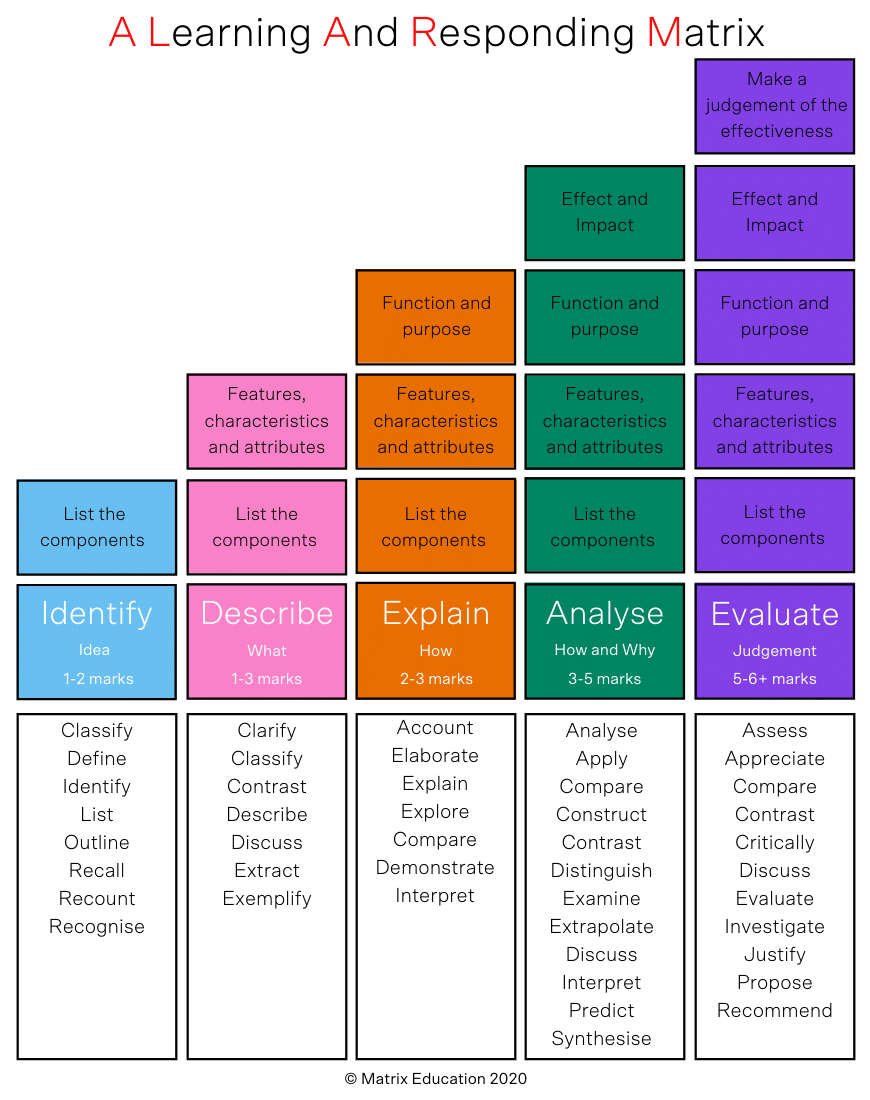
Use this practical guide:
| Mark range | Aim for |
|---|---|
| 1–2 marks | A direct answer. Give the requested detail or idea precisely; add brief evidence or explanation if the directive requires it. |
| 3 marks | A clear overall point developed through more than one relevant detail, with links to the question. |
| 4–5 marks | Several connected observations. Explain how evidence supports the central idea; organise the response so it feels purposeful rather than list-like. |
| 6 or more marks | A sustained mini-response. Cover the full scope, develop a line of argument, and give enough evidence and analysis for each major part of the question. |
Watch this short section of Jeddle’s How to Get FULL MARKS in Section I for a practical demonstration of using marks and key terms to plan a response.
How to Get FULL MARKS in Section I (Short Answers) - 2024 HSC Breakdown
Jeddle explains how short-answer mark values affect response length and then shows how to locate the one or two central terms that should guide the answer. Use it as a planning model, not as a rigid rule that every mark requires one quotation.
Watch mark planning for the link between mark allocation, answer length, and the number of developed ideas. Then watch key terms and notice the advice to keep the question’s central idea visible throughout the response.
In an exam, the mark value also helps you manage time. If your teacher has given a total time for the section, divide your writing time roughly across the available marks, leaving a few minutes to check answers. Do not spend six minutes polishing a two-mark response while leaving too little time for a six-mark question.
A complete deconstruction: worked examples
Example 1: a focused three-mark question
Explain how the writer conveys the narrator’s growing sense of isolation. (3 marks)
| Part | Annotation |
|---|---|
| Directive | Explain |
| Focus | the narrator’s growing sense of isolation |
| Scope | You need a change over time: earlier and later moments, or evidence that isolation intensifies. |
| Marks | 3 marks: give a clear point and develop it with relevant details and explanation. |
Your answer plan should not merely be “find techniques.” Instead, look for evidence of progression: perhaps the narrator first feels distant, then becomes silent, then physically withdraws. Each detail should help explain growing isolation.
Example 2: a visual-text question
Identify two ways the image represents a shared human experience. (2 marks)
| Part | Annotation |
|---|---|
| Directive | Identify |
| Focus | a shared human experience |
| Scope | Give two ways shown in the image. The word shared means look for an experience presented as collective or widely recognisable. |
| Marks | 2 marks: two precise visual details with a concise statement of what experience they represent. |
Because the command is identify, a long analysis of camera angle or symbolism is unnecessary unless it helps you name the two required ways.
Example 3: a judgement question
To what extent does the article challenge the belief that technology always brings people together? (6 marks)
| Part | Annotation |
|---|---|
| Directive | To what extent signals evaluation or assessment. |
| Focus | the belief that technology always brings people together |
| Scope | Discuss how the article challenges that belief and make a judgement about degree. The word always matters: does the article reject the belief entirely, or show limits and exceptions? |
| Marks | 6 marks: build a sustained, supported judgement across the article. |
A suitable central claim could be:
The article largely challenges the belief that technology brings people together, showing that it can create communication while also encouraging superficial contact and isolation.
That is a judgement. The rest of the answer would need to prove it from the article.
Your 60-second question routine
Before writing any unseen-text response, pause and complete this routine:
- Read the full question twice. On the second read, circle the command word.
- Name the focus in plain language. Ask: “What idea must my answer be about?”
- Check the scope words. Notice named texts, lines, techniques, relationships, stages, audiences, or instructions such as two ways.
- Look at the marks. Decide how much development is realistic and necessary.
- Write a one-sentence task translation. For example:
“I need to explain how details from lines 8–15 create an uneasy atmosphere, using enough developed evidence for 3 marks.” - Only then return to the text to find evidence.
This routine takes less than a minute and prevents the most expensive exam mistake: producing a thoughtful answer to a question that was never asked.
Key takeaways
To deconstruct an unseen-text question, identify:
- the directive verb, which tells you the kind of response required;
- the conceptual focus, which is the idea your answer must address;
- the scope, which sets boundaries such as texts, lines, methods, relationships, or number of examples;
- the mark value, which signals the required depth and helps you manage time.
Remember: marks are not a quotation-counting system. A strong response is direct, covers the complete task, and develops evidence in the way the directive requires.
Next lesson, you will practise selecting concise textual evidence that directly supports the specific question you have unpacked.
Can't find a good explanation? Sign up and we'll make it for you
Sign up