
Good evidence selection begins before you start writing. In the previous lesson, you learned to unpack a question into its directive, focus, scope, and mark value. Now you will use that unpacking to make a sharper decision: which exact words, moments, or visual details are worth using?
Your earlier two-pass reading, inference, and paraphrasing routines help here. You do not need to understand every possible layer of an unseen text. You need to locate a small number of details that let you answer this question clearly and convincingly.
By the end of this lesson, you should be able to select brief, precise textual evidence that directly supports a point, rather than collecting quotations simply because they contain a technique.
Evidence is not just a quotation
A quotation becomes evidence only when it proves something relevant to the question.
Suppose the question is:
Explain how the writer conveys the narrator’s growing isolation. (3 marks)
And an extract includes:
At first, I kept the curtains wide, listening for footsteps. By winter, the street had learned to pass without me; I answered the door only in dreams.
Almost every part of this could be highlighted. But not all details are equally useful.
| Possible selection | What it suggests | Decision |
|---|---|---|
| “curtains wide” | The narrator initially expects contact. | Useful only if discussing the contrast over time. |
| “By winter” | Time has passed; isolation has developed. | A helpful structural detail, but too slight on its own. |
| “the street had learned to pass without me” | The narrator feels excluded from ordinary community life. | Strong evidence: directly conveys isolation. |
| “only in dreams” | Contact has become impossible or imaginary. | Strong evidence: concise and open to explanation. |
The best evidence is not necessarily the most dramatic sentence or the first technique you spot. It is the detail that gives you the clearest route back to the question.
For this question, a useful evidence plan might be:
- “the street had learned to pass without me”: suggests exclusion and disconnection from others.
- “only in dreams”: shows that human contact has become unreal or unreachable.
- “By winter”: can support the idea that the isolation has increased over time.
Notice that the quotation does not need to be long. In fact, short quotations are usually easier to explain precisely.
Select evidence with the question in front of you
A common exam mistake is to annotate every technique first and decide what it means later. A better approach is to let the question filter your choices.
For a question about fear, look for details that create threat, uncertainty, vulnerability, or loss of control. A beautiful image of safety may be well written, but it is not useful unless it contrasts meaningfully with the fear.
For a question about belonging, look for moments of connection, inclusion, shared language, acceptance, exclusion, distance, or attempts to fit in. Do not choose a quotation just because it contains alliteration, a simile, or a metaphor.
Use this four-part test before committing to evidence.
The directness test
Ask:
“Does this detail help prove my exact point about the question’s focus?”
If the question asks how a writer represents resilience, evidence of sadness might be relevant background, but it is not enough by itself. You need something showing endurance, recovery, defiance, adaptation, or persistence.
The specificity test
Choose the exact word or image doing the work.
Compare these:
- Too broad: “The narrator says that the mountains were frowning down upon them.”
- More precise: “frown down upon us”
The second selection is easier to analyse. The verb “frown” personifies the mountains as hostile and judgemental, helping to create danger.
The analysability test
A strong quotation contains something you can explain: a loaded word, contrast, image, action, shift, repetition, sound, or visual feature.
If you cannot finish this sentence, reconsider the evidence:
“This supports my point because the word/detail _____ suggests _____.”
For instance:
“The street had learned to pass without me” supports isolation because the street is personified as deliberately moving on without the narrator.
You do not need an impressive technique label first. You need a genuine observation about meaning.
The economy test
Take only the amount you need.
Long quotations often hide the most useful language inside unnecessary words. Rather than copying a full sentence, extract the meaningful core while preserving its sense.
| Overlong selection | Efficient selection |
|---|---|
| “By winter, the street had learned to pass without me; I answered the door only in dreams.” | “the street had learned to pass without me” |
| “I answered the door only in dreams.” | “only in dreams” |
Concise evidence gives you more time and space for explanation in a short-answer exam.
Watch an evidence selector at work
The following short excerpt from How to Analyse a Text in English Language GCSE by Save My Exams uses a danger question to demonstrate why individual loaded words and short phrases are often stronger than large blocks of quotation. The exam system is different, but the evidence-selection principle transfers directly.
How to Analyse a Text in English Language GCSE
Watch “How to Analyse a Text in English Language GCSE” from Save My Exams to see a clear demonstration of selecting a few meaningful words rather than highlighting entire sentences.
Watch selecting evidence. Focus on why “unmercifully” and “frown down upon us” offer more to explain than a large quotation would. Then watch the key rule, which summarises the value of brief, targeted evidence.
The important lesson is not “always select one word.” Sometimes you need a phrase, a full image, or two connected details. The rule is: select the smallest piece of evidence that still proves your point.
Build a small evidence bank, not a large highlight cloud
After you unpack the question, use your second reading to make a compact evidence bank. For each possible detail, record three things:
| What to note | Example for an isolation question |
|---|---|
| Evidence | “only in dreams” |
| Choice or feature | Restrictive adverb “only”; dream imagery |
| Connection | Contact is imagined rather than real, revealing severe isolation. |
You are not writing a full response yet. You are testing whether each choice has a clear purpose.
For a three- or four-mark response, two well-chosen pieces of evidence may be enough if each supports a distinct observation. A higher-mark question generally needs a broader evidence bank. However, evidence quantity is never a rigid formula: one quotation may contain several useful details, while three unrelated quotations may create a weak, list-like answer.
A practical guide is:
- 1–2 marks: select the precise requested detail or feature; add brief evidence where needed.
- 3–4 marks: select two or more details that develop the same answer.
- 5–6 marks: select several strong details, often from different moments or choices in the text, and make sure together they cover the question’s full scope.
The mark value helps you decide how much evidence to gather. It does not mean that each mark requires one full quotation.
Evidence can be verbal, structural, or visual
In unseen texts, evidence is not limited to dialogue or written quotations. Select evidence appropriate to the form.
| Text form | Strong evidence might include | Weak selection to avoid |
|---|---|---|
| Prose fiction or memoir | A revealing phrase, a character’s action, narration, contrast between moments | A random descriptive sentence with no link to the focus |
| Poem | An image, repeated word, line break, contrast, sound pattern, shift in voice | Naming rhyme without explaining what it supports |
| Speech or article | Inclusive pronouns, rhetorical question, anecdote, high-modality statement, statistic | Quoting a fact that does not support the argument in the question |
| Photograph, poster, cartoon | Facial expression, colour, framing, angle, salience, symbolism, written slogan | Saying only “the colours” or “the layout” without identifying the detail |
| Multimodal text | One visual detail and one language detail that work together | Treating the image and written text as unrelated lists |
For example, if a photograph is said to represent shared resilience, “the image uses colour” is not evidence. A more useful evidence note is:
The group is positioned closely together in the foreground, while the dark background surrounds them.
That selection is concrete. It gives you something specific to connect to solidarity and perseverance.
The NSW Department of Education resource below shows how evidence should connect to the human experience or idea in the question, and how language, form, and visual features can be recorded separately but purposefully.
english-standard-s6-hsc-paper-1-section-1-revision-student-resource.docx
Read the relevant planning material in this NSW Department of Education resource. It reinforces the distinction between identifying an experience or idea, selecting moments that represent it, and choosing techniques that show how it is represented.
In “Table 5 – textual analysis graphic organiser,” read the whole “Suggested sequence,” especially the steps that move from the composer’s comment to relevant moments and techniques. Begin around the choice of moments; notice that examples are selected because they relate to the idea already identified. Then, in “Activity 6 – guided short answer responses,” read all of “Table 6 – planning and unpacking the exploration of human experiences.” Focus particularly on the adjacent “Key evidence” and “Representation” rows, including these planning prompts.
A worked selection: choose details that answer, not merely decorate
Consider this short poem:
After months of ash, one green blade
presses through the pavement.
We lift our faces to the rain.
Now imagine the question is:
Explain how the poet represents hope after hardship. (3 marks)
The question has already given you a filter:
- Focus: hope after hardship
- Scope: both hardship and hope matter
- Directive: explain how
- Marks: develop the idea with more than one relevant detail
Here is a useful evidence bank.
| Evidence | Why it is worth selecting |
|---|---|
| “months of ash” | Clearly establishes a period of destruction, loss, or difficulty. |
| “one green blade” | A small but vivid sign of renewal; directly represents emerging hope. |
| “presses through” | The forceful verb suggests persistence against an obstacle. |
| “We lift our faces” | The collective pronoun suggests shared recovery rather than private hope. |
| “the rain” | May suggest renewal, but is weaker if used alone. |
A poor selection would be “the rain,” simply because rain is often associated with renewal. The word has a possible meaning, but without the surrounding action it does not prove enough.
A strong selection combines details that do different jobs:
- Hardship: “months of ash”
- Hope and persistence: “one green blade” that “presses through”
- Shared recovery: “We lift our faces”
These choices enable a response to explain a movement from damage toward renewal. They also stay concise enough to be integrated smoothly into sentences.
Avoid the five evidence-selection traps
1. Technique hunting
This happens when you choose something because you can name it.
“The composer uses a metaphor, ‘one green blade’.”
That may be technically correct, but it does not yet show why the detail answers a question about hope after hardship. Select the detail because of its meaning first; label the technique only when it helps explain that meaning.
2. The quotation dump
This is a long quotation followed by a vague claim.
“After months of ash, one green blade presses through the pavement. We lift our faces to the rain” shows hope.
The marker must do the interpretive work for you. Instead, isolate the words that matter and prepare to explain their effect.
3. Evidence from the wrong scope
If a question specifies lines 10–18, evidence outside those lines is risky, even if it is excellent. If it asks about the ending, a quotation from the opening will not fully answer the task unless you are explicitly comparing the two.
4. Almost-relevant evidence
A detail can relate generally to the text but fail to support your exact point.
For a question about a character’s growing confidence, a description of their clothing might be interesting. But it only earns its place if it clearly reveals increased confidence, such as a shift from hiding to standing visibly before others.
5. Repeating the same evidence
Do not select three quotations that all prove exactly the same small point. For a longer answer, choose evidence that develops your idea: perhaps an initial feeling, a turning point, and a final change.
What concise, integrated evidence looks like
The annotated example below shows evidence placed inside the student’s explanation rather than dropped in as separate chunks. Its annotations identify a topic sentence, evidence with techniques and explanations, and a concluding sentence.
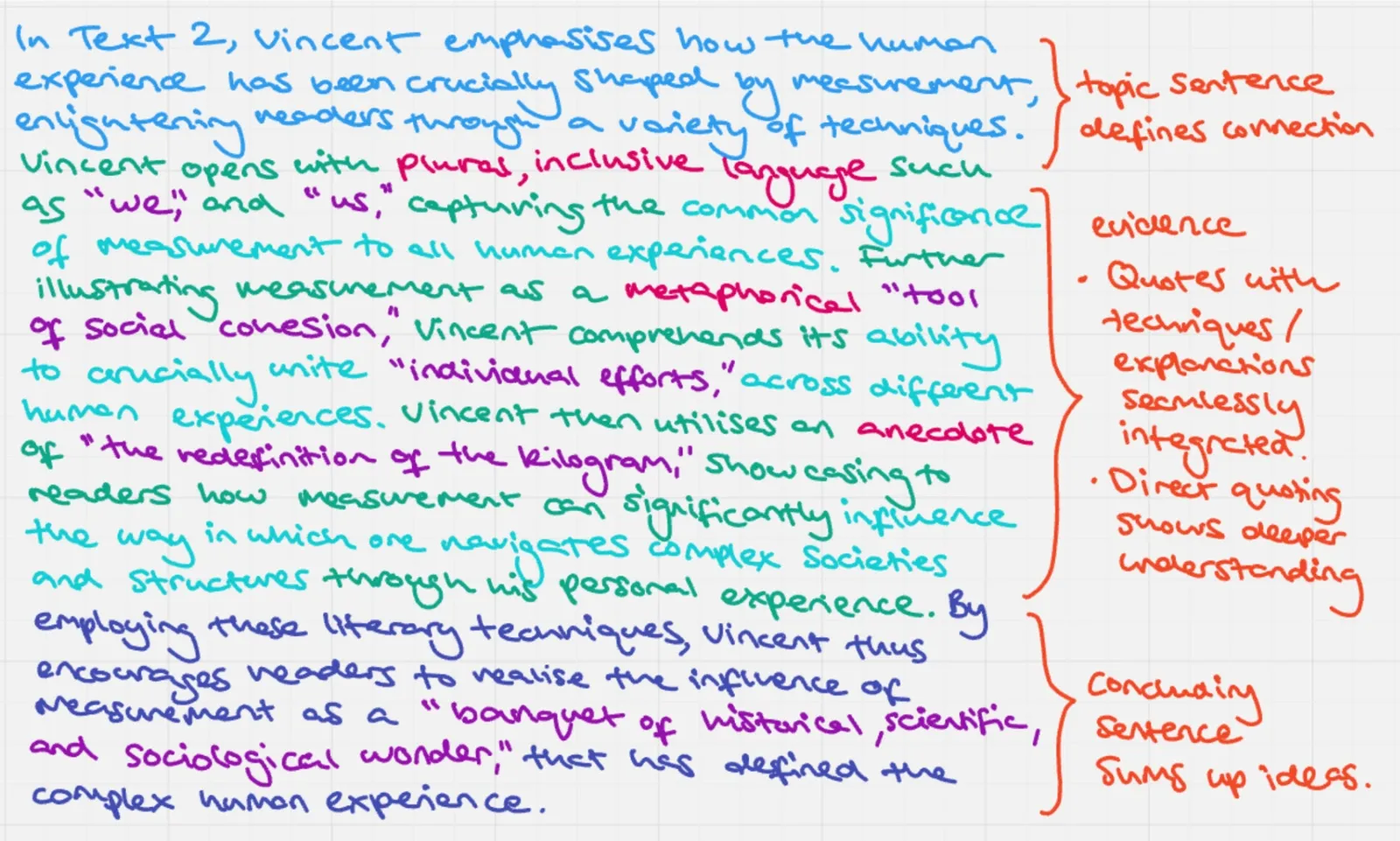
When selecting evidence, aim to make this kind of integration possible. Your quotation should fit naturally into a sentence:
- The personification of the street as having “learned to pass” suggests that the narrator feels forgotten.
- The restrictive phrase “only in dreams” makes connection seem impossible in waking life.
- The repeated inclusive pronoun “we” presents the experience as collective.
Each quotation is short, precise, and immediately connected to a claim. In the next lesson, you will focus on developing that connection into a clear explanation of how a language or structural choice shapes meaning.
Your exam-time selection routine
Once you have unpacked a question, use this quick routine:
- Write the focus in one or two words at the top of the text: for example, isolation, hope, or belonging.
- Find candidate details that directly relate to that focus, paying attention to repeated words, contrast, shifts, striking images, and significant actions.
- Bracket only the useful core of each quotation: the key word, phrase, image, or visual detail.
- Test each candidate: “What exact point could this prove?”
- Keep the strongest few that offer distinct, analysable support for your answer and fit the question’s scope.
- Record a brief note beside each: evidence, feature or choice, and connection to the focus.
This routine prevents over-highlighting and keeps your evidence purposeful. It also leaves you with a clear plan for writing under time pressure.
Key takeaways
Concise evidence selection is a form of decision-making:
- A quotation is only evidence when it directly supports your answer to the question.
- Select details for their meaning and relevance, not just because they contain a recognisable technique.
- Choose the most precise word, phrase, image, action, structural shift, or visual feature that does the work.
- Use the question’s focus, scope, directive, and marks to decide what evidence you need.
- Gather a small evidence bank in which each detail has a distinct purpose.
- Keep quotations brief enough that you can explain exactly how they shape meaning.
Next, you will turn these selections into analysis: explaining how a language or structural choice creates meaning and supports your answer.
Can't find a good explanation? Sign up and we'll make it for you
Sign up