
Welcome back. In the last lesson, you learned to infer a text’s central idea and tone by noticing repeated details, contrasts, and emphasis. That wider understanding is essential here: when a phrase seems difficult, its meaning is rarely contained in the phrase alone. The speaker’s situation, the surrounding images, and the text’s tone all help you work it out.
This lesson focuses on paraphrasing: explaining a complex, unfamiliar, idiomatic, or figurative expression in clear words while preserving its meaning. In an unseen-text exam, this prevents one confusing phrase from blocking your understanding of a whole paragraph—and gives you a precise way to answer questions such as “Explain what the writer means by…”
Meaning first, wording second
To paraphrase is to restate an idea in your own words without changing what it means.
For an unseen text, this does not mean replacing every word with a synonym. That can make an answer awkward or inaccurate. Instead, identify the full idea the phrase communicates, then express that idea plainly.
Consider:
Maya’s confidence was a carefully painted mask.
A weak paraphrase might be:
Maya’s confidence was colourful.
This treats “painted” literally and misses the comparison. A stronger paraphrase is:
Maya appeared confident, but this confidence was deliberately presented and may have hidden her real feelings.
The word “mask” suggests concealment, while “carefully painted” suggests effort and artificiality. Your paraphrase should retain both ideas.
A useful rule is:
Do not ask only, “What does this word mean?” Ask, “What is this phrase making me understand about the person, event, or idea?”
This short video models that approach with an unfamiliar word. Although the example is about climbing equipment rather than literature, the reasoning is exactly what you need in an exam: use nearby details to infer function and meaning.
Using context clues to determine the meaning of a word | Reading | Khan Academy
Watch “Using context clues to determine the meaning of a word” from Khan Academy. It demonstrates how surrounding details can produce a sensible working definition even when the word itself is completely unfamiliar.
Watch what context means, where the presenter defines context as the words and ideas around an unfamiliar term. Then watch the clue process. Notice that the final definition is built from several details: mountain climbing, the harness, the rope, and danger of falling.
In an exam, you may not need a perfect dictionary definition. You need a meaning that is supported by the passage and helps you continue reading accurately.
Context is more than the sentence containing the phrase
Context means the material surrounding a word or expression. It operates in three useful ranges:
| Range of context | What to inspect | Why it matters |
|---|---|---|
| Immediate | Words in the same sentence | They may provide a direct explanation, contrast, or action. |
| Local | The sentence before and after | They often show cause, effect, reaction, or an example. |
| Whole-text | Speaker, situation, tone, and central idea | They help you decide which possible meaning fits best. |
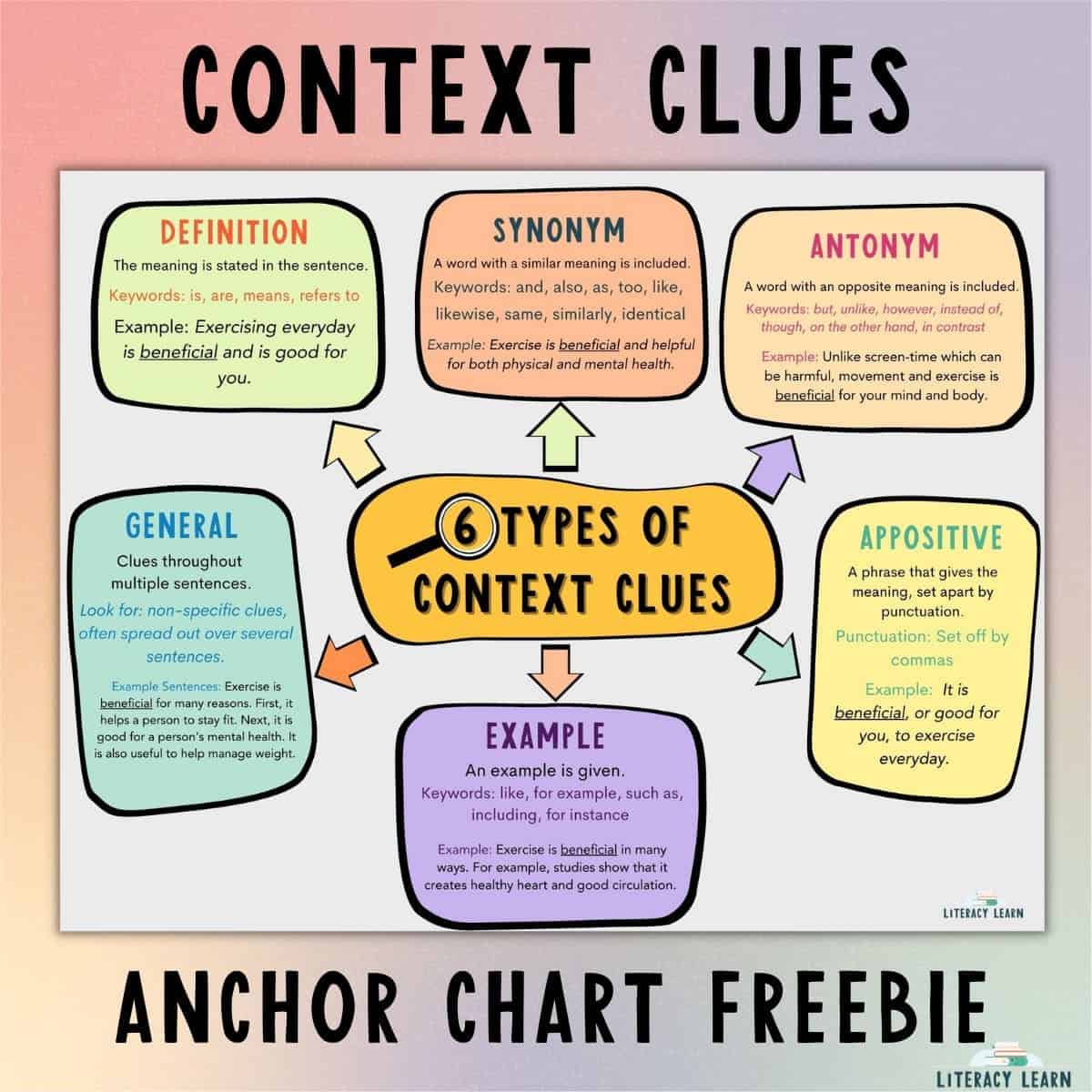
The chart’s categories can be simplified into four exam-friendly sources of evidence.
1. Explanation or restatement
Sometimes the writer gives the answer nearby.
The crowd’s euphoria, a sudden and overwhelming excitement, filled the stadium.
The phrase after the comma defines euphoria. A clear paraphrase would be:
The crowd felt an intense, joyful excitement.
2. Example, action, or consequence
A writer may show what an unfamiliar phrase causes or looks like.
After the argument, Leo walked home alone, ignored his friends’ messages, and stayed silent at dinner. He was carrying the weight of the world.
The expression does not mean Leo is physically lifting the planet. His isolation and silence show that he feels overwhelmed by a serious burden or worry.
3. Contrast
Words such as but, however, although, instead, and yet often clarify meaning by showing what something is not.
The advertisement promised freedom, but the contract bound customers to three years of expensive payments.
Here, “freedom” is undermined by “bound” and “expensive payments.” The passage suggests that the advertised freedom is misleading; customers are actually restricted.
4. Overall situation and tone
Sometimes there is no direct clue. You must use the speaker’s situation and the attitude created across the passage.
Dad called the tiny backyard “our private wilderness,” although it contained one lemon tree, a rusted swing, and a fence shared with three neighbours.
The light, exaggerated description makes “private wilderness” humorous. It means the family treats their very ordinary small yard as if it were a wild natural landscape.
The context-clue method is set out clearly in the following reading. Its final step—testing your interpretation by substituting it into the sentence—is especially useful under exam conditions.
Read the “Applying Context Clues: A Step-by-Step Approach” section from Translateen. It gives a practical routine for moving from an unfamiliar idiom or expression to a meaning that fits the passage.
In the section “Applying Context Clues: A Step-by-Step Approach,” begin at the strategic routine. Read through Steps 1–5. Focus particularly on reading the sentences around the expression, combining clues with the situation, and testing whether your inferred meaning still makes the sentence logical.
Recognising figurative language without stopping at the label
Figurative language communicates an idea non-literally. It may create an image, convey a feeling efficiently, or make an abstract idea easier to grasp. In an exam, identifying a technique can help—but the important step is explaining its meaning in context.

The most common forms you are likely to meet are below.
| Form | What it does | Example | Context-based paraphrase |
|---|---|---|---|
| Simile | Compares using “like” or “as” | “The queue moved like a glacier.” | The queue moved extremely slowly. |
| Metaphor | States that one thing is another | “Her words were a lifeline.” | Her words gave someone desperately needed help or hope. |
| Personification | Gives human qualities to something non-human | “The old house watched us leave.” | The house seems emotionally significant, as if it silently observes the departure. |
| Idiom | A familiar phrase whose meaning differs from its literal words | “He let the cat out of the bag.” | He accidentally revealed a secret. |
| Hyperbole | Deliberate exaggeration | “I have told you a million times.” | The speaker is frustrated because they have repeated something many times. |
Notice that the paraphrases vary in length. “Like a glacier” can be translated briefly because the comparison is straightforward. “The old house watched us leave” needs more than “the house looked” because the personification creates a sense of farewell and attachment.
A strong paraphrase retains the force of the original. Compare these responses to a metaphor:
The principal’s announcement dropped like a stone into the room.
- Too literal: “The announcement fell into the room.”
- Too vague: “The announcement was important.”
- Accurate: “The announcement created a sudden, heavy silence and shocked the people in the room.”
The surrounding reaction tells you why a “stone” is an effective comparison: it suggests heaviness, abruptness, and a disruptive impact.
A five-step routine for difficult phrases
When you meet a complex expression in an unseen passage, use this routine. It should take less than a minute once it becomes familiar.
1. Mark the phrase and check the literal meaning
Notice when a literal reading seems impossible, strange, or incomplete.
For example:
The city finally exhaled after the rush-hour traffic cleared.
Cities do not literally breathe. This is personification, so the sentence is likely describing a change in atmosphere.
2. Establish what is happening
Use your first-pass reading skills. Who is speaking? What has just happened? What changes after the phrase?
In the example above, traffic has cleared after a busy period. The city becomes quieter and less crowded.
3. Gather the most useful nearby clues
Look for:
- actions and reactions;
- descriptive words with strong connotations;
- contrasts;
- explanations or examples;
- punctuation that adds emphasis;
- the tone you identified across the passage.
For “the city finally exhaled,” finally suggests relief, while traffic clearing suggests reduced noise and pressure.
4. Say the idea plainly
Turn the image into an ordinary statement:
Once rush hour ended, the city seemed to relax and become calmer.
You do not need to retain the original image. Your job is to communicate its meaning.
5. Test the substitution
Replace the phrase mentally with your paraphrase:
The city finally became calmer and less pressured after the rush-hour traffic cleared.
It fits the grammar and preserves the logic. That is a good sign.
Be careful not to overstate. “The city exhaled” may suggest relief, but it does not prove that every person in the city is happy. Use measured wording: seems, suggests, conveys, or implies.
Worked example: paraphrasing a metaphor through context
Read this invented passage:
At first, I thought the new school would be a fresh start. By lunchtime, though, the corridors had become a maze. Every turn led to another unfamiliar face, another group already laughing together. I held my timetable so tightly that its corners bent into my palm. When the bell finally rang, I followed the crowd, hoping it knew where it was going.
Suppose the question asks:
Explain what the narrator means when they say that “the corridors had become a maze.”
Do not simply write, “The corridors were confusing.” That is partly correct, but it misses the emotional context.
Step 1: Read around the metaphor
The earlier phrase “fresh start” establishes the narrator’s initial hope. “By lunchtime, though” signals a shift. The narrator sees “unfamiliar” people and groups that are “already” connected. Their timetable is gripped tightly, suggesting anxiety.
Step 2: Infer the comparison
A maze is difficult to navigate and can make a person feel lost. Here, the narrator may know that the corridors are physically real and ordinary; the image conveys their experience of entering an unfamiliar social and physical environment.
Step 3: Paraphrase accurately
The narrator feels lost and overwhelmed in the unfamiliar school, both because they do not know their way around and because they do not yet feel that they belong.
This response includes the literal situation—an unfamiliar building—but also the deeper implication: social isolation. It is supported by several details, not only the word “maze.”
Worked example: complex language is often compressed meaning
Not every difficult phrase is figurative. Writers may compress a complex idea into formal or dense wording.
The committee’s apology, delivered only after public pressure made silence impossible, did little to repair the damage.
Break this apart:
- “delivered only after”: the apology came late;
- “public pressure”: people criticised or demanded a response;
- “made silence impossible”: the committee could no longer ignore the issue;
- “did little to repair the damage”: the apology was not enough to restore trust or fix the harm.
A useful paraphrase is:
The committee apologised only because public criticism forced it to respond, and the late apology did not do much to fix the harm it had caused.
This is not word-swapping. It unfolds the sentence’s relationships: cause, delay, pressure, and inadequate outcome.
When a sentence is dense, look for its basic structure:
- Who or what is being discussed?
- What happened?
- Why did it happen?
- What result or attitude does the sentence convey?
That process often makes the meaning manageable.
Turning a paraphrase into an exam response
Questions on meaning can take several forms:
- “What does the phrase ‘…’ suggest?”
- “Explain the meaning of ‘…’.”
- “How does the metaphor ‘…’ convey the narrator’s feelings?”
- “What is implied by the description of …?”
Match the depth of your answer to the wording.
If the question asks only for meaning, give a concise, clear paraphrase:
“A carefully painted mask” means that Maya’s confidence is an outward performance that hides her insecurity.
If it asks what the image suggests or conveys, add the relevant effect or attitude:
Describing Maya’s confidence as “a carefully painted mask” suggests that her confident appearance is artificial and deliberately hides insecurity, creating a sympathetic but uneasy impression of her situation.
A dependable response pattern is:
The phrase means that [plain-language meaning]. This is suggested by [one nearby clue], which shows that [relevant nuance].
For example:
The phrase “carrying the weight of the world” means that Leo feels overwhelmed by serious worries. His silence at dinner and decision to ignore his friends show that this burden has made him withdraw from others.
This pattern keeps your answer grounded in the text. It also prepares you for later lessons, where you will select evidence and explain how specific language choices answer a question.
Avoid these common errors
Treating figurative language literally
“The city exhaled” does not mean a city has lungs. Pause when literal meaning seems impossible.
Naming a technique without explaining it
“This is personification.”
That may be true, but it does not answer a meaning question. Add what the personification makes the reader understand.
Using a dictionary-style definition that ignores the passage
A word can have several meanings. Context decides which one is active. “Cold,” for example, may describe temperature, emotional distance, or an unfriendly atmosphere.
Replacing words without preserving the idea
Changing “weight of the world” to “mass of the planet” is technically related to the literal words but completely misses the idiom.
Forgetting qualifications
A phrase may suggest possible loneliness, resentment, or hope rather than proving it absolutely. Let the evidence control the strength of your claim.
Key takeaways
Paraphrasing difficult language means expressing the text’s idea clearly in your own words while preserving its meaning, feeling, and implications.
When a phrase is unfamiliar or figurative:
- Read the full sentence and nearby sentences.
- Use the speaker, situation, tone, and shift in the passage.
- Look for explanation, example, contrast, reaction, and connotation.
- Translate the expression into plain language.
- Test whether your version still makes sense in the original sentence.
Most importantly, do not stop at identifying a simile, metaphor, idiom, or personification. Explain what it communicates in this particular text.
Next lesson, you will learn to deconstruct an unseen-text question itself: identifying its directive verb, conceptual focus, scope, and mark value before you begin writing.
Can't find a good explanation? Sign up and we'll make it for you
Sign up