
Hello again. In the previous lesson, you practised reading an unseen text in two passes: first to identify the speaker, situation, subject, and major shifts; then to return to the details that confirm that first understanding.
This lesson takes the next step. Once you know what is happening in a text, you need to infer what the text is saying about it. You will learn to identify a text’s central idea and tone by tracking patterns: details that are repeated, placed in contrast, or given special emphasis. These are the details that usually carry the most meaning in an unseen-text question.
By the end, you should be able to make a precise claim such as:
The passage suggests that returning to a familiar place can reveal how much a person has changed; its initially nostalgic tone becomes uneasy and regretful.
From subject to central idea
Your subject is the literal topic of a text. It is usually a short noun phrase:
- a family moving house
- a teenager beginning at a new school
- an endangered beach
- a friendship under pressure
A central idea is the text’s larger insight about that subject. It needs a complete statement.
| Subject | Weak “central idea” | Strong central idea |
|---|---|---|
| A family moving house | Change | Moving on from a familiar home can be painful, but it can also make a family recognise what they value. |
| A new school | Belonging | Feeling like an outsider is often the first stage of learning how to belong. |
| An endangered beach | Nature | Environmental damage becomes harder to ignore when people see its effects in a place they personally love. |
Words such as change, belonging, identity, and nature are useful starting points, but they are concepts, not yet interpretations. In an exam response, develop the concept into a claim that the details of this particular text support.
A reliable formula is:
The text suggests that [insight about people, places, or experiences], especially when [relevant condition or tension].
For instance:
The text suggests that memories can make a familiar place meaningful even after its physical reality has changed.
This remains specific enough to prove from a passage, rather than sounding like a general life lesson.
Do not search for a hidden “correct theme”
An unseen text may support more than one reasonable central idea. Your task is not to guess what is in the writer’s mind. Your task is to make an interpretation that is:
- grounded in several details, not one isolated word;
- sensitive to shifts or contradictions in the text; and
- expressed cautiously when the evidence is open to more than one reading.
Use verbs such as suggests, presents, explores, implies, or reveals. They make an analytical claim without pretending the text has only one possible meaning.
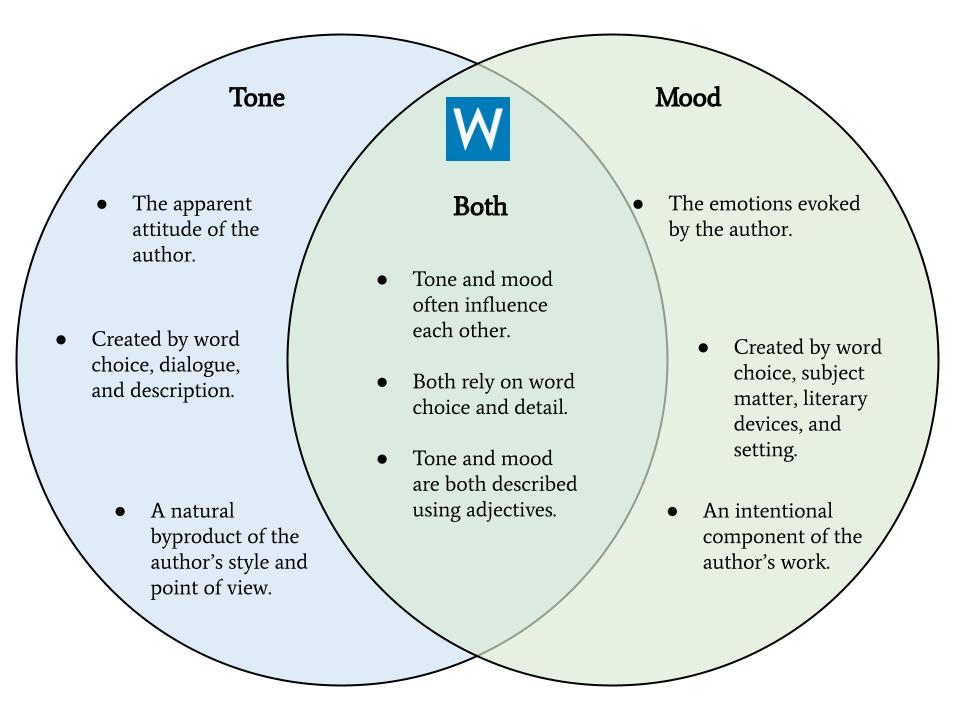
Tone is the speaker’s attitude; mood is the reader’s atmosphere
Tone is the attitude conveyed by a speaker, narrator, or writer towards a subject. A tone may be admiring, critical, affectionate, detached, anxious, humorous, frustrated, reflective, hopeful, or regretful.
Mood is the emotional atmosphere created for the reader: perhaps tense, peaceful, eerie, cheerful, or gloomy. Tone and mood are closely connected, but they are not interchangeable.
Consider these lines:
The council unveiled another “visionary” car park, replacing the last patch of grass in the town centre.
The speaker’s tone is likely sarcastic or critical. The quotation marks around “visionary” signal that the speaker does not genuinely admire the project. The mood might be frustrating or disappointing for a reader who shares that concern, but the exam question may ask specifically for the speaker’s attitude, so call it tone.
Avoid vague labels such as “the tone is sad” when you can be more exact:
| Basic label | More precise possibilities |
|---|---|
| Sad | mournful, regretful, disappointed, elegiac, melancholy |
| Happy | celebratory, relieved, affectionate, optimistic, proud |
| Angry | indignant, bitter, contemptuous, frustrated, accusatory |
| Serious | reflective, solemn, concerned, earnest, contemplative |
The most useful tone word is the one that matches the evidence. A grieving narrator may be nostalgic and restrained, not necessarily angry; an article may be skeptical, not simply negative.
"What is Tone in Literature?": A Literary Guide for English Students and Teachers
Watch “What is Tone in Literature?” from the OSU School of Writing, Literature and Film. It defines tone clearly, then models how diction, imagery, and contrast can reveal a speaker’s layered attitude.
Watch the definition for the literary meaning of tone and why it must be inferred from words on the page. Then watch the poem analysis. Focus on how respectful comparisons of the dancer are set against the crowd’s objectifying language, producing an attitude that becomes compassionate.
The important exam lesson from this model is that tone can be complex. A text can be both affectionate and regretful; celebratory at first, then skeptical; calm on the surface, but quietly critical underneath. Your earlier work on shifts helps here: when the focus changes, the tone may change too.
Read patterns, not isolated “techniques”
The best clues to central idea and tone are usually not single techniques that you spot once. Look instead for patterns of choice. Three pattern types are especially valuable.
1. Repeated details: what keeps returning?
A repeated word, image, action, sound, or idea is rarely accidental. It tells you what the text keeps placing before us.
For example, imagine a narrator describing their childhood house:
The cracked window rattled in the wind.
At dinner, the window rattled again.
Years later, I still hear that rattle whenever a storm begins.
The repeated “rattle” does more than describe sound. It connects the house with discomfort and memory. It may suggest that the narrator cannot entirely escape the insecurity of the past.
When you spot repetition, ask:
- What is repeated exactly, or what idea keeps returning in different forms?
- Does its meaning grow stronger, darker, or more hopeful each time?
- What does the repetition make seem important?
Do not automatically write, “The repetition emphasises…” and stop there. Explain what it emphasises and why that matters.
2. Contrasts: what has been placed against what?
Contrast is one of the quickest ways to find a text’s tension. Look for direct signposts such as but, yet, instead, however, and although. Also notice contrasts in imagery, time, setting, or behaviour.
A writer might contrast:
- past and present;
- appearance and reality;
- silence and noise;
- wealth and poverty;
- an individual’s view and a group’s view;
- expectation and disappointment.
In the previous lesson’s shop extract, “expecting the usual smell of oil” is sharply opposed to “only dust.” That contrast moves the passage from ordinary routine to loss. It supports a central idea about the fragility of familiar family traditions, while creating a disappointed, subdued tone.
3. Emphasis: where does the text make you pause?
Writers can emphasise an idea without repeating it. Look closely at:
- a short sentence after longer description;
- a sentence or image at the end of a paragraph, stanza, or text;
- direct speech;
- an exclamation, rhetorical question, italics, capitals, or quotation marks;
- an unusual word that feels stronger than the surrounding language;
- a list or accumulation of details;
- a shift to first person, second person, or collective pronouns such as “we.”
For instance:
The garden was overgrown, the gate hung loose, and the paint had peeled from every board. No one had been home for years.
The final short sentence gathers the earlier images of decay into a clear, emphatic meaning: abandonment. It may shape a desolate or mournful tone.
Use diction and imagery as evidence of attitude
Diction means word choice. Individual words have connotations: emotional associations beyond their literal definitions. Compare the following descriptions of the same place:
- “The empty station waited quietly.”
- “The abandoned station crouched beneath the bridge.”
- “The station rested beneath the bridge.”
All three refer to an empty station, but their language produces different attitudes. “Crouched” personifies the station and makes it seem guarded or threatening; “rested” makes it seem peaceful.
Analyzing the impact of word choice on meaning and tone | Guided practice (article) | Khan Academy
Read Khan Academy’s guided explanation of how diction and figurative language shape meaning and tone. Its examples show the exact reasoning needed in an unseen-text response: identify a choice, explain its connotations, then connect those connotations to an attitude or larger idea.
In the section “How do authors use language to convey meaning?”, read the word choice explanation. Notice how strongly negative vocabulary supports a harsh attitude, rather than merely being listed as a technique. Then continue into the figurative-language example and read the maze metaphor; focus on how replacing “maze” with a different comparison would change the meaning. Finally, in “Let’s work through an example together,” read the Nymerius extract and the analysis immediately below it. Track how images of heat, shadows, and confinement build both tension and Oliver’s sense of restriction.
A strong explanation does not need to name every possible device. This is more useful:
The metaphor “a glittering cage” contrasts beauty with imprisonment. Although the palace appears luxurious, “cage” suggests confinement, revealing Oliver’s uneasy attitude towards his privileged life.
Than this:
The author uses a metaphor, adjective, imagery and contrast.
The first answer explains meaning. The second mostly labels features.
A four-step inference routine
On your second pass through an unseen text, use the following method. It builds directly on your first-pass map of subject and shifts.
1. Circle or underline meaningful clusters
Mark a small number of details that seem connected. You might see repeated references to cold, images of doors and walls, or words associated with watching and silence.
Do not treat every highlighted word as equal. A repeated image and a final sentence generally deserve more attention than an ordinary descriptive adjective.
2. Name the pattern
Put the evidence into a plain-language observation:
- Repeated descriptions of darkness and silence make the setting feel isolating.
- The narrator contrasts childhood freedom with adult responsibility.
- The final direct address makes the narrator’s regret more personal.
This is the bridge between quotation and interpretation.
3. Infer tone
Ask: What attitude does this pattern reveal? Choose one or two accurate adjectives and qualify them if necessary.
The narrator’s tone is nostalgic but increasingly uneasy.
That is stronger than trying to force a list of five tone words.
4. State the central idea
Now ask: What larger claim about the subject does this pattern support?
The text suggests that nostalgia cannot restore the past; revisiting it may instead reveal what has been lost.
Central idea and tone should support each other, but they answer different questions:
| If you are asking… | You are working out… |
|---|---|
| What insight about the subject emerges? | Central idea |
| What attitude does the speaker take towards the subject? | Tone |
| Which words, images, and structural choices prove both claims? | Evidence and analysis |
Worked example: from clues to a defensible interpretation
Read this short invented prose passage as though it were an unseen text:
Every July, Nana hung lanterns along the verandah before the neighbours arrived. This year, the hooks were bare. The old house seemed to be holding its breath beneath its sagging roof. Mum said we would celebrate at the apartment instead, where the windows did not open and the hallway smelled of polish.
“It will be easier,” she said.
Easier. I carried the final box to the car and looked back at the dark verandah. For the first time, I understood that a house could remain standing after it had stopped being home.
First-pass map
- Speaker: a first-person young person reflecting on a family move
- Situation: the family is leaving a grandmother’s old house
- Subject: loss, home, and family change
- Shift: from remembering an annual celebration to recognising the emotional reality of leaving
Second-pass evidence clusters
| Pattern | Evidence | What it suggests |
|---|---|---|
| Absence replaces tradition | “Every July,” “This year,” “hooks were bare” | A familiar family ritual has ended. |
| The house is personified | “holding its breath” | The house feels vulnerable and emotionally significant to the speaker. |
| Old and new homes are contrasted | open verandah versus windows “did not open”; lanterns versus “smelled of polish” | The apartment may be practical, but it lacks the warmth and memories of the old home. |
| A word is isolated and repeated | “Easier.” | The speaker questions or resists Mum’s practical explanation. |
| The final statement reframes the passage | “stopped being home” | A building is not automatically a home; belonging depends on people, memory, and shared life. |
Tone
The speaker’s tone is nostalgic and mournful, with an undercurrent of resistance. The language does not simply say, “I am sad.” Instead, absence is shown through “bare” hooks and a “dark verandah,” while “Easier” is separated as a one-word sentence. That emphasis makes the word sound unconvincing to the speaker.
Central idea
A well-supported central idea could be:
The passage suggests that leaving a family home means losing more than a physical building, because shared rituals and memories are what make a place feel like home.
Notice that this idea emerges from several connected details. It is not based only on the word “home” in the final line.
What this could sound like in an answer
Through the contrast between Nana’s former lantern-lit verandah and the closed windows of the new apartment, the passage suggests that home is created through memory and family ritual rather than convenience alone. The speaker’s nostalgic, mournful tone is reinforced by the bare hooks and “dark verandah,” while the isolated repetition of “Easier” reveals their quiet resistance to Mum’s practical view of the move.
This paragraph makes a claim, selects only relevant evidence, and explains the relationship between language, tone, and central idea. In later lessons, you will make this structure even more concise and adaptable to different question types.
A quick exam checklist
Before committing to a central-idea or tone claim, check:
-
Have I moved beyond the subject?
“A house” is a subject; “a home depends on memory and connection” is a central idea. -
Do at least two or three details support my claim?
One word can be ambiguous. A pattern is more reliable. -
Have I noticed a contrast or shift?
Texts often reveal their deepest meaning when something changes. -
Is my tone word precise?
Replace “sad” with “mournful,” “regretful,” or “nostalgic” if the evidence allows it. -
Have I explained, rather than labelled?
Say what “bare,” “cage,” “dark,” or a short final sentence makes the reader understand. -
Am I overstating?
If the passage only implies an idea, use “suggests” or “may reveal,” rather than making an absolute claim.
Key takeaways
Central idea is the text’s larger insight about its subject, expressed as a complete, evidence-based statement. Tone is the speaker’s or writer’s attitude towards that subject, inferred through diction, imagery, structure, and contrast.
To identify both under exam conditions, look for:
- repetition, which reveals what the text keeps making important;
- contrast, which exposes tensions between ideas, times, people, or places; and
- emphasis, especially final lines, short sentences, direct speech, and unusually charged words.
The most convincing interpretation connects these patterns: this repeated or contrasting detail creates this tone, which supports this central idea.
Next, you will practise paraphrasing complex and figurative language using its surrounding context. That skill will help when an unseen text contains an unfamiliar image or phrase that is central to its meaning.
Can't find a good explanation? Sign up and we'll make it for you
Sign up