
Hello. This course builds a practical seven-day routine for Year 11 Standard English unseen-text questions: first understand what the text is doing, then select evidence and explain it clearly under exam conditions. Today’s foundation is a two-pass reading routine. Its purpose is to stop you from either rushing into techniques too early or reading passively and missing the text’s movement.
By the end of this lesson, you should be able to read an unseen text twice and quickly identify:
- who is speaking
- the situation in which the text occurs
- the subject being explored
- important shifts in perspective, time, mood, focus, or intensity
Start with the question, then read for the whole text
In an exam, take a brief look at the question before you read the text. You are not yet trying to plan an answer or decode every directive word; later lessons will make that process precise. For now, the question gives your reading a direction: it tells you what broad idea to keep in view.
For example, if a question mentions belonging, change, identity, relationships, or challenges, do not assume that is the whole meaning of the text. Instead, read alertly for moments that may connect to that idea.
Schooling Online’s HSC-focused advice is useful here, although your Preliminary exam’s exact timing and format may differ by school: use the reading time specified on your paper, rather than assuming a fixed number of minutes.
Human Experiences - Reading Comprehension, Unseen Texts | HSC Texts and Human Experiences Lesson 6
In “Human Experiences – Reading Comprehension, Unseen Texts,” Schooling Online explains why you should see the questions before reading closely: they give you a purposeful focus without replacing overall comprehension.
Watch reading time for the advice to look at the prompts first. Then watch the big message. Notice the balance: keep the question in mind, but first understand each text’s central situation and overall meaning rather than hunting immediately for techniques.
The key principle is:
First pass: understand the text as communication.
Second pass: notice the details that make that communication meaningful.
Pass One: map the text before analysing it
On your first read, move steadily from beginning to end. Do not try to label every simile, adjective, camera angle, or punctuation mark. If one word is unfamiliar, make your best guess from context and continue. A single difficult phrase should not prevent you understanding the larger picture.
Your goal is to make a quick map using four questions.
1. Who is speaking?
The speaker is the voice communicating in the text. In a poem, this may be a persona rather than the poet. In a story extract, it may be a narrator or character. In a speech, article, advertisement, or letter, it may be a real-world writer, presenter, organisation, or campaigner.
Look for:
- pronouns: I, we, you, they
- the speaker’s attitudes and level of knowledge
- clues about their relationship with others
- the form of the text: private diary entry, public speech, news report, memoir, review, and so on
Avoid making a claim that is more certain than the text allows. If you cannot identify the speaker exactly, write a careful description such as:
- “a reflective first-person narrator”
- “a speaker addressing a loved one”
- “a concerned local resident”
- “a promotional voice addressing potential customers”
This is much stronger than guessing an identity without evidence.
2. What is the situation?
The situation is the immediate circumstance of the text. It answers questions such as:
- What is happening?
- Where and when does it seem to occur?
- Who is involved or addressed?
- What has prompted the speaker to communicate?
- What tension, decision, memory, or event matters here?
A situation might be a student preparing to leave home, a person revisiting a childhood place, a community responding to a disaster, or a writer persuading readers to change a habit.
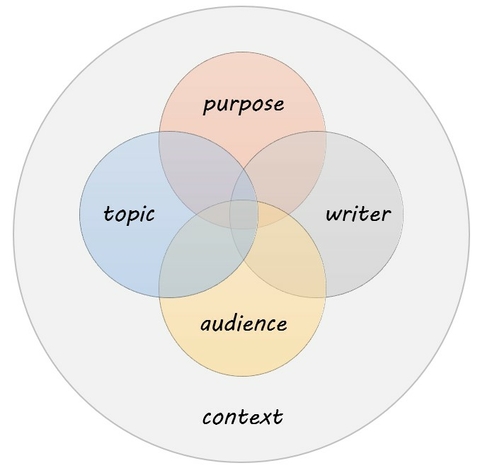
The diagram helps explain why “situation” is larger than plot. A speaker’s purpose and audience affect what they say and how they say it. A mayor speaking after a flood, for instance, faces a very different situation from a teenager texting a friend about the same event.
3. What is the subject?
The subject is what the text is literally about. Keep this concise.
| Term | Useful question | Example |
|---|---|---|
| Subject | What is being discussed, described, remembered, or represented? | A family closing its small business |
| Central idea | What larger insight does the text suggest about that subject? | Change can make a familiar place feel emotionally unfamiliar |
At this stage, do not force yourself to state a sophisticated theme. A clear literal subject gives you firm ground for later interpretation.
4. Where does the text shift?
Most texts do not stay in one emotional or intellectual place. A shift is a noticeable change in what the text focuses on or how it presents that focus.
On the first pass, simply place a small star or a vertical line beside a possible shift. You do not need a full explanation yet.
Common signals include:
- contrast words: but, yet, however, instead, although
- changes in time: past to present, childhood to adulthood, morning to night
- changes in place or scene
- a new paragraph, stanza, heading, image, or voice
- a change from description to reflection
- a change from certainty to doubt, hope to disappointment, humour to seriousness
- a final sentence or image that reframes what came before
A shift is not automatically a technique. It is a movement in meaning. Later, you will use techniques to explain how that movement is created.
Your first-pass annotation: brief and functional
Under timed conditions, long annotations are a trap. They consume time and can make the page harder to read. Try this compact margin code instead:
| Mark | What to note |
|---|---|
| Sp | Speaker or voice |
| Si | Situation or event |
| Su | Subject |
| * | Possible shift |
| ? | A confusing phrase to revisit |
After the first read, aim to be able to complete this four-line snapshot:
Speaker: …
Situation: …
Subject: …
Shifts: from … to …
Your wording can be provisional. “Provisional” means it is your best evidence-based understanding so far, not a final verdict.
For example:
Speaker: a first-person narrator reflecting on a family event
Situation: a familiar workplace is being closed
Subject: loss and change within a family business
Shifts: from expectation to shock, then to personal understanding
That is already enough to prevent a scattered response later.
Pass Two: test and refine your first understanding
Now read again, with the question and your first-pass snapshot in mind. This is when you underline or highlight only the details that help you confirm, complicate, or revise your initial reading.
The second pass has three jobs.
Confirm the speaker and situation
Return to the clues that establish voice and circumstance. If the narrator says “I watched,” they are an observer; if they use an imperative such as “remember,” they may be addressing someone directly; if the text uses collective language such as “our town,” the voice may speak for a group.
Ask: What can I now say with confidence, and what should remain cautious?
Trace the shifts precisely
A first-pass star becomes useful only when you can name what changes. Use this sentence frame:
The text shifts from [earlier focus or feeling] to [later focus or feeling] when [specific word, image, structural change, or event] appears.
For example:
The passage shifts from routine expectation to disappointment when “instead” introduces the empty shop.
Notice that this does not yet require a long technique analysis. It identifies the textual turning point accurately.
Select, do not collect
Your second pass is not a scavenger hunt for every device. Choose a small number of details that do real work:
- a repeated word or image
- a contrast
- an important verb or adjective
- a change in pronouns
- a key structural moment, such as a short final sentence
- an image that appears at the point of a shift
A useful rule is: if you cannot connect a marked detail to the question or your overall understanding, do not spend time on it.
Worked example: applying both passes
Imagine this short unseen prose extract:
At six, I lifted the shutters of my father’s repair shop, expecting the usual smell of oil. Instead, there was only dust. Mum stood behind the counter, her coat still on. “We can’t keep it,” she said. I watched the street wake beyond the glass and, for the first time, understood why Dad had taught me every lock.
First pass: map the communication
You might write:
- Speaker: a first-person child or young person
- Situation: the speaker arrives at their father’s repair shop and learns that it will close
- Subject: the closure of a family business; family change
- Shifts: routine expectation changes to shock; then shock changes to a new understanding of the father’s teaching
You should not claim that the father has died, moved away, or is bankrupt. The text does not state this. Strong unseen-text reading separates what is explicit from what is merely possible.
Second pass: locate proof of the movement
Now revisit the exact details:
- “expecting the usual smell of oil” establishes familiarity and routine.
- “Instead” clearly signals contrast.
- “only dust” replaces the expected smell with emptiness and neglect.
- The short direct speech, “We can’t keep it,” makes the situation unmistakable.
- “for the first time” marks a final shift in the speaker’s understanding.
- “every lock” suggests that the father’s lessons now have a meaning beyond practical repair work, perhaps responsibility or inheritance.
The reading is still concise, but it is now precise. You can see the text’s movement from the familiar, to loss, to a changed understanding of the past.
Watch an expert model the two passes
The following demonstration uses an unseen poem, but the routine applies equally to prose, speeches, articles, and visual texts. What matters is the order: establish broad sense first; return for significant choices and shifts second.
In “Nail the UNSEEN POEM in 2022,” Mr Salles Teaches English models his thinking while encountering a text for the first time. The most useful feature is his willingness to form sensible hypotheses without panicking when every detail is not immediately clear.
Watch the first pass. Focus on how he identifies a speaking voice, notices repetition, and records uncertainty while continuing to read. Then watch the second pass, where he returns to repeated phrases, imagery, and a key change in viewpoint. Finish with the recap to reinforce the distinction between reading for overall sense and rereading for methods.
One especially useful habit from this model is to treat uncertain ideas as hypotheses. You might think, “This image may suggest protection,” rather than deciding instantly that it has one fixed meaning. The rest of the text can then support, refine, or challenge that first thought.
A 60-second routine for the exam
When you meet an unseen text, use this sequence:
- Glance at the question so you know the broad focus.
- Read once without heavy annotation. Aim to understand who is communicating, what is happening, and what the subject is.
- Mark possible shifts with a star, especially contrasts, new stanzas or paragraphs, changes in time, and significant final lines.
- Write a four-line snapshot: speaker, situation, subject, shifts.
- Read again. Underline only details that confirm or complicate that snapshot and that may help answer the question.
- Keep uncertainty controlled. Make claims the text can support; do not invent background information.
This routine is designed to make your reading more deliberate, not slower. With practice, the first pass gives you a map and the second pass gives you evidence.
Key takeaways
A strong response to an unseen text begins before you write. On your first pass, establish the speaker, situation, subject, and major movements in the text. On your second pass, revisit the most important wording and structural moments to prove or refine that initial understanding.
Remember the distinction:
- Speaker is the voice communicating.
- Situation is the context and immediate circumstance.
- Subject is the literal focus of the text.
- Shifts are changes in focus, perspective, time, tone, or intensity.
In the next lesson, you will build on this map by learning how to infer an unseen text’s central idea and tone from repeated, contrasting, and emphasised details.
Can't find a good explanation? Sign up and we'll make it for you
Sign up