
Hello. In the previous lesson, you learned to select short, relevant evidence rather than collecting quotations at random. This lesson is the next step: turning that evidence into analysis.
In an unseen-text response, the marker needs to see more than “what happens” or “which technique is used.” You need to explain how a particular language or structural choice creates meaning, and then connect that meaning directly to the wording of the question. By the end of this lesson, you should be able to write sentences that move confidently from evidence to interpretation.
Analysis explains how, not just what
Consider this question:
How does the writer convey the speaker’s mixed feelings about returning home?
And this short extract:
At the gate, I slowed. The house crouched beneath its peeling roof, yet the kitchen window glowed like an old promise. I wanted to run inside; instead, I counted the cracked tiles.
A response that only summarises might say:
The speaker has mixed feelings because they want to go inside, but they also notice that the house is damaged.
That is true, but it mostly retells the extract. It does not explain how the writing constructs those mixed feelings.
A stronger response examines the choices inside the wording:
The personification of the house as “crouched” makes it seem withdrawn and uneasy, while the contrast introduced by “yet” shifts to the warm image of a window that “glowed like an old promise.” This suggests that home still offers comfort and belonging, but its damaged appearance also makes the speaker hesitant, conveying their conflicted feelings about returning.
This does four useful things:
- It makes a clear point about the speaker’s feelings.
- It selects precise evidence.
- It explains the connotations of particular words and the contrast between them.
- It links the explanation back to the question’s focus: mixed feelings.
The difference is not a matter of using fancier vocabulary. It is a matter of completing the interpretive step:
| Level | Example |
|---|---|
| Identify | The writer uses personification in “the house crouched.” |
| Describe | The house is described as crouching. |
| Analyse | “Crouched” makes the house seem guarded and diminished, suggesting that the speaker’s home feels unfamiliar or emotionally difficult to approach. |
| Link | This helps convey the speaker’s unease about returning home. |
A technique label can be useful, but it is never the main point. The meaning lies in what the specific word, image, pattern, or structural movement suggests.
A reliable chain: choice, meaning, and relevance
When analysing under exam conditions, use this internal sequence. You do not need to announce every step separately in your writing.
- Make a point that answers the question.
- Name or describe the choice precisely.
- Zoom in on the evidence: a word, phrase, image, sentence pattern, or shift.
- Explain its meaning using connotations and implications.
- Connect that meaning to the question’s key idea.
For the extract above, you might plan your second point like this:
| Part of the analysis | Planning note |
|---|---|
| Point | The speaker wants connection but cannot fully trust it. |
| Evidence | “I wanted to run inside; instead” |
| Choice | Structural contrast within the sentence; semicolon interrupts the expected action. |
| Meaning | The desire to return is immediately replaced by restraint and close attention to damage. |
| Link | The speaker’s feelings are divided between affection and discomfort. |
Notice that a structural observation is not just “there is a semicolon.” The punctuation matters because it separates the speaker’s impulse from what they actually do. The sentence presents desire, then disrupts it.
A developed sentence could be:
Structurally, the speaker’s urge to “run inside” is interrupted by “instead,” which redirects attention to the “cracked tiles.” This contrast between impulse and action reveals that affection for home is restrained by memories or signs of damage, reinforcing the speaker’s divided response.
The technique is only a starting point. Your explanation must answer: What does this choice make us understand about the person, situation, idea, or tone named in the question?
Language choices: look closely at what the words carry
A language choice is any meaningful use of words or sounds. It may be a familiar technique such as metaphor, personification, repetition, or rhetorical question. It may also be a single striking verb, adjective, noun, pronoun, or contrast word.
You do not need to force every observation into a complicated label. Often, it is stronger to write:
The harsh verb “scraped” suggests discomfort and abrasion...
than:
The author uses a verb, “scraped”...
The useful part is the explanation of scraped: it carries associations of roughness, pain, or damage.
Watch this short section of “5 Tips for Analysing an Unseen Text” by Jeddle. It is particularly helpful when an unfamiliar text does not contain obvious metaphors or similes, because it shows that accurate observations about word choice, syntax, modality, and tone still count as analysis.
5 Tips for Analysing an Unseen Text
“5 Tips for Analysing an Unseen Text” by Jeddle explains how to analyse language even when a formal technique label is not immediately obvious, then summarises the essential parts of an unseen-text response.
Watch language choices for practical fallback areas to analyse: modality, emotive language, syntax, and tone. Then watch response basics and note the four essentials: precise evidence, a choice or method, its consequence, and a connection to the prompt.
Make “effect” specific
A weak explanation often stops at a vague audience reaction:
This makes the reader feel sad.
Sometimes a text does invite sadness, but this statement is too broad unless you explain why. A more precise explanation focuses first on the meaning constructed in the text:
The image of the empty chair presents absence as physically present in the room, making the loss seem inescapable.
You can then add an audience effect if it genuinely follows:
This invites the reader to recognise the lasting weight of grief.
Use the word effect to mean the impact of a choice on meaning, tone, character, argument, or representation. It does not always have to mean “how the reader feels.”
Here are some stronger analytical verbs:
| Instead of | Try |
|---|---|
| shows | suggests, conveys, presents, reveals |
| makes the reader feel | invites the reader to see, positions the reader to recognise |
| uses imagery | creates an image of, contrasts, personifies, repeats |
| makes it interesting | foregrounds, intensifies, complicates, reinforces |
| proves | supports, develops, emphasises |
These are tools, not compulsory replacements. The quality comes from the idea after the verb.
Structural choices: analyse the arrangement of meaning
Structure concerns how the text is organised. Rather than looking closely at one word, you consider where ideas appear and how the text moves between them.
In an unseen text, useful structural choices include:
- a contrast between the opening and ending
- a shift in tone, focus, pace, or viewpoint
- repetition that gains new significance
- a short sentence after longer description
- a list that builds pressure or emphasis
- chronological movement through time
- juxtaposition of two opposing images or ideas
- a final line that resolves, complicates, or leaves a question unanswered.
A structural claim needs evidence just as much as a language claim. Avoid vague comments such as:
The structure makes the text effective.
Instead, identify the actual movement.
Consider this mini-extract:
At first, I whispered the names. By dusk, I said them aloud. At dawn, I stepped beyond the gate.
If the question asks how the writer presents a movement from grief to resolve, structural analysis might be:
The time markers “At first,” “By dusk,” and “At dawn” organise the speaker’s experience as a gradual progression. Their voice develops from a “whisper” to speaking “aloud,” before the final action of stepping “beyond the gate,” suggesting that private grief is slowly transformed into the resolve to move forward.
This analysis does not simply identify a sequence. It explains what the sequence means: increasing confidence and a movement beyond confinement.
A compact comparison can help you distinguish language and structural analysis:
| Choice type | Evidence | What to explain |
|---|---|---|
| Language | “whispered” | The quiet verb suggests grief, caution, or emotional vulnerability. |
| Language | “beyond” | This word implies crossing a boundary and leaving confinement behind. |
| Structure | “At first” to “At dawn” | The ordered time progression represents change rather than a fixed emotional state. |
| Structure | Final action | Ending with “stepped” gives the extract a sense of decision and forward movement. |
Often, your best response combines both. The structural progression tells us that the speaker changes; the individual word choices show the nature of that change.
Use STEEL as a thinking guide, not a rigid script
The STEEL structure can keep a short-answer response focused, especially when time is limited.
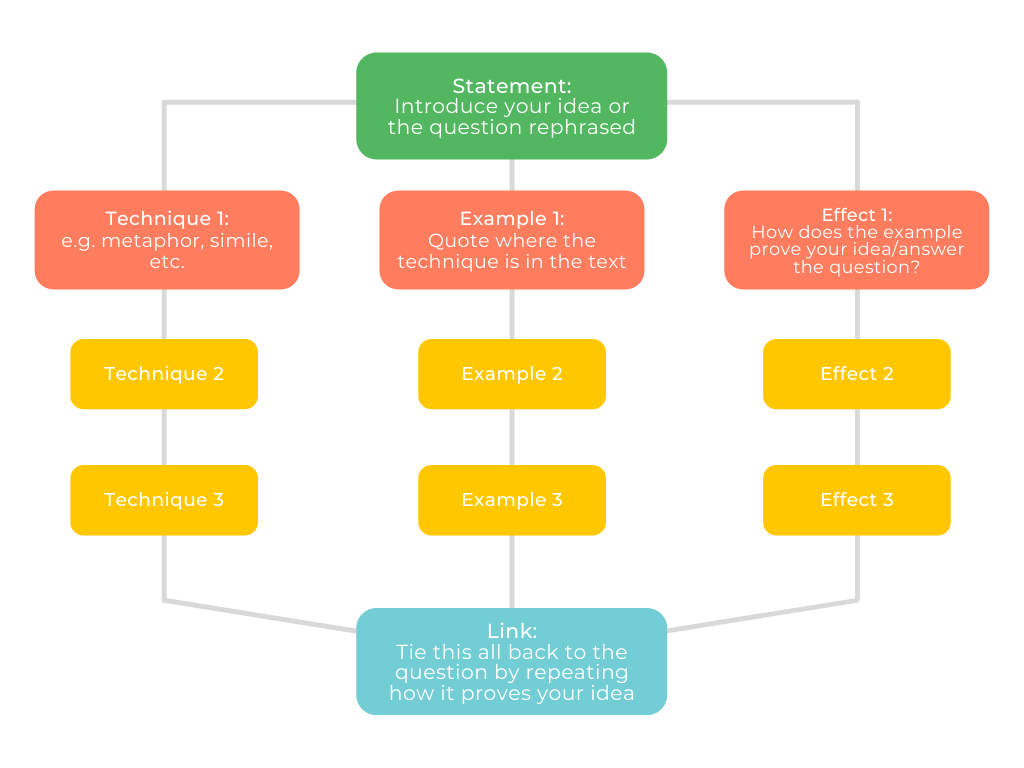
In the chart:
- Statement means your answer to the question.
- Technique means a language or structural choice.
- Example means the exact supporting evidence.
- Effect means the meaning created by that choice.
- Link returns to the question’s focus.
For a three- or four-mark question, you do not need a long formal essay paragraph. Usually, one clear statement followed by two developed pieces of evidence is more effective than trying to force a separate introduction and conclusion around every quotation.
This reading from “How to Ace Unseen Texts for HSC English Paper 1” by Art of Smart shows the move from selecting suitable techniques to explaining them in a modified STEEL response. Although it uses HSC examples, the short-answer structure is directly useful for Preliminary unseen-text questions.
How to Ace Unseen Texts for HSC English Paper 1 ✍️
Read Art of Smart’s planning advice and model STEEL response to see how each technique is chosen for the specific question and developed into an explanation.
In “Step 4: Which techniques suit the unseen texts practice question?”, read the planning advice and notice that relevance to the question matters more than collecting many techniques. Then continue to “Step 5: Answer with STEEL” and read the full model response. In its middle section, follow one developed explanation; focus on how the quotation, interpretation, and link to the idea of community are integrated into the same sentence.
The full STEEL chart may show several technique-example-effect groupings, but do not treat that as a rule that every answer needs exactly three techniques. Let the mark value and the question determine how much you write. A three-mark response needs concise development; a five- or six-mark response can develop several distinct choices.
A worked response: combining language and structure
Return to the homecoming extract:
At the gate, I slowed. The house crouched beneath its peeling roof, yet the kitchen window glowed like an old promise. I wanted to run inside; instead, I counted the cracked tiles.
Question:
How does the writer convey the speaker’s mixed feelings about returning home? (4 marks)
Here is a strong response:
The writer conveys the speaker’s mixed feelings through contrasting images of the house. The personification of the house as “crouched” beneath its “peeling roof” makes home seem diminished and unwelcoming, suggesting the speaker’s discomfort with what it has become. However, the conjunction “yet” introduces the kitchen window, which “glowed like an old promise”; this warm image implies that memories of safety and belonging still draw the speaker back. Structurally, the desire to “run inside” is immediately reversed by “instead,” as the speaker focuses on the “cracked tiles.” This interruption reveals that affection is complicated by hesitation, conveying an uneasy but enduring attachment to home.
Why it works:
| Part | How it earns marks |
|---|---|
| First sentence | Directly answers the question with “mixed feelings” and “contrasting images.” |
| First explanation | Interprets “crouched” and “peeling,” rather than merely naming personification. |
| Second explanation | Explains the significance of “yet” and the warm simile. |
| Structural explanation | Identifies the change from wanting to act to holding back. |
| Final sentence | Returns to the question’s idea of conflict and attachment. |
The response does not claim that every word has one fixed meaning. Instead, it offers a plausible interpretation supported by closely chosen evidence. That is exactly what unseen-text analysis requires.
An exam-time check before you move on
After writing an analytical sentence, quickly check it against these four prompts:
- Have I identified the exact word, image, or structural moment doing the work?
- Have I explained what it suggests, rather than only named a technique?
- Does my explanation address the question’s key idea?
- Have I avoided vague claims such as “it makes the reader interested”?
If one sentence only identifies a device, add the missing meaning:
The repetition of “still” emphasises...
Then finish the thought:
...the speaker’s refusal to abandon hope, supporting the text’s portrayal of resilience.
If a sentence only paraphrases, zoom in on the choice that creates that meaning:
The speaker is nervous.
can become:
The fragmented syntax and repeated pauses present the speaker’s thoughts as unsettled, conveying their anxiety.
Key takeaways
Analysis is the bridge between evidence and your answer:
- A language choice may be a technique, but it can also be a precise word, phrase, sound, or sentence pattern.
- A structural choice concerns the order, contrast, pacing, repetition, shifts, and ending of a text.
- Do not stop at naming a technique. Explain what the chosen detail suggests and how it shapes the text’s meaning.
- Keep the question’s key term in view. Your final explanation should clearly support it.
- STEEL is useful as a checklist: make a statement, use precise evidence, explain the effect, and link back.
In the next lesson, you will put evidence selection and analysis together to write and self-check a concise unseen-text response within an exam-appropriate time limit.
Can't find a good explanation? Sign up and we'll make it for you
Sign up