
Welcome to the final lesson in this unseen-text strategy module. You have already practised reading for key details, inferring ideas and tone, unpacking questions, selecting evidence, and explaining how language and structure create meaning. The last step is to make those skills work together quickly and reliably under exam conditions.
This lesson focuses on producing a concise response that has a clear point, relevant evidence, and explanation—and then checking it without losing time. The goal is not to write the longest answer. It is to write the amount of purposeful analysis that the question’s mark value requires.
A useful study route for this lesson is about 40 minutes:
| Part | Time |
|---|---|
| Planning and timing principles | 8 minutes |
| Compact response routine | 8 minutes |
| Worked 4-mark response | 10 minutes |
| Video model | 6 minutes |
| Self-check system and recap | 8 minutes |
Let the marks set the size of your response
A short-answer response should be proportional. A two-mark question does not need a mini-essay; a five- or six-mark question cannot be answered fully with one quotation and a general comment.
First, work out the average time available per mark in your exam:
For example, if a section has 20 marks to complete in 45 minutes, that gives about minutes per mark. In practice, it is wise to work closer to two minutes per mark so you retain a few minutes at the end for checking.
Use this as a practical starting guide:
| Mark value | Usual time budget | Useful response shape |
|---|---|---|
| 2 marks | 4–5 minutes | A direct answer with one or two concise, explained examples |
| 3 marks | 6–7 minutes | A clear point plus two analytical sentences |
| 4 marks | 8–9 minutes | A clear point plus three analytical sentences |
| 5–6 marks | 10–13 minutes | A short mini-essay or sustained paragraph with several developed examples |
These are planning guides, not marking rules. The wording of the question still matters. If a two-mark question asks “In what ways” or asks you to compare two things, you need to address both parts. Conversely, adding six techniques to a three-mark response usually creates rushed explanation and wastes time.
The Matrix short-answer flowchart is useful because it reminds you that writing is only one part of the task: you must read the question, read the text with a purpose, budget time, answer thoroughly, and move on when the time limit ends.
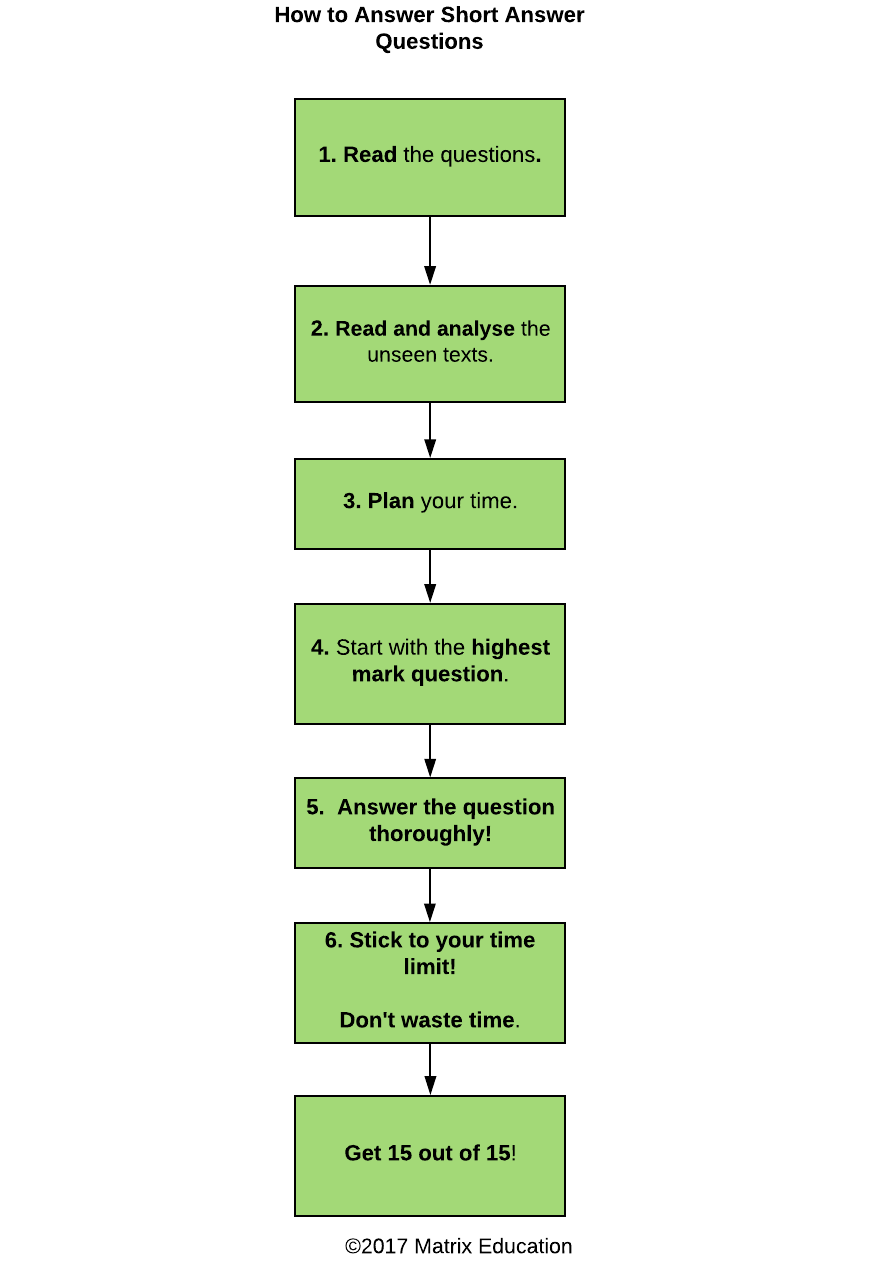
Before continuing, read this compact guide to planning and structuring a response. It is written for HSC students, but its basic routine works well for Year 11 Preliminary short answers.
HSC Unseen Texts - If You Can Follow a Recipe, You Can Write an A+ Short Answer Response
Read Project Academy’s planning-and-writing guide for a practical way to turn a question into a concise response. Focus on the planning sequence and the purpose of each part of TEEL; do not treat its suggested number of techniques as an inflexible rule.
In the “Follow the Recipe” section, read the planning steps. Notice the order: establish the task before hunting for quotations. Then read the “Topic Sentence” and “Evidence” advice, beginning with the topic-sentence guidance. Focus especially on how a point should answer the question rather than repeat it.
A four-stage routine for writing under time pressure
Once you have read the text and broken down the question, use a small, repeatable routine. It should feel like a checklist in your head, not a rigid paragraph template.
1. Re-anchor yourself in the question
Take a few seconds to identify:
- the directive verb: explain, analyse, describe, compare
- the conceptual focus: for example, conflict, belonging, change, resilience, relationships
- any scope words: such as through dialogue, in this extract, in what ways, or at the end
- the mark value, which determines your time and the amount of support needed.
Your first sentence should respond to the focus with a specific interpretation. Compare these openings for a question about a character’s isolation:
| Less effective | More effective |
|---|---|
| The writer shows that the character is alone. | The writer presents the character’s isolation as increasingly uncomfortable, as physical separation develops into emotional disconnection. |
The second version gives the response a direction. It tells the marker what your evidence will prove.
2. Make a tiny plan, not a quotation list
For a 4-mark question, aim to write only a few planning notes. Choose evidence that gives you different angles on the same main idea. Often, looking at the beginning, middle, and end of the extract helps you avoid repeating yourself.
Your plan might look like this:
| Part of text | Evidence | What it may show |
|---|---|---|
| Beginning | “poured through the gates” | Others move together; speaker remains apart |
| Middle | “silence pressed” | Quiet becomes threatening |
| Ending | “before its doors had fully opened” | Urgent wish to escape |
This should take roughly a minute, not five. Once you have enough evidence to support a clear point, stop searching. A strong answer explains a few well-chosen details; it does not mention every technique you can find.
3. Draft with point, evidence, and explanation
For most 3- and 4-mark questions, a compact structure works well:
- Point sentence: answer the question and state your interpretation.
- Analytical sentences: embed a short quotation, explain the choice, and link it to the question’s focus.
- Final analytical sentence: often use the ending or a shift in the text to show development, resolution, or tension.
You have encountered STEEL and TEEL already. Use them as a mental prompt:
- Point or statement: What is your answer?
- Evidence: Which exact words support it?
- Explanation: What do those words suggest?
- Link: How does that meaning answer this question?
You do not need to write labels such as “Technique,” “Evidence,” or “Effect.” Nor do you need to force one new technique name into every sentence. If you can clearly explain the significance of a precise word or contrast, that is analysis.
4. Check with purpose, then move on
A self-check is not a full rewrite. It is a fast audit for missing marks.
If you finish early, do not automatically add another quotation. First ask whether the answer already has:
- a direct point
- enough relevant evidence for the mark value
- explanation of what each piece of evidence means
- a clear connection to the question.
If it does, use the spare time to improve clarity, quotation accuracy, punctuation, and legibility. Then move to the next question.
Worked example: planning, writing, and checking a 4-marker
Read this short unseen-style extract:
At 5:30, I watched the last commuters pour through the gates, each face lit blue by a phone. I told myself I enjoyed the quiet. Yet the silence pressed against the glass, turning my reflection into a stranger. When the train finally arrived, I stepped aboard before its doors had fully opened.
Question:
Explain how the writer conveys the speaker’s unease while waiting at the station. (4 marks)
A sensible eight-minute plan might be:
| Time | Action |
|---|---|
| First minute | Identify the focus: unease while waiting |
| Next minute | Plan one main point and choose three details |
| About five minutes | Write four concise sentences |
| Final minute | Self-check against the question and correct errors |
Here are the planning notes:
| Main idea | Evidence and meaning |
|---|---|
| The speaker becomes increasingly unsettled and isolated. | “pour through” contrasts commuters’ movement with the speaker’s stillness |
| Quiet is not comforting. | “Yet”; “silence pressed” makes silence feel oppressive |
| Unease becomes urgency. | Boards before the doors are fully open |
A strong response could read:
The writer presents waiting at the station as increasingly unsettling, as the speaker’s attempt to welcome solitude gives way to alienation and urgency. The image of commuters who “pour through the gates” contrasts their purposeful movement with the speaker’s stillness, while each face being “lit blue by a phone” makes the crowd seem disconnected rather than companionable. The conjunction “Yet” overturns the claim that the speaker “enjoyed the quiet,” and the personification of silence that “pressed against the glass” suggests a claustrophobic force that isolates them. Finally, the speaker boards “before its doors had fully opened,” and this rushed final action reveals their need to escape, reinforcing their unease during the wait.
Notice what makes this response efficient:
| Feature | How it earns marks |
|---|---|
| Clear first sentence | It answers how unease is conveyed and gives a specific interpretation. |
| Short quotations | The evidence is woven into sentences rather than copied in large chunks. |
| Explanation | It explains the implications of “pour,” “Yet,” “pressed,” and the final rushed action. |
| Development | The response moves from isolation to pressure to urgency. |
| Consistent relevance | Each sentence returns to unease, waiting, isolation, or escape. |
The response is not impressive because it uses complicated vocabulary. It works because every sentence has a job.
Watch a concise response being built
The following video shows a three-mark response being planned and drafted from a prose extract. Its HSC-level text is more challenging than many Preliminary exam extracts, but the useful lesson is the method: form a specific topic sentence, choose brief evidence, explain it, and keep linking back to the prompt.
How To Get Full Marks in Section I (Short Answers) - 2023 HSC Breakdown
In “How To Get Full Marks in Section I (Short Answers) - 2023 HSC Breakdown,” Jeddle demonstrates how to turn a few observations into a concise three-sentence response. Watch it to see how an analytical response can remain simple and still be precise.
In the three-mark walkthrough, start at writing the response. Watch how the presenter turns the main idea into a topic sentence, selects short quotations, and makes each analytical sentence return to the character’s preference. Focus on the repeated structure of claim, evidence, specific meaning, and question link.
The 45-second self-check
When time is tight, check in this order. Start with the elements that affect marks most directly.
1. Question fit
Read the question again. Ask:
- Have I answered the directive verb?
- Have I addressed the exact concept named in the question?
- If the question asks “how,” have I analysed writing choices rather than only summarised events?
- If it says “ways” or compares ideas, have I covered more than one relevant aspect?
A response about a character’s fear may be well written but still lose relevance if the question asks how the writer presents resilience.
2. Evidence fit
Check each quotation:
- Is it short and accurate?
- Does it directly support my point?
- Have I used evidence from different moments if the text develops or shifts?
Delete a quotation if it adds no new meaning. One developed quotation is more useful than two unexplained ones.
3. Explanation fit
This is the most important check. After every quotation, make sure you have answered:
What does this word, image, contrast, or structural shift suggest?
For example:
The writer uses personification in “silence pressed against the glass.”
This only identifies a technique. Add the interpretive step:
The writer uses personification in “silence pressed against the glass,” making the quiet seem physically oppressive and revealing that the speaker cannot experience solitude as peaceful.
4. Proportion and control
Finally, check the response suits the available marks and time:
- Is a low-mark answer concise?
- Have I stopped after making enough developed points?
- Are my sentences complete and readable?
- Have I left enough time to move to the next question?
If you are running out of time, use this priority order:
- Finish an incomplete explanation.
- Add a direct link to the question’s key idea.
- Correct a quotation or sentence that changes your meaning.
- Move on.
Do not spend your final minute searching for a more sophisticated technique name. Clear explanation earns more than an uncertain label.
Key takeaways
A successful unseen-text response is a controlled piece of writing, not a rushed list of devices.
- Budget your time from the mark value, usually allowing about two minutes per mark plus a final checking buffer.
- Begin with a clear point that answers the question’s conceptual focus.
- Select only enough evidence to support that point fully.
- Make every quotation earn its place by explaining what it suggests.
- Use the mark value to guide the length of your response, but always follow the wording of the question.
- Self-check for relevance, evidence, explanation, and time control before moving on.
You now have a complete strategy for Year 11 unseen-text questions: read purposefully, infer meaning, unpack the question, select evidence, analyse choices, and produce concise responses under time pressure. Regular timed practice with 3- and 4-mark questions will make this process increasingly automatic.
Can't find a good explanation? Sign up and we'll make it for you
Sign up