Hello! Welcome to the third lesson in our course.
In our last session, we mapped the stages of the B2B buying journey, from problem recognition to the final purchase. We established that your copy needs to guide the buyer through this structured process.
Today, we're going to put faces to the names. The B2B "buyer" is rarely a single person; it's a group of people with different jobs, priorities, and levels of influence. Our learning goal is to analyze a purchase scenario to identify the roles in a B2B buying committee, such as the champion, the decision-maker, and the end-user.
Understanding this internal team dynamic is the secret to writing copy that speaks to the right person, with the right message, at the right time.
1. It Takes a Village: Meet the Buying Committee
In B2C, you're often persuading one person. In B2B, you're persuading a team. This team is often called a Buying Committee or, in more modern marketing terms, a Decision-Making Unit (DMU). Forgetting this is one of the biggest mistakes a copywriter can make.
To get a quick overview of the classic roles you'll encounter, let's start with a short video.
B2B Buying Centers - How Firms Make Purchasing Decisions
This video from Professor Wolters introduces the concept of a 'buying center' and outlines the primary roles involved. It's a great foundation for understanding the different players on the field.
Please watch from 0:43 to 4:24. As you watch, make a mental note of each role and their primary function: User, Initiator, Influencer, Gatekeeper, Decider, and Buyer.
2. The Core Roles and What They Care About
The video gave a good overview of the many hats people can wear. For a copywriter, we can simplify this into a few core personas that you'll write for most often. The article "Account-Based Marketing Tactics: DMUs & Personalised Content" provides a very useful summary.
Here are the most critical roles and, most importantly, their primary motivations:
| DMU Role | Who They Are | Typical Job Titles | What They Care About |
|---|---|---|---|
| Decision-Maker | The person with the final "yes" or "no" authority, often controlling the budget. | CFO, CEO, VP of a Department | ROI, business risk, budget impact, bottom line. |
| Influencer | A subject matter expert whose opinion is respected. They evaluate technical fit and feasibility. | IT Director, Senior Engineer, Legal Counsel | Technical specifications, integration, security, compliance. |
| End-User | The person or team who will use your product day-to-day. | Sales Rep, Marketing Manager, Project Manager | Ease of use, features, impact on their daily workflow. |
You might also encounter:
- The Initiator: The person who first identifies the problem (often an End-User).
- The Champion: Your internal advocate. This is the person who is most passionate about your solution and works to get buy-in from the rest of the committee. Your job is to arm this person with the copy and data they need to make their case.
A common mistake is to focus all your energy on the Decision-Maker. However, an End-User who refuses to adopt the tool or an Influencer who flags a security risk can veto the entire deal. You must write to persuade the whole committee.
3. One Person, Many Hats
In reality, these roles often overlap. One person can be both the one who feels the pain (Initiator) and the one who will use the solution (End-User). A department head could be both the budget holder (Decision-Maker) and your internal Champion.
This is where things get interesting. Look at this example diagram of a Decision-Making Unit (DMU) for a fictional company.
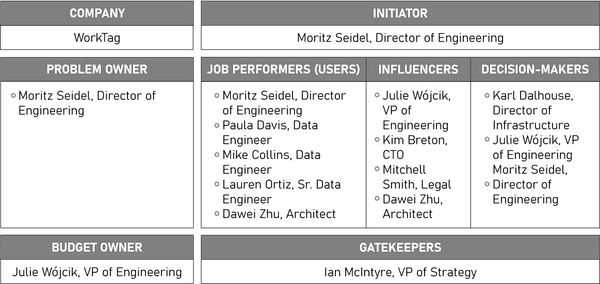
This image perfectly shows why you can't just write for a job title. You have to understand the role they are playing in the context of the purchase. The Director of Engineering cares about the budget (as a Decision-Maker) but also about how the solution will impact his team's daily work (as a User). Your copy needs to address both concerns.
4. Your Turn: Analyzing a Purchase Scenario
Now it's time to put this into practice. Read the following scenario and see if you can identify the key players and their roles.
Scenario:
"Streamline Inc.," a 150-person tech company, is struggling with its hiring process. Resumes are getting lost in email inboxes, candidate feedback is disorganized, and the Head of HR, Maria, feels the company is losing top talent due to slow communication.
Maria researches and finds "HireWell," an applicant tracking system (ATS) that promises to centralize the entire hiring process. She's excited about it and believes it will solve her team's biggest headaches.
To get it approved, she needs to convince David, the CFO, that the annual subscription cost is worth the investment. She also needs to make sure the software will be adopted by her team of three recruiters, who are comfortable with their current (if messy) system. Finally, Leo, the Head of IT, must confirm that HireWell meets the company's data security standards and can integrate with their existing HR information system.
Task:
Based on the scenario, identify the person who best fits each of these roles:
- Champion / Initiator:
- End-Users:
- Decision-Maker (Budget Holder):
- Influencer / Gatekeeper (Technical):
Take a moment to map the names to the roles before reading my analysis below.
Tutor's Analysis:
- Champion / Initiator: This is clearly Maria, the Head of HR. She recognized the problem, found the solution, and is now trying to get internal buy-in. Your copy (case studies, ROI calculators) should be designed to help her build a compelling business case.
- End-Users: These are the three recruiters on her team. They will be in the software all day. They care about efficiency and ease of use. Your copy for them (demo videos, feature checklists) should focus on how HireWell makes their day-to-day job easier, not harder.
- Decision-Maker (Budget Holder): This is David, the CFO. His primary concern is financial. He's asking, "Will this deliver a positive return on investment?" He needs to see copy that speaks to ROI, cost savings (e.g., from hiring faster), and budget predictability.
- Influencer / Gatekeeper (Technical): This is Leo, the Head of IT. He has the power to block the deal if the software isn't secure or compliant. He isn't interested in the UI; he wants to see security white papers, integration documentation, and compliance certificates.
Conclusion
Great work today. You've moved from seeing the B2B buyer as a single entity to understanding the complex team behind every major purchase.
Key Takeaways:
- B2B purchases are made by a committee, often called a Decision-Making Unit (DMU).
- The key roles are typically the Decision-Maker (budget), End-User (usability), and Influencer (technical fit), but don't forget your Champion!
- Each role has different priorities, and your copy must address their specific questions and concerns.
- One person can hold multiple roles, so you need to understand their function in the context of the purchase.
In our next lesson, we'll dive even deeper. Now that we know who we're talking to, we'll learn how to analyze the actual language they use to uncover the rational justifications and emotional drivers behind their decisions. This is where we find the raw material for truly compelling copy.