Hello! Welcome back.
In our last lesson, we broke down the B2B buying committee into its key roles: the Decision-Maker, the End-User, the Influencer, and your internal Champion. We established who you're writing for.
Today, we're digging deeper to understand why they buy. The official learning outcome is to analyze real B2B buyer language to distinguish between rational justification and emotional motivation. It's a common myth that B2B decisions are purely logical. The truth is, behind every spreadsheet and list of technical requirements, there’s a human being driven by very human emotions. Master this, and your copy will become exponentially more persuasive.
1. The Two Systems of the B2B Buyer's Brain
Even the most analytical CFO or IT Director is, first and foremost, a person. Decades of research in behavioral economics show that people make decisions using two different systems of thought.
Stories appeal to both the rational and emotional parts of the brain
The article 'I've Helped Create 150+ Case Studies' from Copyhackers has an excellent, concise explanation of this concept, known as Dual Process Theory.
Read just the short section titled '3. Stories appeal to both the rational and emotional parts of the brain.' Focus on the distinction between 'system one' (fast and emotional) and 'system two' (slow and rational).
As the article notes, we are "instinctual people who rationalize our emotional decisions after the fact." This is the most important concept to grasp in B2B copywriting. Your buyer needs the logical reasons (System 2) to justify a purchase to their boss and their team, but the initial impulse to buy often comes from an emotional place (System 1).
This means your copy has to do two jobs at once:
- Provide the rational proof (features, data, ROI).
- Connect with the underlying emotional driver (fear, ambition, desire for status, etc.).
This framework can help visualize the different needs at play:
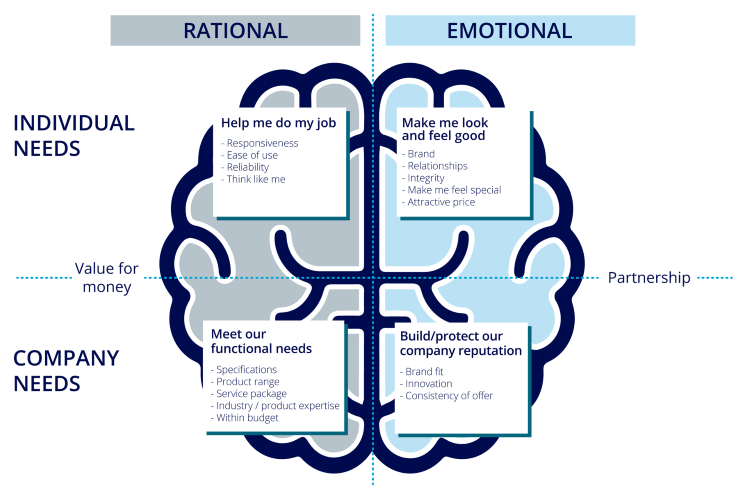
As you can see, a buyer is simultaneously thinking about company needs ("Does this meet our specs?") and individual needs ("Will this make me look good?"). They are weighing rational factors ("What is the budget?") and emotional ones ("Does this brand feel innovative?").
2. Uncovering the "Job to Be Done"
So how do we identify these hidden emotional drivers? A powerful framework for this is called Jobs to be Done (JTBD). The core idea is that customers don't "buy" products; they "hire" them to make progress in their lives or work.
Let's watch a short clip from Bob Moesta, one of the creators of the JTBD framework, who explains this concept perfectly.
The ultimate guide to JTBD | Bob Moesta (co-creator of the framework)
In this clip from Lenny's Podcast, Bob Moesta introduces the core idea of JTBD using a simple but powerful example.
Watch from 04:53 to 07:34. Pay close attention to the Snickers vs. Milky Way comparison. Think about the 'job' each one is hired for. One is functional, the other is emotional.
This functional vs. emotional distinction is the key. In B2B, the same principle applies. A company might hire a project management tool for the functional job of tracking tasks. But the manager who champions the purchase might also be hiring it for the emotional job of reducing their anxiety about deadlines, or the social job of being seen as an effective leader.
To bring this directly into the B2B world, let's watch one more quick clip.
Q: "What's The Difference Between B2B and B2C Copywriting?"
Copywriter Alex Cattoni directly tackles the question of logic vs. emotion in B2B copy.
Watch from 04:06 to 05:36. Notice how she explains that even for a tech product like Slack, the messaging that won was emotional, focusing on passion and transformation.
3. Practical Application: Finding the Emotion in the Logic
You won't often hear a B2B buyer say, "I'm afraid of failing." Instead, they will say, "We need a solution with proven ROI." Your job is to hear the rational statement and infer the underlying emotional driver.
A technique researchers use for this is called laddering. You start with a functional need and keep asking "Why is that important?" to climb the ladder to the core emotion.
How to use laddering to uncover the emotions surrounding B2B jobs ...
This article from Quirks.com, 'How to use laddering to uncover the emotions surrounding B2B jobs,' explains this technique and provides a clear example.
Read the sections 'Incorporating laddering in JTBD IDIs' and 'Uncover emotional and social jobs.' Pay special attention to the example dialogue, which shows how to move from a feature (security) to a personal career goal (becoming a leader).
Your Turn: Decode the Buyer Language
Let's practice. Below are three typical B2B buyer statements. For each one, identify the rational need being stated and then consider the potential emotional or social jobs hiding underneath.
Statement 1:
"We need a marketing automation platform that integrates seamlessly with our existing CRM. We can't have data silos."
- Rational Need: Technical integration, data consistency.
- What could be the emotional driver? (Think for a moment before reading on)
- Possible Emotion: Frustration from having to manually export/import data. Fear of making bad decisions based on incomplete information. A personal desire to feel organized and in control.
Statement 2:
"I need to see a detailed business case showing this software will deliver a positive ROI within 12 months." (This is from a CFO).
- Rational Need: Financial justification, budget accountability.
- What could be the emotional/social driver?
- Possible Emotion/Social Job: Fear of wasting company money and looking foolish. The need to be seen as a responsible steward of the company's finances. Job security that comes from making sound financial decisions.
Statement 3:
"The team is complaining that our current tool is too clunky and slow. They need something with a more modern and intuitive user interface." (This is from a department manager).
- Rational Need: Improved usability and efficiency.
- What could be the emotional/social driver?
- Possible Emotion/Social Job: The desire to be a good manager who listens to their team and removes friction. Pride in leading a modern, effective team. Avoiding the frustration of hearing constant complaints.
This process of looking past the business-speak is where you'll find the most powerful material for your copy. The Copyhackers article you read earlier has a great phrase for this: don't just talk about the "ROI," talk about the "RO-Why-That's-Important." A great result isn't just a number; it's what that number means for the person involved—like the Head of Safety who "sleeps better at night" because of a new system. That's the emotional payoff.
Conclusion
Fantastic work. Today you've added a crucial layer to your understanding of the B2B buyer.
Key Takeaways:
- B2B decisions are driven by both System 2 (rational) logic and System 1 (emotional) instinct.
- Buyers "hire" products for a Job to be Done, which includes functional, emotional, and social components.
- Your job as a copywriter is to listen for the rational justification (e.g., "We need better ROI") and connect it to the underlying emotional driver (e.g., "I need to look smart and protect my job").
In our next lesson, we will get our hands dirty with Voice of Customer research. You'll learn where to find the raw language that buyers use in reviews, forums, and on social media. The framework from today's lesson will be your guide, helping you listen for both the stated needs and the unstated emotions that truly drive the purchase.