Hello! Welcome to your second lesson.
In our last session, we established the fundamental differences between B2B and B2C copywriting, focusing on the longer, more complex decision-making process in the B2B world. You learned that B2B copy needs to build a logical case for an investment while also speaking to the human emotions of the people making the decision.
Today, we'll give that complex process a structure. Our goal is to map the typical B2B buying journey, stage by stage, from the moment a problem is identified to the final selection of a vendor. Understanding this map is the single most important step to "thinking like a buyer." It allows you to anticipate their questions and deliver the exact message they need to hear, right when they need to hear it.
1. The Blueprint of a B2B Purchase
While every purchase is unique, most B2B buying decisions follow a predictable pattern. This journey isn't always a straight line—buyers might loop back to a previous stage—but the core milestones remain consistent.
This flowchart provides a classic, high-level overview of the process. We'll use it as our guide for this lesson.
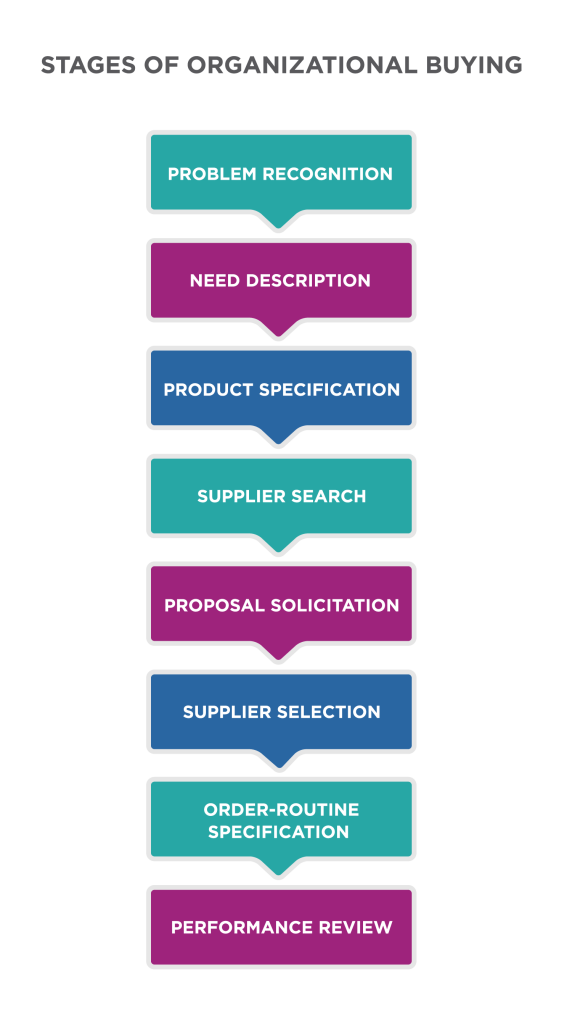
To bring these stages to life, let's watch a short video that walks through a similar process with clear examples.
The B2B Buying Process Explained
This video from Professor Wolters offers a concise explanation of the key stages in the B2B buying process. It will give you a solid foundation for each step on the map.
Please watch from 0:35 to 5:24. As you watch, notice how the process moves from a vague internal problem to a very specific, contractual relationship with a supplier.
2. The Copywriter's Role at Each Stage
Now that you have the blueprint, let's move from theory to practice. Your job as a copywriter isn't to create a single, one-size-fits-all message. It's to guide the buyer through this journey with targeted content for each stage.
Let's break down the first four key stages from a copywriter's perspective.
Stage 1: Problem Recognition
- Buyer's Mindset: "We have a problem. This process is slow/expensive/inefficient." At this point, they are problem-aware, but not necessarily thinking about solutions or specific products yet.
- Your Copy's Goal: Your goal is to enter the conversation happening in their head. You need to articulate their pain point even better than they can. The aim is to make them feel understood and to agitate the problem just enough that they feel compelled to act.
- Content Examples: Blog posts ("5 Signs Your Sales Process Is Leaking Revenue"), LinkedIn posts that ask a provocative question, ads that highlight a common industry frustration.
Stage 2: Solution Exploration & Specification
- Buyer's Mindset: "I know I have a problem. How do other companies solve this? What are the possible approaches? What features should I look for?" The buyer is now solution-aware.
- Your Copy's Goal: Educate, don't sell. This is where you build authority and trust. You provide a framework for how they should think about solving their problem. You're not aggressively pushing your product yet; you're helping them build their list of requirements.
- Content Examples: "How-to" guides, explainer articles ("A Buyer's Guide to Choosing Project Management Software"), webinars that teach a framework, checklists of essential features.
Stage 3: Supplier Search & Evaluation
- Buyer's Mindset: "I know what I need. Who are the best vendors that can provide this?" They are now product-aware and actively comparing you against your competitors.
- Your Copy's Goal: Differentiate your solution and build trust. Buyers at this stage are skeptical and doing heavy research. Your copy needs to provide proof, showcase what makes you unique, and de-risk the decision.
To understand how modern buyers really evaluate suppliers, I highly recommend reading a section from this article by CXL. It's based on recent research and is packed with insights.
The B2B Buying Journey: What Marketing Leaders Need to Know
This article, 'The B2B Buying Journey', explains how buyers actually build their shortlist of potential vendors. The section on 'Consideration set building' is particularly insightful for copywriters.
Please read the section titled 'Consideration set building: How buyers do it' (you can find it about a third of the way down the page). Focus on the 'three-pronged approach': peer-led discovery, review-led validation, and search-led verification. Think about what kind of copy supports each of these activities.
As the article highlights, buyers rely on peer recommendations and review sites before they even seriously consider your website.
- Content Examples: Customer case studies with hard data, testimonials from people in similar roles, comparison pages (vs. a competitor), a strong G2/Capterra profile, and a website that clearly states your unique value proposition.
Stage 4: Purchase Decision & Vendor Selection
- Buyer's Mindset: "We've narrowed it down to two or three options. Now we need to justify the cost and make the final choice." The buyer needs to feel confident and secure in their decision.
- Your Copy's Goal: Reassure the buyer and empower the "champion" who is fighting for your solution internally. You need to make the purchase feel safe and easy to defend to their boss or finance department.
- Content Examples: Detailed pricing pages, ROI calculators, implementation guides, security documentation, and sales proposals with clear terms.
3. Your Turn: Mapping Copy to the Journey
Let's apply this. Imagine your target is a mid-sized e-commerce company struggling with customer support. Their team is overwhelmed with emails, leading to slow response times and unhappy customers. They are in the Problem Recognition stage.
Your company sells a customer support platform that uses AI to answer common questions automatically.
Task:
- Think about the Problem Recognition stage. What is a headline for a blog post or a LinkedIn article you could write to capture the attention of the Head of Customer Support?
- Now, fast forward to the Supplier Evaluation stage. What are two specific pieces of information or proof points you would absolutely feature on your product's landing page?
Take a minute to jot down your ideas before reading my thoughts below.
Tutor's Analysis:
-
Problem Recognition Headline: You want something that reflects their pain.
- Good: "Are Slow Response Times Costing You Customers?" (Directly links pain to business impact).
- Better: "Your Team is Burnt Out, Your Customers are Angry. It's Time to Fix Your Support Queue." (More emotional and specific).
-
Supplier Evaluation Proof Points: At this stage, they're comparing options and looking for trust signals.
- A specific, quantifiable result: "See how [Similar E-commerce Company] reduced their response time by 75% in the first month." This provides tangible proof and social validation.
- A direct comparison or key differentiator: "Unlike other platforms, our AI integrates directly with Shopify, pulling order data for instant, accurate answers." This highlights a unique feature that solves a specific problem for the target audience.
Conclusion
Excellent work. You can now see the B2B buyer's journey not as a single event, but as a multi-stage process that your copy can and should guide.
Here are your key takeaways:
- The B2B Buying Process is a Journey: It moves from Problem Recognition, to Solution Exploration, to Supplier Evaluation, and finally to a Purchase Decision.
- Your Copy Must Adapt: Each stage requires a different type of message—from agitating the pain point at the start to providing concrete proof and justification at the end.
- Think Like a Guide: Your role as a copywriter is to be a helpful guide, providing the right information at each step to build trust and move the buyer confidently toward a decision.
In our next lesson, we will zoom in on the people who make up this journey. We'll analyze the different roles within a B2B buying committee—like the champion, the decision-maker, and the end-user—and learn how to tailor your message for each one.