Hello! Welcome to the first lesson of your course, "Think like a buyer: How to write B2B copy that sells!"
Given your background in copywriting, you're already an expert at persuading individuals. This course is designed to build on that skill, re-orienting it towards the unique world of business-to-business (B2B) sales.
Today, we'll start with the most fundamental concept: understanding exactly what makes a B2B buying decision different from a business-to-consumer (B2C) one. This is the foundation for everything that follows. By the end of this 30-minute lesson, you'll be able to identify these key differences and, most importantly, understand their direct implications for the copy you write.
1. B2B vs. B2C: More Than Just the Audience
In B2C, you're often speaking to one person making a decision for themselves. In B2B, the landscape is much more complex. The audience, their motivations, and the decision-making process are fundamentally different.
To get a solid overview of these differences, let's start with a video from copywriter Alex Cattoni. It directly tackles the question of what separates B2B and B2C copywriting.
Q: "What's The Difference Between B2B and B2C Copywriting?"
This video provides a great introduction to the core differences between B2B and B2C copywriting.
Please watch the following segments: What's the difference? (0:50 - 1:23) Product Complexity (2:05 - 3:09) Logic vs. Emotion (4:06 - 5:36) Speaking to a Team (5:36 - 6:31) The Sales Cycle (6:31 - 7:46) As you watch, focus on how each point contrasts with your experience in B2C copywriting.
To summarize and reinforce what you've just seen, here is a helpful visual comparison.
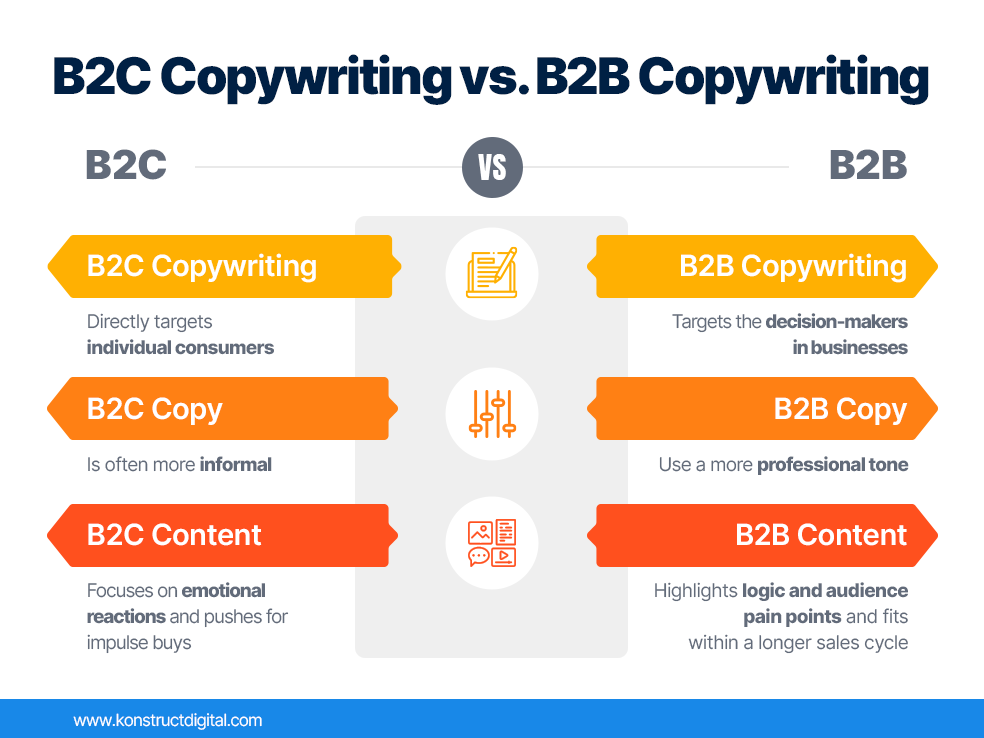
As the video and chart highlight, the key shifts are:
- From an individual to a team: You're not just selling to one person, but to a committee of people with different roles and priorities (e.g., the end-user, the IT manager, the CFO).
- From impulse to investment: B2B purchases are rarely spur-of-the-moment. They are considered investments that require research, justification, and budget approval.
- From a short sprint to a long marathon: The sales cycle is much longer, requiring multiple touchpoints and different types of content to build trust and educate the buyer over time.
2. The Buyer's Mindset: Logic, ROI, and... Emotion?
A common misconception is that B2B decisions are purely logical, driven only by Return on Investment (ROI) and efficiency gains, while B2C is all about emotion. The reality is more nuanced. While logic and a solid business case are essential, you are still communicating with human beings.
This brings us to a crucial concept: Human-to-Human (H2H) marketing.
B2B vs B2C Marketing (What Are The Differences?)
In this clip, marketing expert Adam Erhart argues that we should think of marketing as 'Human to Human' (H2H), regardless of whether it's B2B or B2C.
Watch the section from 3:35 to 6:01. Pay attention to his argument that even in large corporations, it's still people making the decisions.
The big takeaway here is that B2B buyers are trying to make a smart, logical decision for their business, but they are also driven by personal, human emotions:
- Fear: The fear of making the wrong choice and looking foolish in front of their boss.
- Ambition: The desire to be a hero who finds a solution that makes their team more successful.
- Frustration: The annoyance with a current process that is inefficient and wasting time.
Your job as a B2B copywriter is to build a rock-solid logical case for your product while also connecting with these underlying human motivations. You must prove the ROI, but also make the buyer feel confident and understood.
3. Practical Application: Spotting the Difference
Let's put this theory into practice. Your experience in general copywriting has given you a sharp eye for persuasion. Now, we'll use it to dissect B2B copy.
Below are two short copy examples. One is classic B2C, the other is B2B.
Example A (B2C):
"Tired of dull, lifeless skin? Our new Glow-Up Vitamin C serum delivers a radiant complexion in just one week. Feel confident and luminous. Shop now for 20% off!"
Example B (B2B):
"Your finance team is spending 15 hours a week on manual invoicing. Our platform automates the entire workflow, integrates with your existing accounting software, and reduces errors by 98%. Free up your team for more strategic work."
Your Turn:
Take a moment to analyze Example B. Based on what we've covered, consider these questions:
- Who do you think the copy is speaking to? (Hint: It might be more than one person).
- What is the core logical argument being made?
- What is the underlying emotional driver the copy is tapping into (e.g., frustration, desire for efficiency)?
- How does the "ask" or goal of this copy differ from the "Shop now" call-to-action in the B2C example?
Take a few minutes to jot down your thoughts before reading my analysis below.
Tutor's Analysis:
- Audience: The copy is likely targeting a decision-maker (like a Head of Finance or CFO) who cares about team productivity and strategic work. It also speaks to the end-users (the finance team) by acknowledging their tedious manual labor.
- Logical Argument: The logic is built on clear data: saving 15 hours/week and reducing errors by 98%. It also addresses a key technical concern by mentioning integration with existing software. This is all about ROI and efficiency.
- Emotional Driver: The underlying emotion is frustration. The phrase "manual invoicing" is meant to trigger the pain of a slow, repetitive, and error-prone process. The promise of "freeing up your team for more strategic work" appeals to a manager's desire to empower their employees and be more effective.
- The "Ask": While there's no explicit call-to-action here, it's clearly not "Buy Now." The goal is to get the reader to say, "This is interesting; I want to learn more." The next step in this longer sales cycle would likely be to "Request a Demo" or "Download a Case Study," which are low-commitment actions focused on education, not an immediate purchase.
Conclusion
Great work today! We've taken the first crucial step in your journey to mastering B2B copywriting.
Here are the key takeaways:
- B2C vs. B2B: The main differences lie in the audience (individual vs. team), the decision drivers (emotion/impulse vs. logic/ROI), and the sales cycle (short vs. long).
- Implications for Copy: B2B copy must be educational, build a logical case, and provide proof. Its goal is often to move the buyer to the next step in their research, not to an immediate sale.
- The Human Element: Despite the focus on logic, B2B buyers are still people. Effective copy addresses their professional goals and their personal fears and ambitions.
In our next lesson, we will build directly on this foundation. Now that you understand how B2B buying is different, we'll explore the what and when by mapping the typical B2B buying process, from problem recognition to vendor selection. This will help you understand the customer's mindset at each stage of their journey.