Hello! Welcome back to our module on writing attention-grabbing headlines.
In our last session, we deconstructed high-performing B2B headlines to understand the principles that make them work—like the "Four Us" framework and data-backed formulas from BuzzSumo. You learned to analyze why a headline is effective.
Today, we shift from analysis to creation. Your goal is to write B2B headlines that lead with a specific business outcome rather than a product feature. This is one of the most fundamental and powerful shifts you'll make as you transition from general copywriting to the B2B world. We'll focus on a systematic way to translate what a product does (its features) into what a business gets (its outcomes).
1. The Core Principle: Benefits, Not Features
You already know the difference between features and benefits. In B2B, this distinction is paramount, but the "benefit" is almost always a tangible business result. B2B buyers aren't just buying software; they're buying increased revenue, decreased risk, or enhanced productivity.
Your headline's job is to promise that result, not describe the tool.
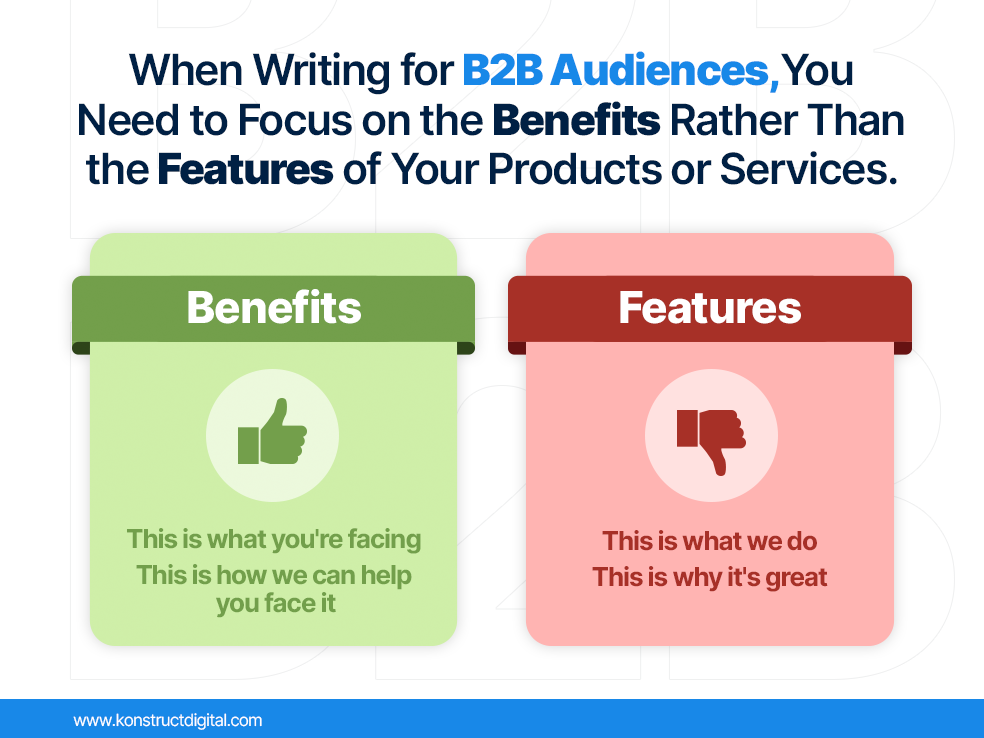
A simple way to start making this mental shift is the "so you can" technique. It's a bridge that connects a feature to its immediate benefit.
Copywriting tips: Features vs. Benefits - The Critical Key to Selling More
This video from Jon Benson's 'Sales Copy Secrets' channel provides a quick and practical way to turn dry features into more compelling benefits.
Please watch from 01:21 to 04:21. The first part defines features and benefits, and the second part (starting at 05:41) introduces the simple but effective 'so you can' method for converting one to the other.
The "so you can" method forces you to complete the thought from the buyer's perspective.
- Feature: Our software has 256-bit encryption.
- Benefit Bridge: Our software has 256-bit encryption, so you can... protect sensitive client data and ensure regulatory compliance.
2. Finding the Real Business Outcome
"So you can" is a great first step, but it often leads to a first-level benefit. To write truly compelling B2B headlines, you need to dig deeper to find the ultimate business outcome. Why does "ensuring compliance" actually matter to a CEO or a department head?
A more powerful technique is to repeatedly ask "Why does this matter?" and answer with "Because...". This chain of reasoning helps you climb the ladder from a technical feature to a high-level business result.
Mastering B2B Marketing Copy: Turning Features to Benefits
The article 'Mastering B2B Marketing Copy' from BAM Advertising offers an excellent method for this kind of deep-dive. It will show you how to move from generic benefits to the explicit needs that drive B2B decisions.
Please read the sections 'The Continuum Of Needs: Implicit Versus Explicit' and 'Tip #2: Talk To Yourself: Ask “Why?” — And Answer “Because”'. Focus on the example provided for SEO services, as it perfectly illustrates the process of drilling down to the root benefit.
As the article demonstrates, the chain might look like this:
- Feature: We offer SEO services. -> Why does it matter?
- Because it increases organic authority. -> Why does it matter?
- Because it generates leads. -> Why does it matter?
- Because it drives revenue. -> Why does it matter?
- Ultimate Outcome: Because with that extra revenue, you can cut advertising expenses and increase profit margins.
That final point is what makes a CFO or CEO pay attention. A headline about "increasing profit margins" is infinitely more powerful than one about "SEO services."
3. Writing the Outcome-Driven Headline
Once you've identified the most powerful outcome, your final step is to put it front and center in your headline. This is where you grab the reader's attention by leading with the result they desperately want.
This approach often involves using specific numbers and clear, strong language. Let's look at some powerful before-and-after examples.
Explore Effective B2B Copywriting Examples to Boost Your Business ...
This blog post from CyberOptik provides fantastic, concrete examples of how modern B2B copy has shifted from being feature-led to outcome-led.
Please read the section 'Side-by-Side Look at Copy Examples.' Pay special attention to the table titled 'how headlines have changed.' It directly contrasts old, feature-based headlines with new, outcome-based ones.
Notice the pattern in the "New Headline" examples:
- "Advanced Business Intelligence Platform" becomes "Transform Raw Data into Revenue in 48 Hours."
- "Comprehensive Marketing Automation" becomes "Double Your Lead Quality While Cutting Follow-up Time by 60%."
The new headlines are specific, quantified, and promise a tangible transformation. They lead with the prize.
Your Turn: Rewrite These Headlines
Let's put this all together. Here are two scenarios. For each one, use the "Why? -> Because" method to find the ultimate business outcome, then write a headline that leads with that outcome.
Scenario 1:
- Product: A cybersecurity software for e-commerce companies.
- Feature-based Headline: "Next-Generation Cybersecurity Solution"
Scenario 2:
- Product: A financial planning tool for small businesses.
- Feature-based Headline: "AI-Powered Cash Flow Forecasting"
Your Task (10 minutes):
- For each scenario, write down your "Why? -> Because" chain to uncover the core business outcome.
- Rewrite each feature-based headline into a compelling, outcome-driven headline. Try to make it as specific as possible.
Take your time to think through the chain of value for each product. What is the highest-level result a business owner would care about?
Conclusion
Excellent work. Today you've practiced the essential B2B copywriting skill of transforming features into business outcomes and placing those outcomes at the very front of your copy—in the headline.
Key Takeaways:
- Go Beyond "So You Can": Use the "Why? -> Because" method to drill down past surface-level benefits to find the ultimate business value (e.g., increased profit, reduced costs, competitive advantage).
- Lead with the Outcome: Structure your headline to promise the end result, not the tool. Instead of "Our new feature is X," write "Achieve Y with our new solution."
- Quantify for Credibility: Whenever possible, use specific numbers, percentages, or timeframes in your headlines to make your promised outcome more concrete and believable.
In our next lesson, we'll build on this foundation. Now that you know how to identify the core message of your headline, we will explore proven headline formulas (like "How to," question-based, and problem/solution hooks) and learn how to adapt them for a sophisticated B2B audience without sounding gimmicky.