Hello! Welcome to the first lesson in our module on writing attention-grabbing headlines.
In our last session, you did an excellent job transforming a weak, company-focused value proposition into a strong, buyer-centric message. That core message is the engine of your copy, but the headline is the key that starts the ignition. Without a good headline, even the best message goes unread.
Today, your goal is to analyze high-performing B2B headlines to identify the persuasion principles at work. We won't be writing headlines just yet. First, we need to develop the skill of deconstructing what makes them successful, so you can apply those principles in your own work. We'll look at a universal framework, data from real B2B content, and the psychological triggers that make a buyer stop and read.
1. A Universal Framework: The "Four Us"
A great way to start analyzing any headline is with a simple, effective framework known as the "Four Us." It provides a checklist to evaluate a headline's core strengths.
Headlines Copywriting Crash Course | How To Write Headlines (The RIGHT Way)
This video from Copy Squad introduces the 'Four Us' framework. It's a foundational concept in copywriting that will help you quickly diagnose a headline's effectiveness.
Please watch from 01:00 to 03:07. Focus on understanding the role of each 'U': Unique, Useful, Urgent, and Ultra-specific.
To summarize, the "Four Us" are, in order of importance:
- Unique: Does it stand out from the noise?
- Useful: Does it promise a clear benefit or solution to the reader?
- Urgent: Does it compel the reader to act or read now?
- Ultra-specific: Does it use concrete details and numbers to build credibility and clarity?
You don't need all four in every headline, but the strongest ones usually contain at least two or three. For example, a generic headline like "Better Project Management" fails on all counts. But consider this B2B alternative:
"How Asana Cut Marketing Team Meetings by 30% in 90 Days"
Let's analyze this using the Four Us:
- Unique: The claim is bold and different from generic promises.
- Useful: It promises a highly desirable benefit for managers: fewer meetings.
- Urgent: While not explicitly urgent, the time-bound result ("in 90 Days") implies a fast-acting solution.
- Ultra-specific: "30%" and "90 Days" add significant credibility. "Asana" and "Marketing Team" make it concrete.
2. What the Data Says About B2B Headlines
While general frameworks are helpful, your goal is to master B2B copywriting specifically. This requires understanding what works for a professional audience, which often differs from a consumer (B2C) audience.
The marketing analytics company BuzzSumo analyzed 10 million articles shared on LinkedIn to find out what makes a B2B headline successful.
How to Write B2B Headlines: LinkedIn Analysis | BuzzSumo.com
This article, 'How to Write Engaging B2B Headlines,' presents the key findings from BuzzSumo's research. It's packed with data-driven insights into what resonates with a business audience.
Please read the following sections: 'The Top Two-Word Phrases That Start B2B Headlines,' 'The Top Three-Word Phrases That Start B2B Headlines,' and 'Comparison of Top Facebook and LinkedIn Phrases.' Pay close attention to the types of phrases that perform well on LinkedIn and how they differ from those on Facebook.
The key takeaways from this research reinforce what a B2B audience values: practical solutions, data, and industry insights.
- Instructional headlines win: "How to" is the dominant phrase, promising a tangible skill or solution.
- Listicles work: Phrases like "X ways to..." or "X things you..." are highly effective because they promise structured, easy-to-digest information.
- B2B is not B2C: The language that works on a general platform like Facebook is very different from what works on a professional network like LinkedIn.
This image from the article makes the B2B vs. B2C difference crystal clear:
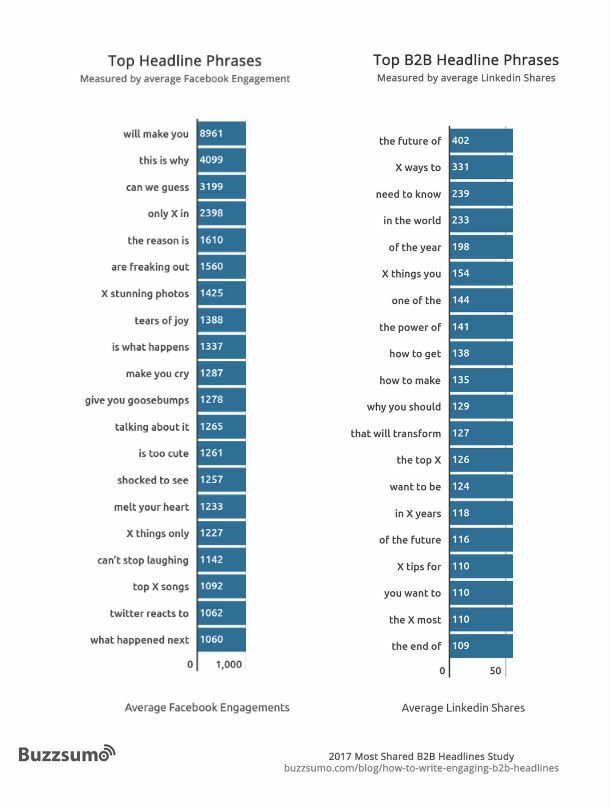
As someone with a background in general copywriting, this distinction is crucial. B2B buyers respond less to emotional clickbait ("will make you," "this is why") and more to headlines that promise professional value and tangible outcomes.
3. The Psychology Behind Persuasive Headlines
Formulas like "How to..." work because they tap into fundamental psychological principles. Understanding these principles allows you to analyze any headline, even those that don't fit a neat formula.
The article "Writing High Engagement Headlines" by Informa TechTarget provides a great overview of these triggers. Here are a few of the most common ones used in B2B headlines:
- Social Proof: We trust things that others already trust.
- Example: "Join 50,000+ managers who trust our platform"
- Curiosity Gap: Humans have a natural desire to fill a gap in their knowledge.
- Example: "The one data point most marketers ignore"
- Authority: We defer to credible experts and data.
- Example: "A Harvard study reveals the secret to effective team management"
- Scarcity/Urgency: We value things that are limited in time or availability.
- Example: "Why you need to update your strategy before the next Google algorithm change"
When you see a high-performing headline, try to identify which of these psychological levers it's pulling. Is it leveraging the authority of an expert? Is it making you curious about a "secret"? This layer of analysis will deepen your understanding significantly.
4. Your Turn: Analyze This Headline
Let's put your new analytical skills to the test. Here is a typical high-performing B2B headline.
Headline:
The Future of Sales: 7 Trends You Need to Know in 2024
Your Task (5-7 minutes):
Analyze this headline by answering the following questions:
- How does it use the "Four Us" framework (Unique, Useful, Urgent, Ultra-specific)?
- Which data-backed B2B formula(s) from the BuzzSumo article does it employ?
- Which psychological principle(s) are at play?
There can be multiple correct answers. The goal is to practice applying the concepts we've discussed.
Conclusion
Great work today. You've learned how to look past the surface of a headline and understand the machinery working underneath. This analytical skill is the foundation for becoming a strategic B2B copywriter.
Key Takeaways:
- The Four Us: A quick and effective checklist to evaluate any headline's strength (Unique, Useful, Urgent, Ultra-specific).
- B2B Formulas are Practical: Headlines starting with "How to" or numbered lists perform well because they promise clear, actionable value to a busy professional audience.
- Psychology is the 'Why': Persuasive headlines work because they tap into cognitive biases like social proof, authority, and the curiosity gap.
In our next lesson, we'll move from analysis to creation. You'll use these principles to write B2B headlines that lead with a specific business outcome rather than a product feature, turning your value proposition into an irresistible hook.