Hello and welcome back!
In our last lesson, you learned the crucial skill of writing headlines that lead with a clear business outcome, moving beyond product features to focus on tangible results. This established the what of a great B2B headline.
Today, we're focusing on the how. We will explore how to adapt common headline formulas from B2C to fit B2B contexts without sounding gimmicky. Many powerful headline structures are universal, but their application in the B2B world requires a specific touch. You'll learn how to use these proven formulas as a framework for your outcome-driven messages, ensuring they are both persuasive and professional.
1. B2B vs. B2C: Why Adaptation is Key
Before we dive into formulas, it's essential to understand why a simple copy-paste from B2C doesn't work. B2B and B2C buying cycles are fundamentally different, which changes the tone and focus of your copy.
B2B vs B2C Marketing (What Are The Differences?)
This short video from marketing expert Adam Erhart provides a concise breakdown of the differences between B2B and B2C marketing. It also introduces the valuable concept of 'Human to Human' (H2H) marketing, which will be our guiding principle today.
Please watch from 02:44 to 06:01. The first part outlines the classic differences (order size, decision time), and the second part explains why, despite these differences, all marketing is ultimately 'Human to Human'.
The key takeaway here is that while B2B decisions are more rational and ROI-driven, they are still made by people. The H2H concept reminds us that we can use psychological principles to connect with our audience, but our approach must be authentic and professional. We're not "businessing up" our copy with jargon; we're adapting proven human persuasion techniques to a business context. This means replacing B2C's often-impulsive emotional triggers with B2B's core drivers: efficiency, profitability, risk reduction, and career advancement.
2. A Toolbox of B2B Headline Formulas
Formulas aren't about mindlessly filling in blanks. They are proven structures that tap into fundamental human motivations like curiosity, self-interest, and the desire for solutions. Let's look at some of these formulas, already adapted for a B2B audience.
51 Headline Formulas for High-Converting B2B Ads
The agency Digitopia has compiled an excellent PDF, '51 Headline Formulas for High-Converting B2B Ads,' which will serve as our primary reference today. It's a powerful swipe file you can return to again and again.
Please open the PDF and quickly scan the list of 51 formulas on pages 3 and 4. You don't need to memorize them. Just get a feel for the different categories: questions, lists, social proof, how-to guides, etc. We'll be working with these patterns.
As you can see, these formulas provide a reliable starting point. They can be grouped into several effective categories.
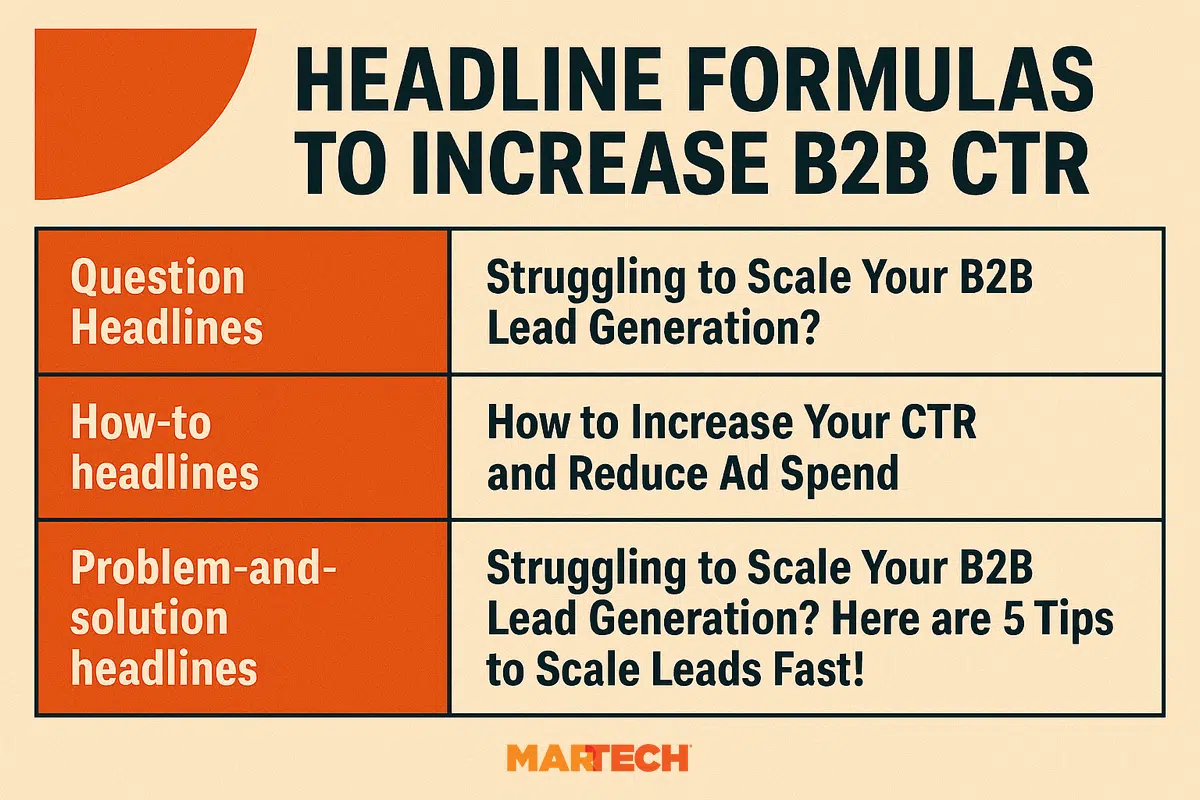
Let’s connect this back to our last lesson. The formula is the skeleton; the business outcome is the muscle.
- Formula: The How-To Headline (#1) -
How to [Achieve a Desired Outcome] - Outcome: "Cut follow-up time by 60%"
- Resulting Headline: "How to Cut Client Follow-Up Time by 60%"
The formula gives you the structure, but the power comes from the specific, valuable outcome you insert.
3. The 'Gimmick' Filter: Staying Professional
The biggest challenge in adapting formulas is avoiding the clickbait-y, over-sensationalized tone that plagues much of B2C marketing. A headline like "This One Weird Trick Will Triple Your Revenue" would instantly lose credibility with a B2B audience.
So, how do you filter for professionalism? You apply these three lenses:
-
Specificity over Vagueness: A B2B buyer values concrete information. Instead of a vague promise, use data and clear language.
- Gimmicky: "The Secret to Unlocking Insane Profits"
- Professional: "The Framework 5 Fortune 500 CFOs Use to Increase Profit Margins by 15%"
-
Credibility over Hype: Your audience is skeptical. Build trust by focusing on proof, education, and realistic outcomes.
- Gimmicky: "The Last Project Management Tool You'll Ever Need!"
- Professional: "How ACME Corp. Shipped a Flagship Product 3 Weeks Ahead of Schedule"
-
Business Value over Personal Emotion: While emotion plays a role, it's professional emotion (frustration with inefficiency, ambition for growth).
- Gimmicky: "You'll Be Shocked When You See This!"
- Professional: "Is Your Tech Stack Creating Hidden Security Risks? A CIO's Checklist"
The goal is to spark professional curiosity and signal value, not just to trigger a raw emotional click.
Mastering LinkedIn Hooks: An In Depth Look at How B2B Thought ...
The article 'Mastering LinkedIn Hooks' provides an excellent breakdown of the psychology behind what makes an opening line effective. These principles are universal and will help you gut-check whether your adapted headline is compelling or just clickbait.
Please read the sections 'The Psychology Behind Effective Hooks' and 'Make it Relevant to B2B'. Focus on the concepts of curiosity, relevance, and specificity. Notice how the B2B examples ground these psychological triggers in concrete business scenarios.
Your Turn: Adapt These Formulas
Let's put this into practice. You have a product and a core business outcome. Your task is to adapt three common B2C-style formulas to create strong B2B headlines.
- Product: A project management software designed for remote engineering teams.
- Core Business Outcome: It helps teams ship products 20% faster by reducing communication overhead and unnecessary meetings.
Your Task (5-7 minutes):
Take these three B2C-style formulas and rewrite them into professional, outcome-driven B2B headlines for the scenario above.
- The 'Secrets' Formula: (e.g., "The 5 Secrets to Effortless Weight Loss")
- The 'Mistakes' Formula: (e.g., "7 Mistakes You're Making When You Cook Pasta")
- The 'How to Without' Formula: (e.g., "How to Get Fit Without Going to the Gym")
Write down your adapted versions. Think about how to make them specific, credible, and focused on business value.
Conclusion
Great job! You've taken another significant step in mastering B2B copywriting by learning to wield headline formulas with precision and professionalism.
Key Takeaways:
- Formulas are Frameworks: Proven headline formulas are effective skeletons. You bring them to life by filling them with the specific business outcomes that matter to your buyer.
- Adapt, Don't Just Adopt: To make a formula work for B2B, shift the focus from broad consumer emotions to tangible business value (ROI, efficiency, risk reduction).
- Avoid the Gimmick Trap: Use specificity, credibility, and professional language to build trust. Your goal is to spark professional curiosity, not just to get a cheap click.
In our next lesson, we will broaden our focus from just the headline to the opening hook of your content. We'll see how the principles you learned today apply to the first few lines of a social media post or an article, grabbing your reader's attention and compelling them to engage further.