Hello and welcome to our next lesson!
In our last session, we focused on adapting headline formulas for B2B, ensuring they are professional, credible, and outcome-driven. You learned how to turn a generic formula into a sharp, specific promise for a business audience.
Today, we'll take the next logical step. Once your headline has stopped the scroll, the first few lines of your content—the opening hook—must convince the reader to invest their time and keep reading. Our goal is to learn how to write opening hooks for B2B content that establish immediate relevance for the target buyer. This is the art of earning the "See more" click on LinkedIn or drawing a reader into the first paragraph of a blog post.
1. What Makes a Hook "Relevant"?
A relevant hook isn't just clever or interesting; it meets the buyer exactly where they are in their journey. A message that resonates with someone actively looking for a solution will fall flat for someone who doesn't even realize they have a problem.
This is where the Stages of Awareness come in. Understanding your buyer's awareness level is the key to crafting a hook that feels like it was written specifically for them.
Best Tips On Copywriting For B2B Marketers In 2021 | B2B Copywriting Tips For Beginners
To understand these stages, let's watch a segment from Dekker the Marketer. He provides a simple and effective framework that breaks down the four key stages of buyer awareness.
Watch from the beginning until 07:11. Pay close attention to the four stages he outlines (problem-unaware, category-unaware, brand-unaware, product-aware) and how the example copy for the travel agency changes to match each stage.
As you saw, relevance is contextual. The right hook for a problem-unaware buyer introduces a problem they didn't know they had, while the right hook for a solution-aware buyer might compare features or offer a demo. Your hook's primary job is to align with the buyer's current mindset.
2. The Anatomy of an Effective B2B Hook
Now that we have a strategic framework, let's look at the tactical tools. There are several proven types of hooks, each tapping into a different psychological trigger.
First, a simple but powerful distinction is the frustration hook vs. the results hook.
The $1 Million Landing Page (Works For Normal People)
This short clip from Daniel Priestley clearly explains these two fundamental types of hooks.
Watch from 00:59 to 01:55. Notice how he frames both hooks around a specific feeling (frustration) or a state of readiness for a result.
Building on this, we can explore more nuanced "flavors" of hooks. A LinkedIn post from copywriter Rosanna Campbell offers a great, practical breakdown.
Here's how I write B2B blog intros
This LinkedIn post provides a concise, real-world guide to different intro styles. It's a great cheatsheet for choosing the right type of hook for your situation.
Read the section starting 'Step 2: If it's a fancy intro, choose a flavor.' Focus on the descriptions for 'The Painful Intro,' 'The Weird Intro,' and 'The Punchy Quote/Stat.'
These types of hooks work because they tap into fundamental psychological principles. To deepen your understanding of why they are so effective, let's turn to a more detailed analysis.
Mastering LinkedIn Hooks: An In Depth Look at How B2B Thought ...
The article 'Mastering LinkedIn Hooks' provides a fantastic deep dive into the psychology of what grabs our attention. This will help you understand the science behind the art.
Please read the section titled 'The Psychology Behind Effective Hooks (Curiosity, Emotion, and Value).' Pay special attention to the subsections on 'Relevance and Self-Interest' and 'Specificity and Credibility,' as these are the cornerstones of establishing relevance in B2B.
Let's see one of these principles in action. Here is an email from Stripe that uses a frustration/painful hook masterfully.
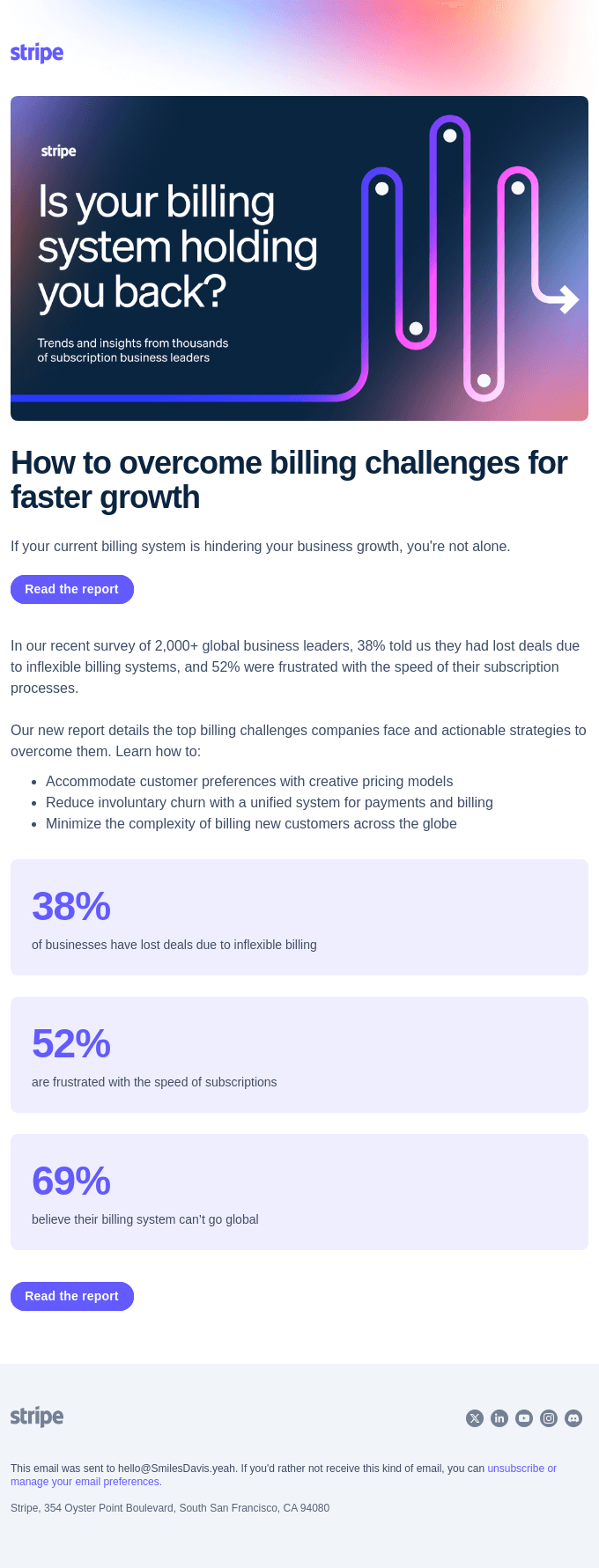
The headline calls out a specific frustration, and the sub-headline offers a solution based on credible data ("Trends and insights from thousands of subscription business leaders"). It's a perfect B2B hook: it's relevant, specific, and credible.
Your Turn: Write Hooks for Different Awareness Stages
Now it's time to apply these concepts. You are writing content for a SaaS company that provides an AI-powered analytics platform for e-commerce businesses. Your target buyer is the Head of Marketing.
Your Task (7-10 minutes):
Write an opening hook (1-3 sentences for a blog post or LinkedIn post) for the Head of Marketing in each of the following scenarios. Try to use a different hook type for each.
-
Problem-Unaware Scenario: The marketing head is focused on their current campaigns and believes their standard analytics tools are sufficient. They aren't actively thinking about the limitations of their data.
- Hint: Your goal is to interrupt their routine and introduce a problem or idea they haven't considered. A "Punchy Stat" or a "Weird Intro" (analogy) could work well.
-
Problem-Aware Scenario: The marketing head is frustrated. They know their team is spending too much time manually pulling reports and that they're missing key insights, but they aren't sure what a better solution looks like.
- Hint: Your goal is to validate their frustration. A "Painful Intro" or "Frustration Hook" that describes their exact feeling will resonate deeply.
-
Solution-Aware Scenario: The marketing head is actively researching AI analytics platforms. They know the category exists and are comparing different vendors.
- Hint: Your goal is to stand out from competitors. A "Results Hook" showing a specific, desirable outcome or a hook that teases a unique feature or benefit is a good approach.
Take your time to craft each hook, thinking about the buyer's mindset in each stage.
Conclusion
Excellent work! Today you've moved beyond the headline and learned how to pull a reader deep into your content with a compelling opening hook.
Key Takeaways:
- Relevance is Relative: A powerful hook meets the buyer at their specific stage of awareness.
- A Hook Has a Job: Its primary purpose is to establish immediate relevance and answer the reader's unspoken question: "Is this for me?"
- Use a Variety of Tools: You can use different hook types—like frustration, results, punchy stats, or painful intros—to match your buyer's mindset and achieve your goal.
- Psychology is Your Ally: Effective hooks work by tapping into psychological triggers like curiosity, self-interest, and the desire for specificity and credibility.
In our next lesson, we will start a new module on Top-of-Funnel Copy. You'll take the skills you've learned in writing headlines and hooks and apply them to a complete piece of content: a LinkedIn ad that targets a specific B2B buyer persona and drives a defined action. You'll see how the hook is the first critical piece of a larger persuasive puzzle.