
Hello! Welcome to your next lesson in the "Customer Value and Segmentation Strategy" module.
In our last session, we focused on how to evaluate customer segments created by analytical models like RFM and clustering. We established that a good segment must be distinct, cohesive, and actionable. Most importantly, we learned to look beyond surface-level metrics like revenue and assess the true profitability of each segment.
Now that we can critically assess a set of segments, the next logical step is to decide what we want to achieve with them. This brings us to today's learning outcome: to formulate distinct marketing objectives for different customer segments (e.g., activation, retention, monetization). Today, we'll bridge the gap between analysis and action, transforming data-driven segments into a clear strategic plan.
1. From Segments to Objectives: The Customer Lifecycle Framework
A powerful way to organize your thinking about marketing objectives is to map them to the customer lifecycle. A customer's needs and their relationship with your brand change over time. Your objectives for a brand new user will be fundamentally different from your objectives for a loyal, long-term advocate.
The main stages of the customer journey, and the corresponding high-level marketing objectives, can be generalized as:
- Awareness & Acquisition: Getting potential customers to know you exist and making their first conversion (e.g., sign-up, first purchase).
- Activation: Guiding new customers to their "aha moment"—the point where they experience the core value of your product or service.
- Retention: Keeping existing customers engaged and ensuring they continue to derive value from your product.
- Monetization: Increasing the revenue generated from existing customers through upselling, cross-selling, or increasing purchase frequency.
- Re-activation / Win-back: Re-engaging customers who have become inactive or have churned.
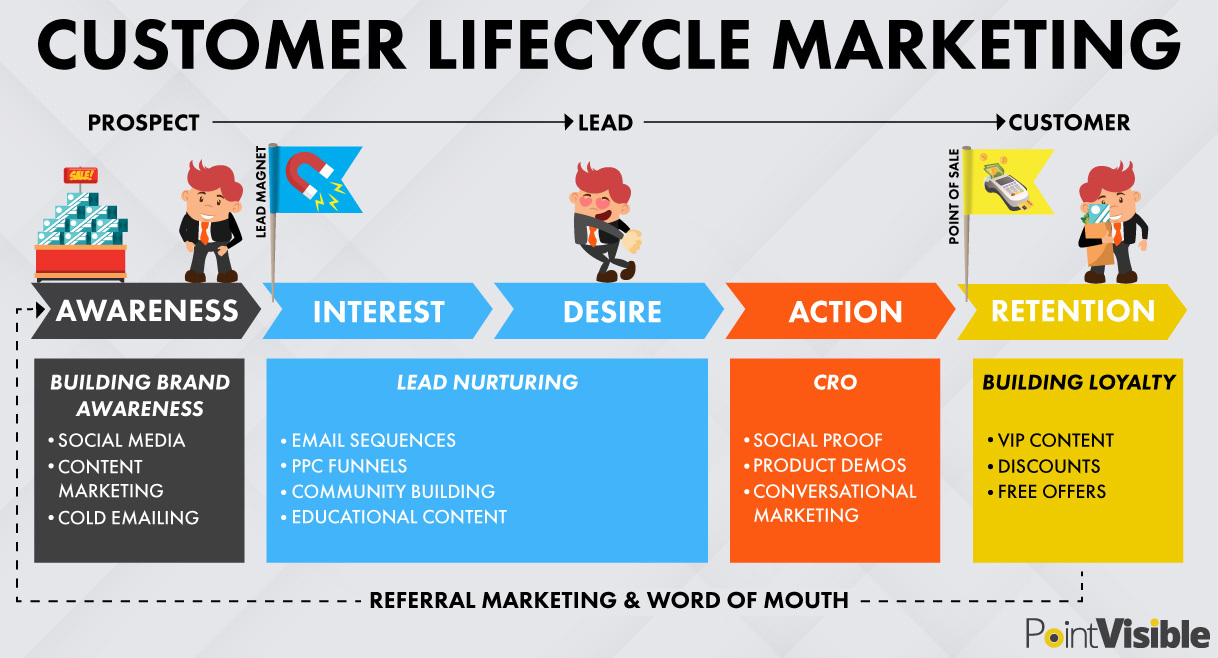
Let's ground this framework in a concrete example using RFM segmentation, which we explored in the last lesson.
2. Tailoring Objectives to RFM Segments
Recall that RFM (Recency, Frequency, Monetary) analysis segments customers based on their purchasing behavior. By combining these three scores, we can create meaningful groups and then assign a primary objective to each one.
The following article provides an excellent, straightforward guide to four key RFM segments and the strategic goals for each.
The Complete Guide to RFM Segmentation
This article from Lexer, 'The Complete Guide to RFM Segmentation', provides a concise breakdown of how to approach different RFM segments.
Please read the section '4 Key RFM Segments'. As you read, pay close attention to the distinct strategy proposed for each of the four groups: High-Value Active, High-Value Lapsed, Low-Value Active, and Low-Value Lapsed.
Building on the article, let's explore a more granular set of segments you might encounter and define the primary objective for each. In practice, data teams often create more than four segments, giving them descriptive names.

Let's watch a video that walks through several of these segments and suggests specific marketing strategies. This will help you see how the theory is put into practice.
Customer Segmentation: RFM Analysis using SPSS
This video from 'the outlier 73' demonstrates how to interpret various RFM segments and devise tailored marketing strategies for them.
Please watch the selected clips, which discuss different customer segments and the marketing actions appropriate for each. Focus on the why behind each recommendation. Best Customers (Champions): (08:54 - 12:36) - Objective: Retention & Loyalty Big Spenders: (14:13 - 15:42) - Objective: Monetization (Upsell) Almost Lost (At-Risk): (15:42 - 17:28) - Objective: Re-activation Lost Customers: (17:28 - 18:47) - Objective: Win-back (if profitable) Lost & Cheap Customers: (18:47 - 20:26) - Objective: Strategic Deprioritization
Let's synthesize this into a clear framework.
Segment: Champions / Best Customers
- Profile: High R, F, and M. Your most valuable and engaged customers.
- Primary Objective: Retention & Monetization.
- Formulation: "Our goal for this segment is to maintain their loyalty and nurture them as brand advocates. We should focus on non-discount-based strategies that increase their lifetime value."
- Example Tactics:
- VIP loyalty programs.
- Early access to new products.
- Exclusive content or events.
- Solicit reviews and user-generated content.
- Strategic Note: Avoid aggressive discounting. As we learned in the last lesson, this can erode the margin on your most profitable segment.
Segment: At-Risk / Needs Attention
- Profile: High F and M, but Recency is slipping. They were great customers but haven't purchased in a while.
- Primary Objective: Re-activation.
- Formulation: "These are high-value customers who are showing signs of churn. Our primary objective is to proactively re-engage them before they are lost for good."
- Example Tactics:
- "We miss you" campaigns with a personalized offer.
- Surveys to understand why they've been inactive.
- Highlight new features or products relevant to their past purchases.
- As the video suggested, "aggressive price incentives" can be appropriate here because the goal is to prevent the loss of a valuable customer.
Segment: New Customers / Recent Users
- Profile: High R, but low F and M. They just made their first purchase.
- Primary Objective: Activation.
- Formulation: "This segment represents our newest customers. The objective is to drive them to their second purchase and guide them to experience the core value of our brand, setting them up for a long-term relationship."
- Example Tactics:
- A structured onboarding email or message sequence.
- Educational content about the product they bought.
- Showcasing related products (cross-sell).
- A small incentive for a second purchase.
Segment: Lost & Cheap Customers
- Profile: Low R, F, and M. They haven't bought in a long time, didn't buy often, and didn't spend much.
- Primary Objective: Strategic Deprioritization.
- Formulation: "This segment has historically provided low value and is now inactive. Our objective is to invest minimal resources here to avoid negative ROI and focus our budget on higher-potential segments."
- Example Tactics:
- Exclude them from most paid campaigns to improve efficiency.
- Keep them on a low-cost channel like a general email newsletter, but don't spend significant effort on targeted campaigns.
- This is a critical leadership decision: actively choosing not to market to a segment.
3. Operationalizing Objectives with Lifecycle Campaigns
Once you've defined the objective for each segment, your team can build specific campaigns to achieve them. As a leader, you need to be familiar with the types of campaigns that map to these objectives.
Let's explore some common lifecycle marketing campaigns. The following article from Customer.io provides an excellent overview of essential, automated campaigns that every marketing team should consider.
6 essential lifecycle marketing campaigns to build now
This article, '6 essential lifecycle marketing campaigns to build now', provides a practical guide to the automated campaigns that bring your objectives to life.
Read through the descriptions of the six campaigns: Welcome and onboarding flow (Objective: Activation) Activation campaign (Objective: Activation/Retention) Retention and engagement nurture (Objective: Retention) Trial expiration and conversion flow (Objective: Monetization) Churn prevention flow (Objective: Re-activation/Retention) Win-back campaign (Objective: Win-back) For each one, notice how it starts with a behavioral trigger and has a clear goal that aligns with the lifecycle stages we've discussed.
To provide more concrete examples of tactics within these campaigns, this short video from AppsFlyer outlines strategies for an app, but the principles apply broadly to many digital products and services.
10 Proven App Marketing Strategies to Drive Installs & Retention in 2024
This video details marketing strategies across the user journey. It offers great tactical ideas for your acquisition, activation, and retention campaigns.
Watch the sections on driving installs (Acquisition, 04:17-07:33) and keeping users engaged (Retention, 07:33-10:03). Note down a few tactical ideas (e.g., promos, social proof, re-engagement messages) that could be used to achieve the objectives we've set for our segments.
By combining segment analysis, clear objectives, and a well-defined campaign structure, you create a powerful, data-driven marketing engine. Your role as a leader is to ensure these three components are aligned.
Test your understanding!
Your analytics team has performed an RFM analysis on your e-commerce customer base. They present you with three segments:
- "Potential Loyalists": These customers have made 2-3 recent purchases. Their monetary value is average. (R=High, F=Medium, M=Medium)
- "Hibernating": These customers used to purchase frequently and spend a lot, but they haven't bought anything in the last 9 months. (R=Low, F=High, M=High)
- "Price Sensitive": These customers purchase infrequently, almost always with a deep discount code, and have a low monetary value. (R=Varies, F=Low, M=Low)
For each segment, formulate a primary marketing objective (e.g., Activation, Retention, Monetization, Re-activation, or Strategic Deprioritization) and briefly explain your reasoning.
Show answer
Here’s a breakdown of the objectives for each segment:
-
"Potential Loyalists":
- Objective: Retention / Increase Frequency.
- Reasoning: These customers are active and showing repeat purchase behavior. The key is to solidify this habit and prevent them from lapsing. The goal is to turn them into "Loyal Customers" or "Champions" by increasing their purchase frequency and monetary value over time. Tactics could include product recommendations or a loyalty program.
-
"Hibernating":
- Objective: Re-activation / Win-back.
- Reasoning: This is a high-value segment that has churned or is close to churning. Their past behavior shows they have a high potential value. It's crucial to invest in winning them back before they are lost forever. The strategy should focus on understanding why they left and providing a compelling reason to return.
-
"Price Sensitive":
- Objective: Strategic Deprioritization (with a potential for low-cost Monetization).
- Reasoning: This segment is likely unprofitable due to their reliance on deep discounts. Investing significant marketing budget to activate or retain them would likely yield a poor return. The best strategy is to minimize spend on them (e.g., exclude from paid ads) while perhaps trying to increase their order value with "bundle and save" offers rather than straight discounts. This protects margins while still trying to extract some value.
Conclusion
Today we've connected the dots between analyzing customer segments and acting on them. By mapping segments to the customer lifecycle, you can formulate clear, distinct marketing objectives that guide your team's efforts and resource allocation.
Key Takeaways:
- Marketing objectives should be tailored to a segment's behavior and position in the customer lifecycle.
- The primary objectives can be categorized as Activation (for new users), Retention (for active users), Monetization (for engaged users), Re-activation (for at-risk users), and Win-back (for lapsed users).
- A critical strategic decision is Deprioritization—choosing not to spend resources on low-value, unprofitable segments to improve overall marketing ROI.
- These objectives are executed through specific, often automated, lifecycle campaigns like onboarding flows, churn prevention sequences, and win-back offers.
Preview of the Next Lesson:
We have now identified our segments and formulated clear objectives for them. The next logical question is: how do we achieve these objectives? In our next lesson, we will focus on how to evaluate a proposed channel and messaging strategy tailored to a specific high-value customer segment. We'll dive into matching the right message and the right channel to a segment to maximize our chances of success.